Akshara International School Nadergul Curriculum: CBSE, IB Methodology and the AEP Approach
When parents in Nadergul, Saroor Nagar, Badangpet, and the surrounding Ranga Reddy corridor research schools for their children, curriculum is usually the question that takes the longest to answer. Not because information is hard to find, but because most schools describe their curriculum in broad strokes that don't actually tell you much — "we follow CBSE," or "we focus on holistic development" — without explaining what either of those things genuinely looks like inside a classroom.
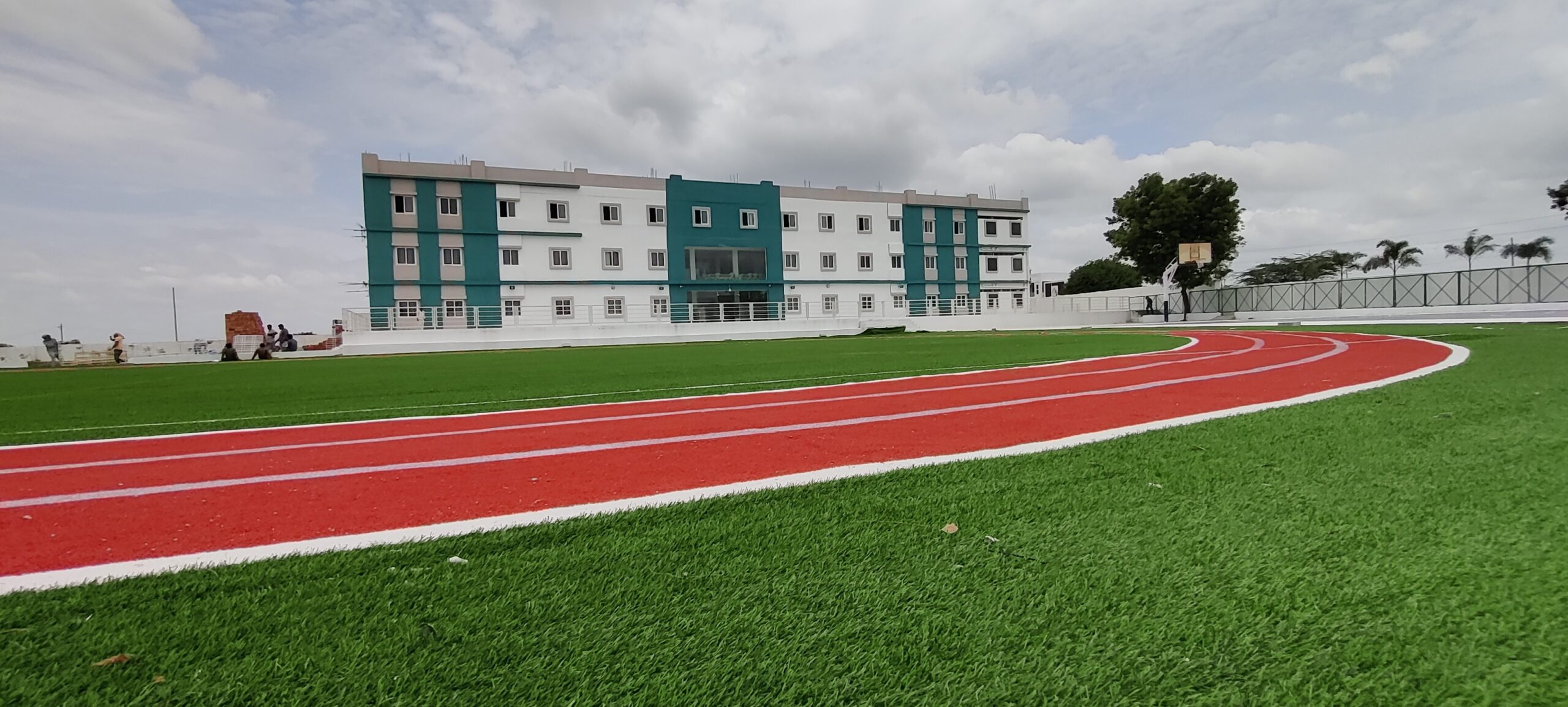
Akshara International School Nadergul takes a different approach. Situated on a prolific 3-acre lavish green campus with state-of-the-art infrastructure, the school has built a curriculum framework that is specific, stage-wise, and grounded in a coherent educational philosophy — one that earned it a place among the Top 8 Schools in India (2025) by Education World and recognition through the British Council's International School Award (ISA). This blog unpacks exactly what the Nadergul curriculum involves, why it's structured the way it is, and what it means in practice for students from Nursery through to Grade X.
The Foundation: CBSE Meets IB Methodology at Akshara International School Nadergul
How the Akshara International School Nadergul Curriculum Blends Two Frameworks
The starting point for understanding the curriculum at Akshara International School Nadergul is this: the school follows CBSE for all grades, but aligns that framework with IB methodology specifically at the Preparatory and Foundation stages of schooling. This isn't a cosmetic distinction. CBSE and IB methodology represent genuinely different orientations toward learning — the former structured around national standards and board examinations, the latter built around inquiry, student agency, and cross-disciplinary thinking. Combining them, done properly, means students get the security and national recognition of the CBSE pathway alongside the intellectual habits that IB-influenced pedagogy develops in young learners.
The practical result is what the school describes as an inquiry-based learning environment — a setting where questions are as important as answers, where understanding how and why something works matters as much as knowing what it is. This distinction becomes particularly valuable at the primary stage, where habits of thinking are formed that persist throughout a child's academic life. Among the best CBSE schools in Hyderabad that go meaningfully beyond standard board delivery, the Nadergul campus's blended approach is a genuine differentiator worth understanding in detail.
This curriculum architecture is held together by the school's in-house pedagogical framework: the Akshara Education Policy (AEP). Developed as a unique curricular and pedagogical structure, the AEP is designed to strike a harmonious balance between academic excellence, social skills, physical development, and spiritual growth. Inspired by the core values of the National Education Policy 2020, it integrates traditional values with a progressive approach — equipping students with academic proficiency, social adaptability, and emotional well-being simultaneously. Crucially, the AEP treats the process of learning as equally important as the outcome, going beyond the prescribed CBSE syllabus to develop competencies that serve students well beyond examination halls. Consequently, the Nadergul campus's curriculum is best understood not as a single board framework but as a layered system — CBSE as the national framework, IB methodology as the pedagogical influence at the formative stages, and the AEP as the school's own integrating philosophy that holds all of it together.
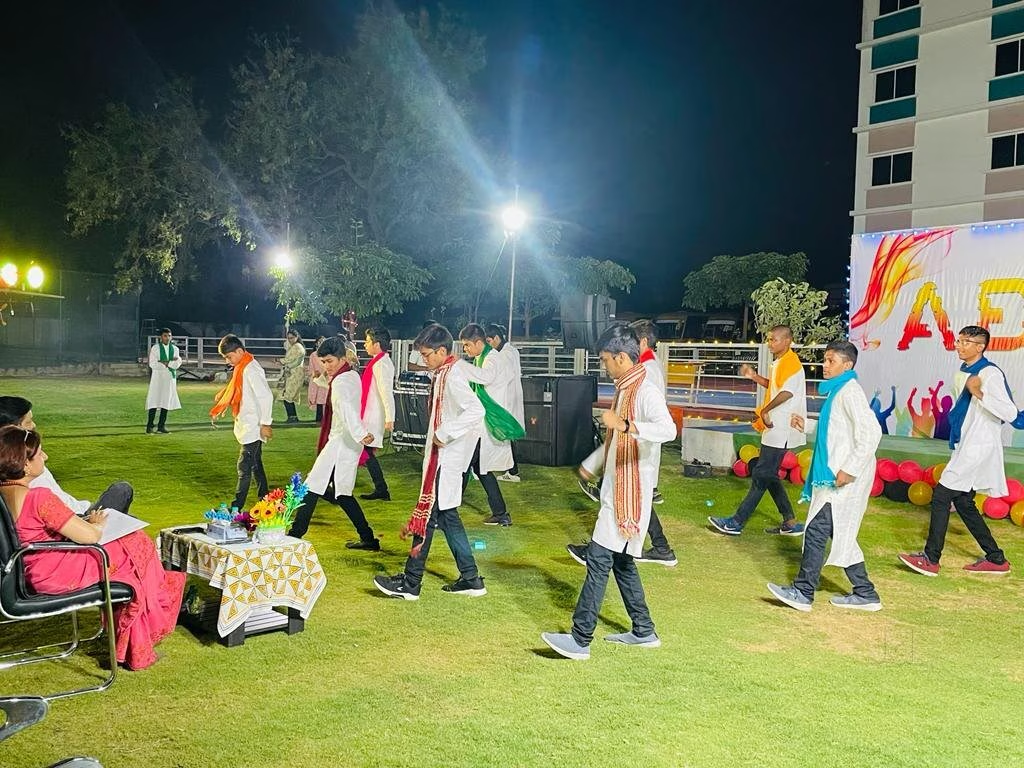
Stage One: The Foundation Stage (Nursery to Grade II)
Akshara International School Nadergul Curriculum at the Earliest Years
At Akshara International School Nadergul, the Foundation Stage covers Nursery through Grade II and is explicitly described as a solid foundation for the whole academic structure, as laid out in the NEP 2020. This framing matters — it signals that the school sees early years not as a warm-up for "real school" but as the most structurally significant period in a child's education. Get these years right, and every stage that follows builds on something genuinely solid.
The Foundation Stage is organised around six key learning areas. Foundational Literacy covers listening, speaking, reading, writing, and understanding — the complete communication stack that underlies all later academic learning. Creativity and Expressive Arts encompasses art and craft, music and movement, and theatre, recognising that creative expression is as developmental as any academic skill at this age. Physical Development addresses both fine motor and gross motor skills alongside health and hygiene habits that children need to establish early. Socio-Emotional Development works on self-confidence, the ability to communicate effectively, and behavioural learning — building the social intelligence that academic success depends on. Foundational Numeracy develops number sense, logical thinking, and early problem-solving. And notably, the Foundation Stage includes an eco-friendly play arena for pre-primary students featuring a sandpit, ball pool, and splash pool — tangible, sensory spaces that connect learning to exploration and physical experience.
This is the stage where IB methodology's influence is most pronounced. The emphasis on expressive arts, socio-emotional learning, and physical development alongside literacy and numeracy reflects the IB's conviction that whole-child development at the early years is the prerequisite for genuine academic ability later. For parents searching for the best CBSE schools near Nadergul for their youngest children, this stage-specific depth is worth noting carefully.
Stage Two: The Preparatory Stage (Grades III to V)
Building Conceptual Depth at Akshara International School Nadergul
The Preparatory Stage at Akshara International School Nadergul covers Grades III through V and is designed to lay the right blend of conceptual and skill-based learning that develops intellectual habits and innovative practices. This is the bridge between the sensory, exploratory learning of the Foundation years and the more structured knowledge-building of the Middle Stage — and it's where the IB methodology influence is most deliberately embedded.
The Preparatory Stage is built on six key features. Exceptional communication skills are developed through language acquisition and ICT integration — recognising that digital literacy is now inseparable from communication itself. Holistic learning through interdisciplinary and project-based approaches moves away from siloed subject teaching toward the kind of connected thinking that reflects how knowledge actually works in the real world. Inquiry-based and experiential learning methodology is the direct expression of IB philosophy at this stage — students don't just receive information, they investigate, question, and construct understanding. Academic rigour focused on conceptual knowledge and skill development ensures that the exploratory approach doesn't sacrifice depth or precision. Active teaching and learning strategies keep students as participants rather than passengers in the classroom. And the stage is further enriched by what the school calls active teaching and learning — a deliberate commitment to keeping students engaged as active agents rather than passive recipients throughout Grades III to V.
This is the stage where parents typically notice whether a school's curriculum philosophy actually shows up in the classroom, or whether it remains aspirational language on a website. The specific articulation of inquiry-based methodology, interdisciplinary project work, and conceptual rigour at this stage reflects a curriculum design that has thought carefully about what 8 to 11-year-olds actually need to develop into strong learners.
Stage Three: The Middle Stage (Grades VI to VIII)
Expanding Horizons at Akshara International School Nadergul
By the Middle Stage — Grades VI through VIII — the curriculum at Akshara International School Nadergul broadens significantly while maintaining the learner-centred orientation established in earlier years. The school describes this stage as offering a broad curriculum that balances the goals of CBSE and lays a strong foundation in order to succeed in any competitive exams in the future. That phrase is important: the Middle Stage is explicitly designed with an eye on both the board framework and the competitive landscape — preparing students for everything from the CBSE board pathway to the national examinations that their secondary years will demand.
Seven features define the Middle Stage. A multidisciplinary approach continues the Preparatory Stage's philosophy of connected learning, ensuring students develop the ability to think across subject boundaries. No rigid separation between subjects allows concepts to reinforce each other organically rather than existing in isolated compartments. 360-degree holistic and experiential learning is the school's most comprehensive expression of its AEP philosophy — acknowledging that academic, physical, creative, and social learning all happen simultaneously and should be structured to support each other. A flexible curriculum allows for adaptation to students' evolving interests and capabilities. Integration of art and sports into interactive classroom learning reflects the school's commitment — stated directly in the Nadergul campus description — to giving equal prominence to academics, sports, and co-curricular activities at every stage, not just in after-school programmes. Inclusivity and equity ensures every learner has genuine access to the curriculum regardless of pace or background. And technology integration keeps the learning environment current and connected to the digital skills students will need in secondary education and beyond.
For parents in Ranga Reddy District researching the best CBSE schools near Saroor Nagar for their middle school-age children, this stage's specific emphasis on multidisciplinary learning and competitive exam foundation is a significant practical advantage.
Stage Four: The Secondary Stage (Grades IX and X)
Akshara International School Nadergul Curriculum at the Critical Examination Years
The Secondary Stage covers Grades IX and X — the years that the school describes directly as a crucial phase and a bridge between the foundational learning of earlier years and the specialized study of higher education. This is where the habits built across the Foundation, Preparatory, and Middle stages pay their most visible dividends, and where the curriculum must deliver on its promise of preparing students for both board examinations and life beyond them.
Ten features define the Secondary Stage, and their specificity is striking. Emphasis on critical thinking through thinking classrooms moves instruction from information delivery to structured intellectual challenge. Holistic progress and assessments ensures that evaluation captures the full range of a student's development, not just examination performance. Multidisciplinary study continues the thread of connected learning that has run through all previous stages. A research-oriented approach with experiential learning prepares students for the kind of self-directed investigation that universities expect. Technology integration keeps the curriculum relevant to contemporary professional and academic contexts. Art integrated learning maintains creative expression as a formal part of the curriculum even at the examination stage. Focus on 21st-century skills addresses communication, collaboration, critical thinking, and creativity — the competencies that matter in any career path. Vocational integration connects classroom learning to real-world application. Inclusion and equity ensures that no student is left behind in the pressure-laden secondary years. And enhanced career guidance gives students the orientation they need to make informed decisions about their path after Grade X.
This is the stage where Akshara's recognition among the top schools in India becomes most tangible. The Nadergul campus has been noted for its innovative teaching methods including IIT-JEE and NEET foundation programmes — a direct expression of this stage's commitment to preparing students for competitive examinations that extend well beyond the CBSE Grade X board.
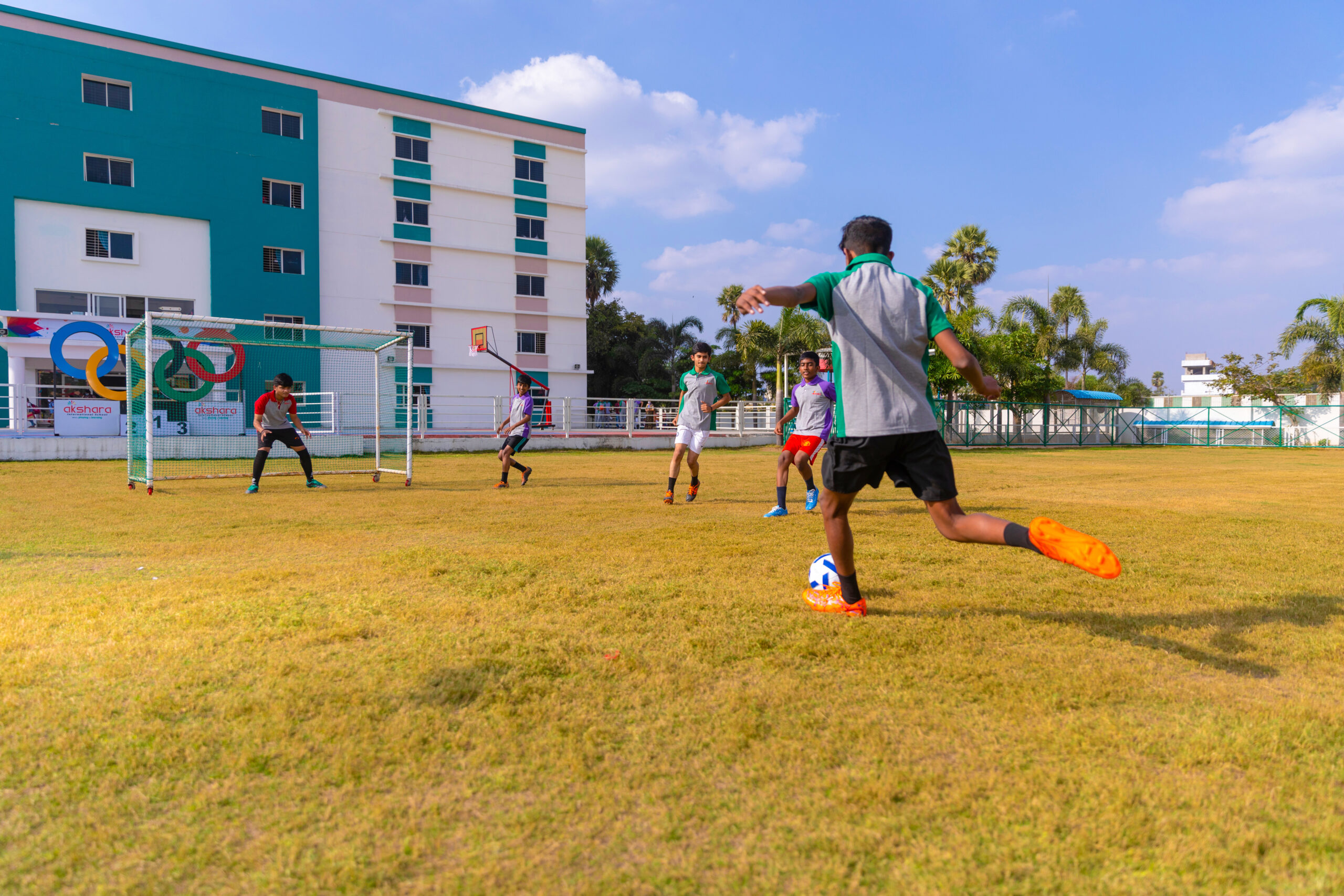
The Iconic Programmes That Deepen the Curriculum
No curriculum blog for Akshara International School Nadergul would be complete without examining the in-house programmes that extend and enrich what happens in formal classroom hours. These programmes — developed under the school's Iconic Initiatives framework — are not extracurriculars in the conventional sense. They are structural enrichments to the academic curriculum itself, and they address dimensions of learning that no board framework fully covers.
The Akshara Skill Enrichment Programme (ASEP) sets the trends and nurtures students with 21st-century scholastic standards specifically designed to prepare them for IIT-JEE, NEET, NTSE, National Olympiads, and International Olympiads. This programme goes beyond the CBSE syllabus in exactly the way the AEP intends — treating the process of developing a student's intellectual capabilities as more important than any single examination outcome.
The Akshara Student Apex Tweet (ASAT) is the school's linguistic aptitude programme, built to develop expertise for international examinations including SAT, TOEFL, PTE, and IELTS. It covers everything from foundational English for beginners to boardroom-level business English, through a platform designed to make language learning rewarding rather than anxiety-inducing. For students at the best CBSE schools in Hyderabad with international educational aspirations, this programme provides meaningful preparation that standard board English simply cannot deliver.
The Language Development Programme (LDP) builds five key language skills — listening, comprehension, verbal communication, interpretation, and written expression — systematically across the school years. Strong language proficiency is the single competency that underpins academic success in every subject, and LDP treats it with the structural seriousness it deserves.
Finally, Student Led Conferences (SLCs) represent Akshara's most distinctive assessment practice. Rather than the conventional model where teachers report on students to parents, SLCs place the student at the centre of the conversation — children lead the entire review of their own strengths and weaknesses, with teachers and parents as participants. This isn't just a format change; it develops self-awareness, ownership of learning, and the communicative confidence that defines capable learners at every level.
Together, these programmes reflect the R&D-driven approach that sits behind the Nadergul campus's curriculum — a dedicated research and development team continuously working on teacher training, pedagogical innovation, and curriculum development that keeps the school's approach current and genuinely effective.
What This Curriculum Means for Your Child
Parents in Nadergul, Saroor Nagar, Badangpet, and the Ranga Reddy corridor researching the best CBSE schools near Nadergul Hyderabad are looking for a school that prepares their child for both examinations and life. The curriculum at Akshara International School Nadergul addresses both directly — through the security and rigour of CBSE, the intellectual development habits of IB methodology, the stage-by-stage coherence of the AEP framework, and the supplementary depth of programmes like ASEP, ASAT, LDP, and SLC. The fact that the school has been recognised among the Top 8 Schools in India (2025) by Education World and holds the British Council's International School Award is external validation of an internally coherent curriculum philosophy — not just a label, but evidence that the approach is working.
Admissions are open for the 2026–27 academic year. To learn more about the curriculum and experience the Nadergul campus in person, visit the official Akshara International School website.
Note: Blogs by Yellow Slate are written based on information, knowledge and perspective of the writer. While every caution has been taken to provide readers with accurate information, please use your discretion before taking any decisions based on the information in this blog. In case you find any information that is factually wrong or something that could be made better, please write to us at contact@yellowslate.com.
Curious about how we arrived at this list? We believe parents deserve full transparency on how schools are evaluated and selected. to understand our school selection methodology.


