Beyond the Classroom: Co-curricular Life at Vishwa Vidyapeeth Takshashila School, Yelahanka
School selection in Yelahanka follows a familiar sequence. Families study the board affiliations, request the pass percentage data, tour the infrastructure, perhaps speak to a few parents whose children already attend. All of that is reasonable. None of it answers the question that actually keeps parents up at night — which is not about marks at all, but about formation. About what kind of person emerges from twelve years inside a particular institution.
Academics shape a portion of that. A fairly modest portion, if one is being honest.
The rest — the character, the confidence, the capacity to think under pressure and collaborate without ego — comes from everything surrounding the academic core. Which is precisely why the co-curricular framework at Vishwa Vidyapeeth Takshashila School deserves a closer look than marketing language typically invites.
The Timetable Tells You More Than the Mission Statement
Here is a useful diagnostic when evaluating any school's commitment to co-curricular development: find out where those activities actually live in the weekly schedule. End of Friday? Voluntary sign-up? Quietly suspended during board examination months? The answers are revealing.
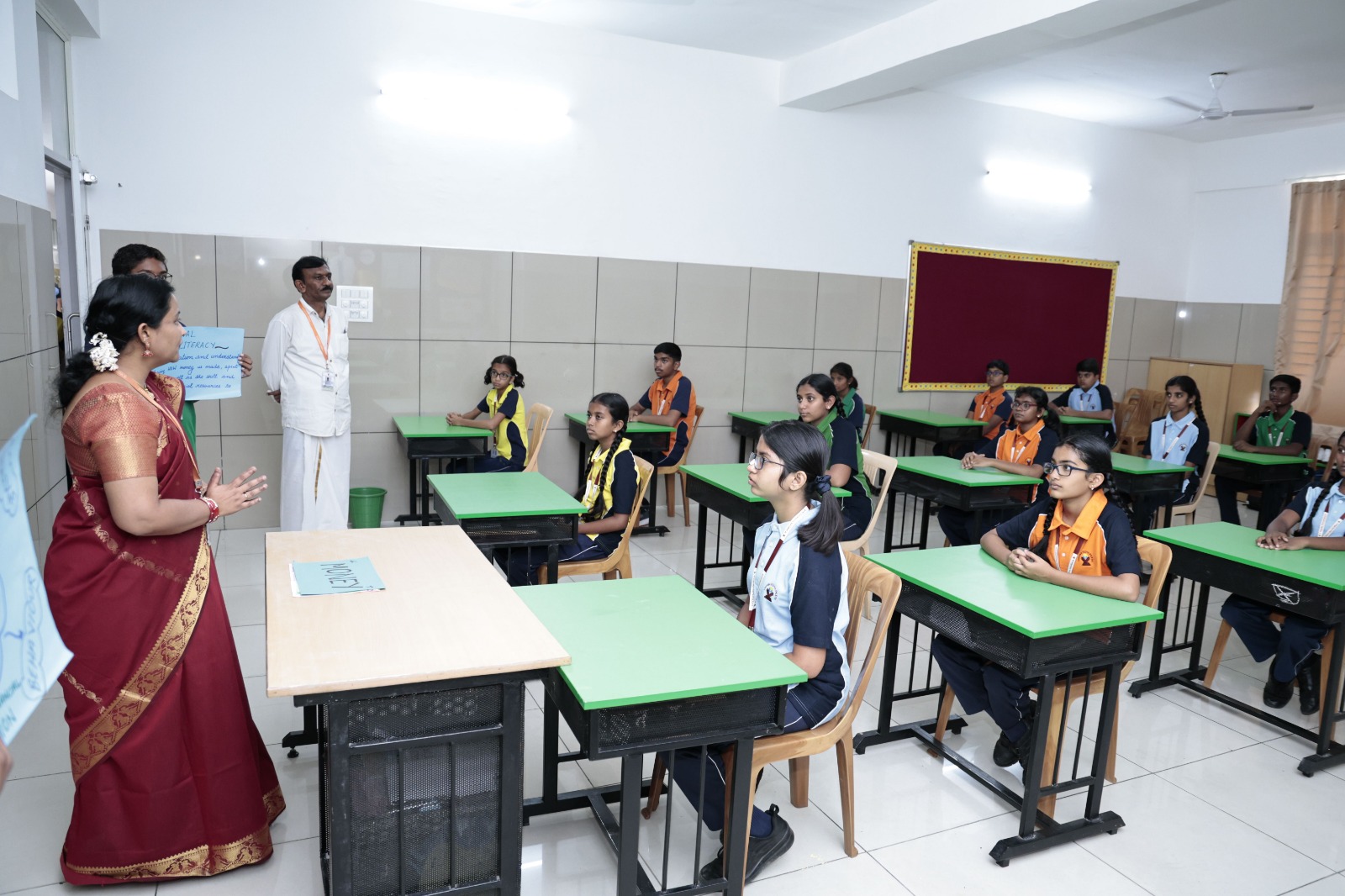
At Vishwa Vidyapeeth Takshashila, active learning methods sit inside the regular instructional timetable. Panel discussions, structured debates, classroom symposiums, role-plays, theatrical exercises — these function as teaching formats, not supplementary enrichment. A student defending an argument in front of peers, under pressure, while the teacher observes and evaluates, is doing something cognitively distinct from a student receiving information from the front of a room. This school appears to have internalised that distinction. Many schools have not.
Monthly competitions run throughout the academic year across both primary and secondary grades. Younger students take part in handwriting events, drawing competitions, Spell Bee, elocution, and a Readathon. The secondary programme is more demanding: VVP Times is a newspaper editing exercise that requires editorial judgement, not just language proficiency. Geometry-based rangoli designing sits alongside poster creation, slogan writing, and science model construction. That rangoli exercise sounds unusual until one considers what it actually demands — spatial reasoning, geometric accuracy, and aesthetic decision-making, simultaneously. It is the kind of crossover activity that reflects a curriculum shaped by thought rather than template.
The Arts: Embedded or Ornamental?
This is a distinction worth pressing, because many schools that claim arts integration are, in practice, offering arts ornamentation. A painted mural in the corridor. A choir performance once a year. An art exhibition that appears in March and is dismantled in April.
Vishwa Vidyapeeth's arts programme has more structural weight than that. Painting, Indian art forms, and hands-on craft projects are woven across grades throughout the year. Music instruction runs through a formal partnership with Furtados — a name with genuine standing in Indian music education — with keyboard and guitar sessions conducted on campus on an ongoing basis. The Junior Choir at the primary level is a functioning ensemble, not a one-off assembly item. Vocal music, by the school's account, is a regular part of school life.
Dance instruction extends across all grades, delivered by experienced mentors. The school's framing of dance is worth noting specifically: it positions the discipline as cognitively significant, not merely culturally expressive. There is a growing body of neurological research supporting exactly this argument — that movement-based learning activates pathways that sedentary instruction does not. Whether the school arrived at this position through research or intuition is less important than the fact that the programme reflects it.
For families comparing ICSE schools in North Bangalore, the embedded nature of arts and music here — inside the weekly timetable, not offered as optional weekend additions — is a meaningful structural distinction.
Sports: The Difference Between a Programme and a Culture
Vishwa Vidyapeeth Takshashila has a skating rink. On a school campus in Yelahanka, that alone is worth noting. Beyond the rink, the school runs Taekwondo instruction throughout the year, swimming through a partnership with CAPSA, and the more standard complement of football, basketball, volleyball, and badminton. Chess, carrom, and jump rope account for the indoor side. A dedicated yoga curriculum, delivered by trained faculty, sits within the formal physical education structure rather than being confined to morning assembly rituals.
None of which proves anything, by itself. Equipment is easy. Facilities are photographable. What cannot be faked, at least not consistently over time, is competitive achievement.
Vishwa Vidyapeeth Takshashila students have won medals at state and national levels across Taekwondo, skating, swimming, karate, yoga, and chess — through KISA, the Karnataka Interschool Sports Association, which is a competitive environment that quickly separates genuine sporting programmes from performative ones. Hansika G won gold at the 8th South Asian Taekwondo Championship. Likith Sharma brought home multiple gold medals from state-level skating competitions. These are not incidental outcomes. They are the product of consistent coaching, real competitive infrastructure, and an institutional culture that takes athletic development seriously enough to resource it properly.
Flagship Annual Events: Where VVP Comes Alive
The Vishwa Vidyapeeth Takshashila Co-curricular Calendar That Parents Love
Some schools hold annual days. Vishwa Vidyapeeth Takshashila builds entire experiences. The school has three flagship annual events that parents and students actively look forward to every year.
Ganitha Mela runs for five days each December. Its purpose is specific: to build genuine enthusiasm for mathematics while addressing the fear that many students develop around the subject, a fear that tends to calcify early and persist for years if left unaddressed. The 2023 edition featured Padma Shri recipients A.S. Kiran Kumar, Rohini Godbole, Sujatha Ramadorai, and Parshuram Atmaram Gangavane. Students attended a Kannada theatrical performance of Lilavathi, a production honouring Bhaskaracharya II, the 12th-century mathematician. A Jugalbandhi performance — Bharathanatyam and Kathak in dialogue — was structured around the mathematics of symmetry and movement. Harate sessions placed students in direct conversation with working scientists. Puppet theatre, magic shows, and live student stalls filled the remaining hours.
Calling this a school event does not quite capture it. It is closer to a curated intellectual festival — the kind of thing one might expect at a science museum or a university, transplanted onto a school campus and made accessible to children across age groups.
Bharatiya Kala Vaibhava is the school's grand celebration of India's classical arts heritage, featuring renowned artists and cultural scholars. It reflects the school's deep commitment to preserving Indian traditions — one of its core stated values — while giving students a direct connection to their cultural roots through high-quality performances.
Jai Jawan Jai Kisan is an event dedicated to honouring soldiers and farmers, recognising their service and sacrifice. For a school that speaks frequently about character development and values, this event embodies exactly that — giving students a sense of civic responsibility from an early age.
Clubs, a Global Experiment, and What the Names Reveal
The club system at Vishwa Vidyapeeth Takshashila is wide enough to suggest genuine range: Science Club, Reva Heritage Club, Quiz Club, Toastmasters Club, Creative Hands Club, Community Science Club, MUN Club, and the PALS (Peer Assistance and Leadership) Club. PALS is worth singling out. The programme treats peer mentorship as a teachable competency — something that can be developed through structured practice — rather than a personality trait that some students happen to possess.
The school's participation in Microsoft's Skype-a-Thon, fourth edition, organised under the theme "Open Hearts, Open Minds," generated over 260 sessions within 48 hours, connecting students with educators and Microsoft leaders including Anthony Salcito and Anand Eswaran, across more than 40 countries. Students presented Indian cultural forms — yoga, folk dance, live music — to international counterparts in real time. For a school in Yelahanka, the scale of coordination required to execute something like this is considerable, and the experience it creates for students is qualitatively different from anything a conventional co-curricular calendar provides.
Interschool competitions carry names that, collectively, reveal something about the school's personality: Kaleidoscope for the Art and Craft Mela, Ecoventure for ecological debate, Nutcrackers for preprimary competition, Boulderdash for the language festival. Community programmes — Annadata Sukhibhava, on-campus organic farming, and a Save Water initiative — translate the school's stated values into regular, tangible practice.
Why the Co-curricular Life at Vishwa Vidyapeeth Takshashila Matters
Volume alone does not distinguish a co-curricular programme. Calendars can be filled. Activities can be listed. What is considerably harder to manufacture is coherence — the sense that each initiative connects back to a consistent, legible belief about what education is actually trying to accomplish.
At Vishwa Vidyapeeth Takshashila, that coherence is detectable. A student with a mathematical inclination finds Ganitha Mela. One drawn to physical discipline finds Taekwondo and skating programmes that have verifiably produced national-level competitors. A student interested in language finds Toastmasters and VVPMUN; one inclined toward visual art finds dedicated studio sessions within the weekly timetable. Across intellectual, physical, creative, and civic domains, the coverage is deliberate.
For families evaluating schools in Yelahanka and North Bangalore with a genuine interest in their child's complete development, coherence of this kind is among the most valuable things to identify — and among the most difficult to sustain artificially over many years. The record at Vishwa Vidyapeeth Takshashila suggests it is not being sustained artificially.
Full programme details and admissions information are available on the school's official website.
Note: Blogs by Yellow Slate are written based on information, knowledge and perspective of the writer. While every caution has been taken to provide readers with accurate information, please use your discretion before taking any decisions based on the information in this blog. In case you find any information that is factually wrong or something that could be made better, please write to us at contact@yellowslate.com.
Curious about how we arrived at this list? We believe parents deserve full transparency on how schools are evaluated and selected. to understand our school selection methodology.


