From Pre-Primary to Grade 10: Understanding NCFE's 4-Stage Curriculum Progression (Fledgling, Watering, Blossoming, Basking)
Most parents choose a school based on facilities, location, or reputation without fully understanding how the curriculum actually evolves year to year. They see grade levels — kindergarten, primary, middle school — and assume it's a linear progression where students simply go deeper into similar subjects. But what if your child's school had deliberately designed each developmental stage with specific learning outcomes in mind? What if the curriculum itself transformed to match how children naturally grow?
This is exactly what National Centre for Excellence (NCFE) Indiranagar has created. Rather than viewing Pre-Primary through Grade 10 as disconnected years, NCFE has reimagined education as four intentional stages, each with a poetic name and a unique pedagogical focus: Fledgling (Pre-Primary to Grade 2), Watering (Grade 3-5), Blossoming (Grade 6-8), and Basking (Grade 9-10).
For parents searching for the best CBSE schools in Indiranagar, understanding this framework is crucial. Among the best schools in Bangalore with innovative curriculum design, NCFE Indiranagar stands out precisely because it thinks differently about how children learn and develop. In this guide, we'll walk through each stage, explaining what makes it unique and how it prepares your child for academic success and life beyond the classroom.
The Philosophy Behind NCFE's 4-Stage Framework
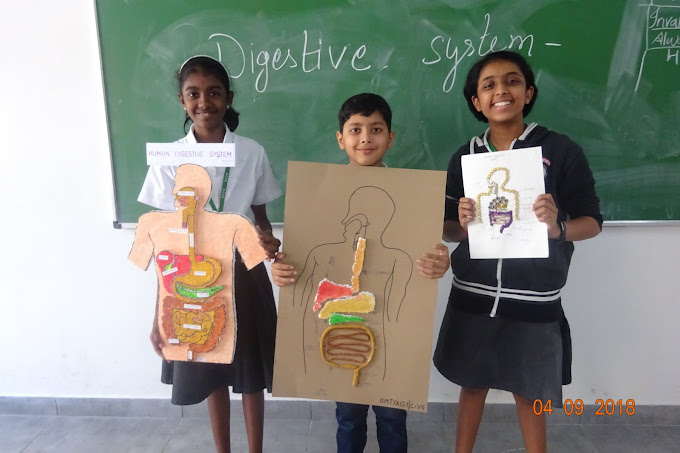
Before diving into each stage, it's important to understand the thinking behind this approach. Rooted in a clear vision and mission, National Centre for Excellence Indiranagar views education not merely as knowledge transfer from teacher to student, but as designing experiences that match each child's developmental readiness — physically, emotionally, cognitively, and socially.
Traditional schooling often treats all Grade 3 students the same, regardless of whether they're ready to think abstractly or still need concrete, hands-on learning. NCFE Indiranagar rejects this one-size-fits-all approach. Instead, the school uses research-backed understanding of child development to create curriculum that evolves intentionally alongside your child's growth.
The 4-stage progression exists because each stage focuses on what matters most at that developmental moment, rather than rushing students toward abstract thinking before they're ready. The beautiful metaphor of growth — fledgling birds learning to fly, plants being watered to grow, flowers blossoming, and finally basking in the sun — captures the natural, organic nature of this approach.
Moreover, NCFE Indiranagar grounds this curriculum in the 5C framework: Communication, Collaboration, Critical Thinking, Creativity, and Citizenship. These aren't bolted-on additions; they're woven through every stage, ensuring that students develop 21st-century skills alongside academic mastery. For a deeper look at how this translates into daily classroom practice, explore the detailed curriculum guide for NCFE Indiranagar.
Stage 1: Foundational Stage — Fledgling (Pre-Primary to Grade 2)
The Goal: Building Joyful, Inclusive Learning Foundations
Imagine a young bird just learning to spread its wings. It's not yet soaring, but it's developing the strength, coordination, and confidence it will need. This is the metaphor behind the Fledgling stage at NCFE Indiranagar.
At this stage, children are naturally curious, imaginative, and tactile. They learn best through play, exploration, and hands-on experiences rather than workbooks and memorization. National Centre for Excellence Indiranagar honors this reality by designing the Foundational Stage around joyful, inclusive experiences and overall development through experiential learning. For families with very young children, it's also worth knowing that NCFE Indiranagar's daycare program provides a nurturing entry point even before formal Pre-Primary begins.
What does this look like in practice? Rather than sitting children down to practice letter recognition, Pre-Primary and Grade 1-2 at NCFE Indiranagar engage children through storytelling, role-play, art, music, and movement. They explore themes that matter to their world — families, animals, seasons, community helpers — and embed literacy and numeracy naturally within these explorations.
For example, a unit on "Houses" might involve children building with blocks (spatial reasoning), singing songs about different homes (language, memory), drawing and painting their dream house (creativity and fine motor skills), and discussing who lives in their house (communication and social awareness). Through this single theme, children develop foundational concepts in mathematics, language, science, and social studies — without ever feeling like they're in separate "subjects."
This stage is also deeply focused on emotional and social development. At NCFE Indiranagar, children at the Fledgling stage learn self-regulation, cooperation, and confidence. They develop listening skills, follow routines, and begin to understand classroom expectations — all essential foundations for the structured learning that comes later. The school's commitment to student well-being and mindfulness starts right from this foundational stage.
Key outcomes by end of Grade 2:
- Foundational literacy and numeracy skills
- Ability to listen, follow instructions, and cooperate with peers
- Confidence in expressing ideas through multiple modalities (art, movement, words)
- Curiosity and comfort with exploration
- Early social awareness and empathy
Parents often worry about whether play-based learning is "rigorous enough." But research consistently shows that children who develop strong emotional foundations and maintain curiosity in these early years become more successful, engaged learners later. NCFE Indiranagar understands this deeply.
Stage 2: Preparatory Stage — Watering (Grade 3-5)
The Goal: Nurturing Fundamental Skills and Inquiry
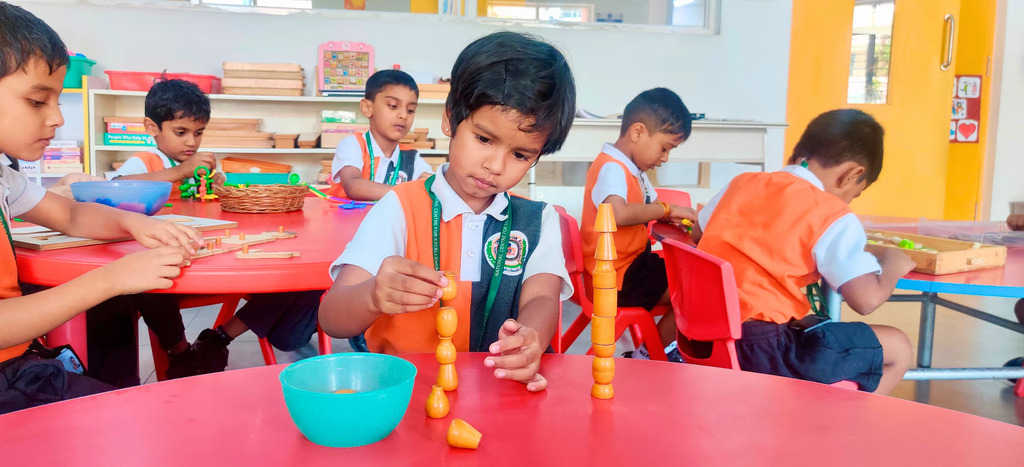
As a young plant needs consistent nourishment and care to develop strong roots, children in Grades 3-5 are at a stage where they're developing the fundamental skills and habits that will sustain their learning throughout school.
The Watering stage at National Centre for Excellence Indiranagar is pivotal. Children are becoming more independent thinkers, their attention spans are growing, and they're developing the ability to understand cause-and-effect relationships. This is when many schools shift to traditional, subject-based teaching. NCFE Indiranagar does something more sophisticated: it cultivates inclusive learning with a focus on fundamental skills while nurturing the ability to inquire about the world around them. Understanding the teaching methodologies employed at NCFE Indiranagar gives parents a clearer picture of how these skills are built in practice.
Rather than teaching English, Math, Science, and Social Studies as isolated subjects, NCFE Indiranagar uses thematic and project-based learning that integrates subjects naturally.
For instance, a Grade 4 unit on "Water Cycle and Conservation" might include:
- Science: Hands-on experiments with evaporation, condensation, and precipitation
- Mathematics: Measuring rainfall, calculating water usage, creating graphs
- Language Arts: Reading informational texts about water sources, writing persuasive essays on conservation
- Social Studies: Learning about water resources in different regions, understanding how communities manage water
- Arts & Movement: Creating water-themed art, expressing the water cycle through dance
Through this integrated approach, children see how subjects connect to real-world problems. They develop inquiry skills — asking questions, investigating, making observations, and drawing conclusions — rather than simply memorizing facts.
Another critical focus of the Watering stage is skill development: literacy skills (reading with comprehension, writing coherently), numeracy skills (problem-solving, mathematical reasoning), scientific thinking (observation, hypothesis, testing), and collaborative skills (working with peers on projects).
By the end of Grade 5, students at NCFE Indiranagar have internalized learning habits — how to read for meaning, how to think through a math problem, how to work with others — that will serve them through middle and high school.
Key outcomes by end of Grade 5:
- Strong foundational literacy and numeracy skills
- Ability to inquire, observe, and think critically about the world
- Understanding of how subjects connect and apply to real life
- Developed collaboration and communication skills
- Confidence in tackling challenging problems
Stage 3: Middle Stage — Blossoming (Grade 6-8)
The Goal: Transdisciplinary Learning and Pattern Recognition
In nature, a plant that's been carefully nurtured through its early stages finally reaches the stage where it blossoms — where growth becomes visible, colorful, and distinctive. This is what happens developmentally in Grades 6-8: adolescents are beginning to think more abstractly, question the world more deeply, and develop their own perspectives and identities.
This is also typically when traditional schools revert to rigid subject-based teaching, often losing the very students who need integration and relevance the most. National Centre for Excellence Indiranagar does the opposite. The Blossoming stage is where NCFE Indiranagar facilitates transdisciplinary learning, guiding students to identify patterns around them and fostering a holistic educational experience. To see how this holistic vision extends beyond academics into campus life, read more about holistic education at NCFE Indiranagar.
"Transdisciplinary learning" means exploring big, real-world questions that naturally require multiple disciplines. For example, a Grade 7 inquiry might be: "How do cities grow sustainably?" This question pulls in:
- Urban Planning & Geography: How do cities expand? Where do people choose to live?
- Mathematics & Data Analysis: Analyzing population growth, calculating density
- Economics: Cost of development, resources required
- Environmental Science: Impact on ecosystems, sustainability measures
- Civics & Social Studies: Government planning, community needs
- Communication: Presenting findings, debating solutions
Students aren't just "learning" these subjects; they're using them to explore a question they care about. They develop critical thinking, collaboration, and real-world problem-solving skills naturally through this process.
At NCFE Indiranagar, students in the Blossoming stage are also beginning to develop their voice and agency. They're encouraged to ask questions that matter to them, propose investigations, and take ownership of their learning. This is when student-led initiatives become vehicles for developing leadership.
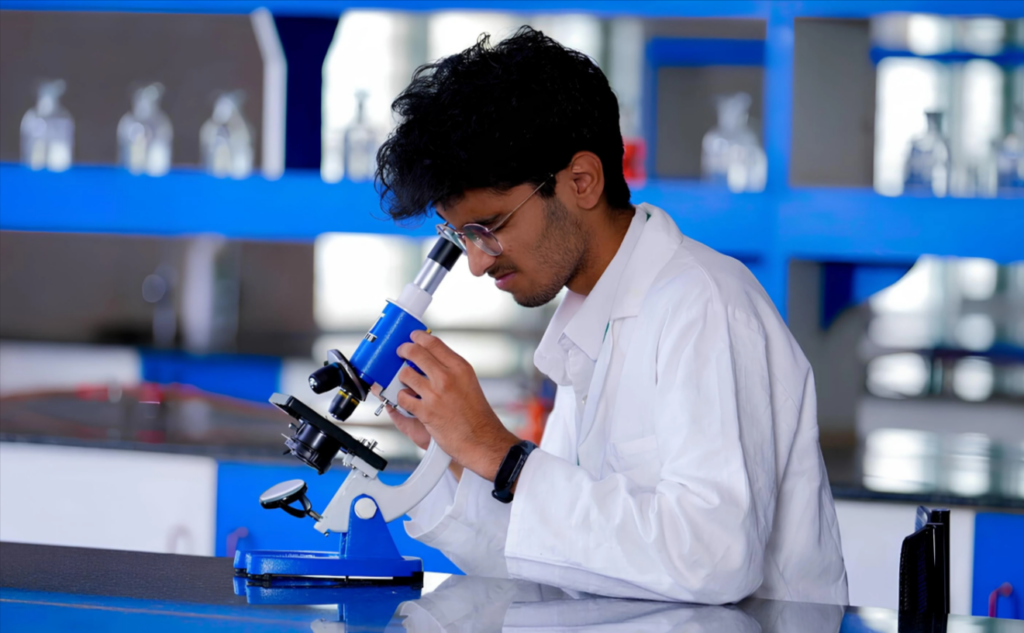
Key outcomes by end of Grade 8:
- Ability to see connections between disciplines
- Strong critical thinking and pattern recognition skills
- Comfort with complex, real-world problems
- Developed voice and perspective on issues
- Collaboration and communication skills
- Beginning understanding of their own learning strengths
Stage 4: Secondary Stage — Basking (Grade 9-10)
The Goal: In-Depth Concept Understanding and Academic Excellence
Finally, imagine a flower that's fully bloomed, basking in the sun, with all its petals fully open. The Basking stage (Grade 9-10) at NCFE Indiranagar is where everything comes together. Students have built foundational skills, developed inquiry habits, learned to see connections, and cultivated their own voice. Now it's time to deepen.
At the Secondary stage, NCFE Indiranagar's emphasis shifts to cultivating in-depth concept understanding, ensuring academic excellence and future success. This is one of the key reasons many parents choose NCFE Indiranagar — its proven ability to combine depth of understanding with strong board exam outcomes. This doesn't mean abandoning the integrated, inquiry-based approach. Rather, it means that when students explore complex topics, they're doing so with greater sophistication and academic rigor.
For instance, in a Grade 9 Economics and History unit on "Industrial Revolution," students explore:
- Historical causation: What conditions made industrialization possible?
- Economic concepts: Labor markets, capital accumulation
- Environmental impact: How did rapid industrialization change the environment?
- Sociological perspective: How did class structures shift?
- Modern connection: How does this echo in today's technological revolution?
By Grade 9-10, students are capable of holding multiple perspectives simultaneously, understanding nuance, and synthesizing information into coherent arguments. NCFE Indiranagar harnesses this cognitive capacity.
The Basking stage is also critical for preparing students for life beyond school. National Centre for Excellence Indiranagar ensures students develop deep concept understanding (not just memorization for exams), strong research and writing skills, ability to analyze and evaluate information, and digital literacy. The school's awards and achievements stand as a testament to how this approach translates into real-world recognition and results.
While CBSE board exams are an external measure at Grade 10, NCFE Indiranagar views them as one outcome among many. The school's focus is on ensuring students truly understand concepts deeply enough that exams become a natural demonstration of that understanding.
Key outcomes by end of Grade 10:
- Deep, conceptual understanding of subject matter
- Strong academic performance including board exam success
- Developed research, writing, and analytical skills
- Self-awareness about learning style and academic strengths
- Career awareness and interest exploration
- Citizenship understanding and social responsibility
How the 5Cs Weave Through All Four Stages
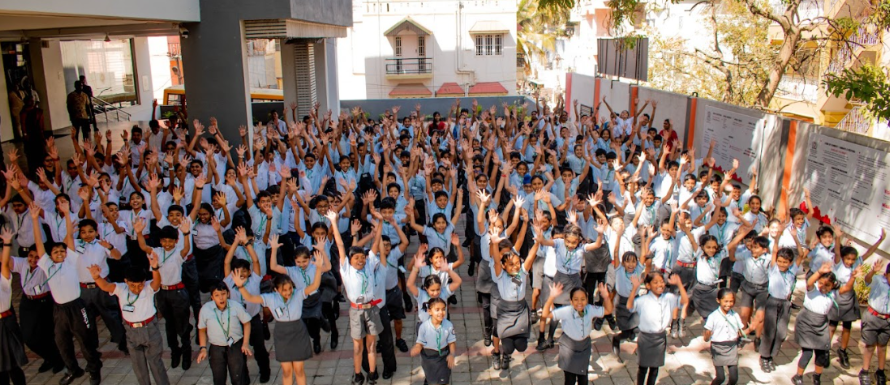
Throughout all four stages — Fledgling, Watering, Blossoming, and Basking — NCFE Indiranagar consistently develops the 5Cs: Communication, Collaboration, Critical Thinking, Creativity, and Citizenship.
These aren't taught as separate units. Rather, they're embedded in how learning happens at each stage:
- In Fledgling, Communication happens through storytelling and play; Creativity through art and music; Collaboration through group play.
- In Watering, Communication develops through presentations and discussions; Collaboration through group projects; Critical Thinking through inquiry questions.
- In Blossoming, students engage in deeper Communication (presentations to real audiences), complex Collaboration (managing group projects), and sophisticated Critical Thinking (analyzing from multiple perspectives).
- In Basking, students demonstrate advanced Communication (academic writing), mature Collaboration (peer feedback), and rigorous Critical Thinking (academic analysis).
By Grade 10, students at NCFE Indiranagar haven't just learned these skills — they've internalized them through years of practice across different contexts. This is also deeply supported by the school's strong partnership with parents, which ensures the 5Cs are reinforced both inside and outside the classroom.
What Parents Should Look For: Recognizing Quality Implementation
Understanding NCFE's 4-stage framework is one thing. Recognizing quality implementation is another. The reviews and parent insights for NCFE Indiranagar offer a real-world window into how these stages play out day to day. Here are signs that National Centre for Excellence Indiranagar is truly delivering on this promise:
In Fledgling classrooms: You'll see children engaged in play-based learning, exploring themes through multiple modalities. Learning feels joyful, not forced. Classrooms are colorful and engaging.
In Watering classrooms: You'll notice integrated units where children explore themes across subjects. They're asking their own questions and investigating answers. They work on projects, not just worksheets.
In Blossoming classrooms: Discussions are sophisticated. Students reference multiple sources, consider different perspectives, and debate ideas respectfully. Projects connect to real-world issues.
In Basking classrooms: Students are engaging with complex, academic material. They're writing analytical essays, conducting research, and thinking critically. Yet the integrated approach remains.
When you visit NCFE Indiranagar or talk to teachers, ask questions like:
- "How do you ensure students understand concepts deeply, not just memorize for exams?"
- "How do you integrate subjects in Grade 7-8?"
- "How do students develop the 5Cs in their daily learning?"
You may also want to explore the campus facilities at NCFE Indiranagar to see how the physical learning environment supports each of these four stages, and review the school's safety and security measures for added peace of mind.
Why This Matters for Your Child's Future
In a rapidly changing world, the specific facts your child memorizes matter far less than their ability to think critically, collaborate, create, communicate, and act with citizenship. Traditional schooling often optimizes for test scores. NCFE Indiranagar optimizes for developing learners who are curious, capable, and ready for whatever comes next.
The 4-stage progression ensures that each child is challenged at the right level for their development. A 6-year-old in Fledgling isn't pushed toward abstract thinking before she's ready; she's building the foundation through play. A 14-year-old in Blossoming is engaging with sophisticated thinking because she's ready.
Moreover, by building in inquiry, integration, and student voice throughout all four stages, National Centre for Excellence Indiranagar ensures that children maintain their natural curiosity. They don't become passive consumers of information; they become active constructors of knowledge. The school's active parental engagement model further strengthens this by keeping families involved in the learning journey at every stage.
Making the Choice: Is NCFE Indiranagar Right for Your Family?
Understanding NCFE Indiranagar's 4-stage framework can help you determine if the school's approach aligns with your values and your child's needs. If you're still weighing your options, the comprehensive parent's guide to choosing NCFE Indira Nagar covers the full decision-making checklist.
If you believe that:
- Education should nurture the whole child, not just test scores
- Children learn best when learning feels relevant and connected
- Your child needs space to develop curiosity and voice alongside academic skills
- You want a school that thinks intentionally about developmental stages
Then National Centre for Excellence Indiranagar deserves serious consideration. Among the best CBSE schools in Indiranagar and best schools in Bangalore with innovative curriculum design, NCFE stands out for this thoughtful, intentional approach.
Taking the Next Step
If you're intrigued by NCFE Indiranagar's approach, the best way to understand it is to experience it directly. Visit the campus during school hours if possible — observe classrooms at different stages, speak with teachers, and ask about how the 4-stage framework translates into daily learning.
Before your visit, you might find it helpful to review the frequently asked questions about NCFE Indiranagar and understand the admission process for 2026-27 so you arrive prepared.
Schedule an admission consultation to discuss your child's specific needs. The choice of school shapes your child's educational journey for years. Taking time to understand NCFE Indiranagar's philosophy is time well invested.
Your child's educational foundation deserves thoughtful, intentional design. NCFE Indiranagar offers exactly that.
Note: Blogs by Yellow Slate are written based on information, knowledge and perspective of the writer. While every caution has been taken to provide readers with accurate information, please use your discretion before taking any decisions based on the information in this blog. In case you find any information that is factually wrong or something that could be made better, please write to us at contact@yellowslate.com.
Curious about how we arrived at this list? We believe parents deserve full transparency on how schools are evaluated and selected. to understand our school selection methodology.


