How Amrita International Vidyalayam Approaches Teaching: Inquiry, Values, and the IB Learner Profile
When parents in Bangalore start comparing IB schools, they usually begin with the obvious questions — which curriculum, which grades, what are the fees? But sooner or later, a more important question tends to surface: how does the school actually teach? What happens inside the classroom? And is the teaching approach genuinely different from a conventional school, or is the IB label simply cosmetic?
At Amrita International Vidyalayam, these questions have considered answers. The school's teaching methodology is built on a coherent philosophy that stretches from Montessori all the way through to the IB Middle Years Programme — and what ties it all together is a consistent commitment to inquiry, student agency, and values rooted in the school's founding ethos. For parents trying to understand what their child's learning experience will genuinely look like at AIV, this blog breaks it all down.
[btn_admissions id=16766]
The Foundation: Montessori at the Earliest Years
Before a child at Amrita International Vidyalayam ever encounters the IB framework, their learning journey begins in the Montessori environment — and that starting point matters more than most parents realise.
The Montessori approach at AIV is grounded in a respect for the individual child. Teachers don't assign work the way a conventional classroom teacher would; instead, they provide materials and encourage children to independently choose what they want to work on, repeating activities until they achieve a sense of mastery. The classroom itself is intentionally designed — low open shelves, spacious rooms, child-height furniture — to support freedom of choice and systematic independent exploration.
How Montessori at AIV Shapes Independent Learners from Day One
One of the most striking contrasts between the AIV Montessori model and a traditional school is how errors are handled. In a conventional classroom, it's the teacher who marks mistakes. In the Montessori environment at Amrita International Vidyalayam, children learn to spot their own errors through feedback built into the materials themselves — a design choice that nurtures self-correction rather than dependence on external judgment.
Mixed-age classrooms, another distinctive feature, place children spanning a three-year age range together. Older children naturally guide younger ones, and younger children observe and absorb from their peers. This horizontal learning dynamic builds community, deepens understanding, and develops empathy — qualities that flow naturally into the IB learner profile attributes the school cultivates in later years.
The IB Primary Years Programme: Transdisciplinary Thinking Begins Early
Once children move into the IB Primary Years Programme (ages 3–12), the teaching approach shifts toward what the IB describes as a transdisciplinary framework. Rather than keeping subjects siloed — science in one box, language in another — the PYP at Amrita International Vidyalayam organises learning around overarching concepts and themes that span multiple subject areas simultaneously.
The Programme of Inquiry at AIV articulates how six transdisciplinary themes are explored across different age groups, ensuring that the curriculum feels coherent and connected rather than fragmented. A child studying a unit on ecosystems isn't just doing science — they're developing mathematical thinking, reading diverse texts, building vocabulary, and forming views about their relationship with the natural world.
Inquiry-Based Learning and the IB Learner Profile at AIV
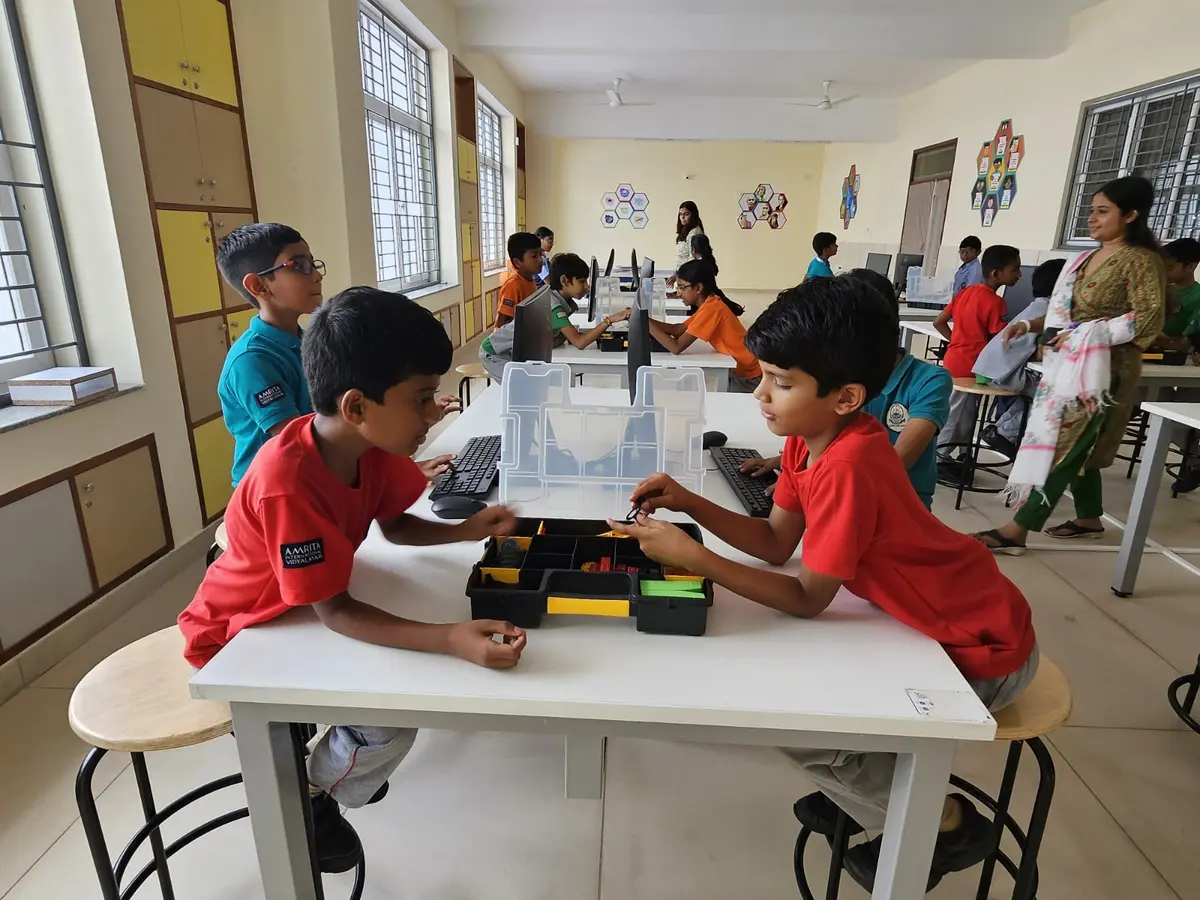
Central to the PYP teaching methodology is what the school calls Approaches to Learning (ATL). The ATL framework is used to facilitate inquiry within the six subject areas and is designed to give students genuine autonomy over their learning journey. Children are not passive recipients of information — they are active participants in exploring, questioning, and making connections.
The IB Learner Profile sits at the heart of this approach. At Amrita International Vidyalayam, learners are actively guided to develop ten key attributes: being inquirers, knowledgeable, thinkers, communicators, principled, open-minded, caring, risk-takers, balanced, and reflective. These aren't abstract ideals on a poster in the corridor — they're embedded into how teachers structure lessons, how feedback is given, and how students are assessed. The multilingual environment adds another dimension, with children exposed to Kannada, Hindi, French, and Spanish — all part of nurturing that international-mindedness from an early age.
The IB Middle Years Programme: Real-World Connections and Student Agency
As students move into the Middle Years Programme (ages 11–16), the teaching methodology at Amrita International Vidyalayam becomes progressively more sophisticated — but the core commitment to inquiry and student agency remains intact.
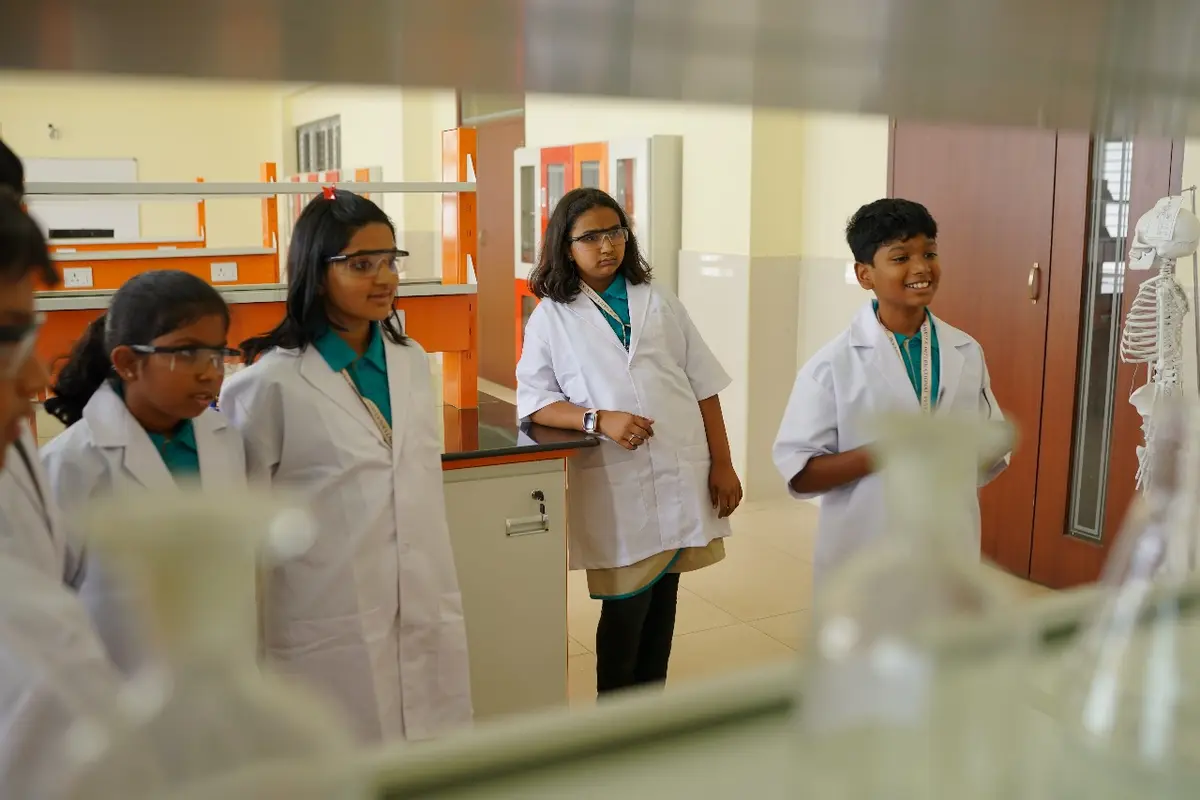
The MYP at AIV covers eight subject groups including Language and Literature, Sciences, Mathematics, Individuals and Societies, Arts, Physical Education, Language Acquisition, and Design (with STEM integration). Each subject group demands at least 50 hours of teaching time per year, and the curriculum is designed to encourage practical connections between classroom learning and real-world situations.
How AIV's MYP Teaching Methodology Builds Interdisciplinary Understanding
What distinguishes the MYP teaching approach at Amrita International Vidyalayam is its emphasis on interdisciplinary learning. Students are expected to integrate knowledge from multiple subject areas — not just understand each discipline in isolation. When exploring a real-world challenge like climate change or migration, for instance, students draw on scientific understanding, historical context, language skills, and ethical reasoning simultaneously. The purpose of this integration is clearly articulated in the curriculum: to offer holistic solutions to complex challenges that no single subject can address alone.
The Approaches to Learning skills in the MYP go further than in the PYP, equipping students to become independent learners, effective communicators, problem-solvers, and global citizens. ATL in the MYP is deliberately integrated across all academic disciplines — it's not a standalone lesson or a bolt-on addition, but a thread running through every subject group.
Student-Led Conferences: Ownership of Learning Made Visible
One of the most tangible expressions of Amrita International Vidyalayam's teaching philosophy is the Student-Led Conference (SLC). Rather than the familiar parent-teacher meeting format — where parents receive a report and the teacher does most of the talking — the SLC flips the dynamic entirely.
Students present their own learning progress, achievements, challenges, and aspirations to their parents and teachers. They come prepared with portfolios or presentations that exhibit their work, reflect on their strengths and areas for growth, and discuss their understanding of the IB Learner Profile attributes they've been developing. Self-reflection is integral to the process: students evaluate their own academic performance, set goals, and articulate strategies for moving forward.
Developing Metacognition and Communication Through AIV's SLC Process
The SLC model at AIV serves a dual purpose. For students, it builds metacognition — the ability to think about one's own thinking — and strengthens communication and presentation skills in a genuine, high-stakes context. For parents, it offers far more insight into their child's inner learning experience than a grade sheet ever could. The collaborative engagement between students, parents, and teachers that SLCs create fosters shared accountability for the child's educational journey, rather than leaving parents feeling like spectators.
Among the best international schools in Bangalore, this kind of structured student ownership of assessment is relatively rare and speaks to the depth of AIV's commitment to building self-aware, self-directed learners.
Values as Pedagogy: How Amma's Philosophy Shapes Classroom Culture
Teaching methodology at Amrita International Vidyalayam cannot be fully understood without acknowledging the values framework that undergirds everything. The school's founding connection to Her Holiness Mata Amritanandamayi Devi isn't simply a philosophical backdrop — it actively shapes classroom culture through specific programmes.
Weekly Vedic chanting sessions form part of the school's Beyond Academic Programme. Students learn and recite selected chapters and verses from the Bhagavad Gita, as well as Shanti mantras from the Upanishads. Yoga and meditation are integrated into the weekly schedule beginning from the primary years. These aren't extras layered on top of the academic programme — they are understood as practices that enhance focus, memory, emotional regulation, and the kind of inner stability that supports learning across all subjects.
The five core values the school identifies — Respect, Empathy, Service, Self-Regulation, and Lifelong Learning — are woven directly into how teachers interact with students, how students are expected to interact with each other, and how Service as Action (SAA) functions within the MYP. Through SAA, students engage in community service activities that develop empathy, a sense of civic responsibility, and an understanding of how their learning connects to real impact in the world.
Among the best IB schools in Bangalore, this integration of values into pedagogy rather than treating them as extracurricular additions is one of the defining characteristics of what AIV offers.
Special Educational Needs: Differentiation Built into the System
A teaching methodology is only as strong as its ability to reach every learner. At Amrita International Vidyalayam, students with diverse learning needs are supported through a partnership with the Stepping Stone Center. Specialised assistance is tailored to address learning difficulties, behavioural challenges, and developmental issues, and teachers are committed to differentiating their strategies, resources, and assessments to accommodate individual needs.
This inclusive approach reflects the school's belief — stated clearly in its mission — that every child is unique and that the teaching framework should adapt to the child, not the other way around.
Conclusion
For parents evaluating the best CBSE, IB, or international schools in Bangalore, teaching methodology is ultimately what determines whether a school's promises translate into real outcomes for children. At Amrita International Vidyalayam, the approach to teaching is consistent from Montessori through MYP: inquiry-driven, values-integrated, and centred on building student agency rather than passive compliance. The combination of the IB Learner Profile, ATL skills, Student-Led Conferences, interdisciplinary learning, and a values framework rooted in Amma's philosophy creates a classroom environment that's genuinely distinct from conventional schooling.
If you want to understand firsthand how this teaching approach works in practice, visiting the campus and speaking with the team at Amrita International Vidyalayam is the best next step. Explore the school's official website for more details on admissions and programmes.
Note: Blogs by Yellow Slate are written based on information, knowledge and perspective of the writer. While every caution has been taken to provide readers with accurate information, please use your discretion before taking any decisions based on the information in this blog. In case you find any information that is factually wrong or something that could be made better, please write to us at contact@yellowslate.com.
Curious about how we arrived at this list? We believe parents deserve full transparency on how schools are evaluated and selected. to understand our school selection methodology.


