How K-IIT World School Pitampura Teaches Differently: The Jaadui GRID and Beyond
When parents in Pitampura start looking seriously at schools, they ask roughly the same questions. Good results? Strong infrastructure? Decent fees? But increasingly, there's a deeper question surfacing in conversations between parents: how does a school actually teach? Not just what curriculum it follows, but what happens in the classroom on an ordinary Tuesday morning when no one is watching. That question is where K-IIT World School, Pitampura genuinely stands apart from the crowd. Among the best CBSE schools in North Delhi, K-IIT has built a teaching philosophy that is specific, named, practised consistently, and — importantly — verifiable in its outcomes.
The school's full name gives you a clue: Kamrah Institute of Innovative Teaching. That word "innovative" isn't decorative. It's a founding commitment, embedded in the institution since its establishment under the aegis of Vidyapati Sansthan. And over the decades, that commitment has materialised into a set of pedagogical practices that would feel quite unfamiliar to anyone whose own school experience consisted mostly of copying notes from a blackboard.
This blog unpacks what K-IIT World School's teaching methodology actually looks like — the frameworks, the classroom practices, the teacher development culture, and the results that emerge from it all.
The Jaadui GRID: K-IIT World School Pitampura's Award-Winning Teaching Framework
The centrepiece of K-IIT World School's pedagogical identity is the Jaadui GRID — an award-winning in-house framework that transforms how subjects are taught, how lessons are structured, and how children experience learning across grades. The name itself signals the intent. "Jaadui" means magical; "GRID" reflects a multi-dimensional structure rather than a linear, subject-by-subject approach.
At its core, the Jaadui GRID makes learning creative, reflective, and multidisciplinary. Rather than treating Science, Mathematics, Language, and the Arts as entirely separate silos, the framework deliberately weaves them together. The most visible outcome of this integration is the school's transformation of STEM into STEAM — Science, Technology, Engineering, Arts, and Mathematics — where artistic thinking is treated not as an extracurricular flourish but as a legitimate cognitive tool for understanding complex concepts.
Why the Jaadui GRID Sets K-IIT World School Pitampura Apart
The practical implication of this is significant. A student learning about geometry isn't just solving abstract problems on paper; the Jaadui GRID approach might bring in visual art, spatial design, or architectural thinking to give that concept texture and meaning. A science concept isn't just memorised for a test — it's explored, questioned, connected to other domains, and ultimately understood at a deeper level. Parents familiar with the rote-learning culture that still dominates many CBSE schools in Delhi will immediately recognise why this distinction matters. Children who understand why something works are far better prepared for competitive examinations, higher education, and careers than those who only know what the textbook says.
The Jaadui GRID also shapes how teachers plan their lessons. Every learning experience is designed to be holistic — not just intellectually stimulating but emotionally engaging and practically grounded. This is one of the distinguishing markers of the best schools in Pitampura: the gap between schools that talk about holistic education and schools that have actually built a system for it.
Enquiry-Based Learning: Questions Before Answers
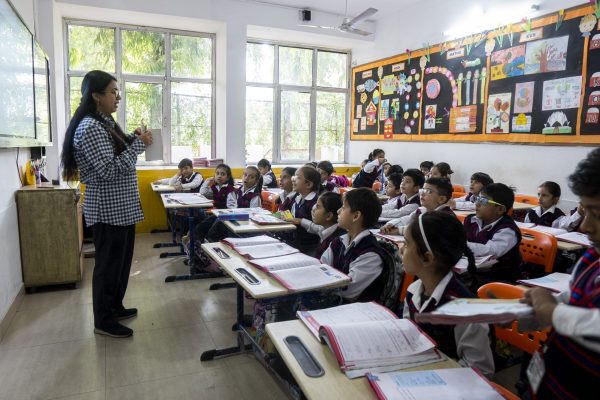
Step into a classroom at K-IIT World School, Pitampura and you're unlikely to find a teacher simply delivering content at the front of the room while students scribble furiously. The school's academic philosophy is rooted in enquiry-based learning — a methodology where students are encouraged to question, explore, and experiment before arriving at conclusions.
This might sound like a soft or idealistic approach, but it has concrete pedagogical mechanics behind it. When a child is trained to ask why and how before accepting an answer, something important happens to their brain's engagement with that material. The information stops being something received and starts being something discovered. That shift — from passive recipient to active investigator — is associated with significantly stronger retention, deeper conceptual understanding, and greater intellectual confidence.
How K-IIT World School Pitampura Builds Enquiry Into Every Classroom
The school reinforces this through interdisciplinary teaching that strengthens conceptual understanding across subject boundaries. Rather than teaching History, Science, and Literature as entirely unrelated disciplines, K-IIT's teachers are trained to draw connections — to show students how a historical period shaped a scientific development, or how a literary work reflects the values of its era. This kind of connected thinking builds the mental architecture that allows students to later approach complex, multi-dimensional problems with confidence.
Furthermore, the school's approach to assessment is aligned with the same philosophy. Evaluation at K-IIT focuses on feedback and improvement rather than using tests purely as ranking mechanisms. The regular assessment structure is designed to support ongoing learning — to identify where a student is struggling and adjust accordingly — rather than simply measure a snapshot performance at the end of a term. Among the best CBSE schools in Delhi that genuinely align their assessment philosophy with their teaching philosophy, K-IIT stands as a consistent example.
Reflective Learning: Journals, Wrap-Ups, and Self-Awareness
One of the most distinctive — and perhaps least expected — elements of K-IIT World School's teaching methodology is its emphasis on reflective learning. Students maintain journals where they record their reflections after each class. At the end of every week, structured "wrap-up of learning" sessions give students a dedicated opportunity to consolidate what they've understood, identify what remains unclear, and articulate their thinking in their own words.
This practice does several things simultaneously. It builds metacognitive skills — the ability to think about one's own thinking — which research consistently identifies as one of the strongest predictors of academic success. It also creates a habit of intellectual self-awareness that serves students well beyond school. A child who can accurately gauge their own understanding, who knows when they've grasped something and when they haven't, is a far more effective learner than one who simply relies on test results to find out.
Reflective Practice and K-IIT World School Pitampura's Teaching Methodology
Parents of students at K-IIT World School, Pitampura often note that their children seem more willing to discuss their school day in substantive terms — not just reporting what happened, but actually processing what they learned. This is a direct outcome of the reflective practice embedded in the school's teaching methodology. It's also worth noting that this emphasis on reflection aligns precisely with the National Education Policy 2020, which explicitly calls for reduced content load and deeper conceptual understanding. What's remarkable about K-IIT is that these values were embedded in its teaching approach long before NEP 2020 formalised them as national educational goals.
STEM, Coding, and the ATL Lab: Future-Ready Skills in the Classroom
Teaching methodology at K-IIT World School, Pitampura doesn't stop at philosophical frameworks. The school has made significant investments in ensuring that future-readiness is a practical, tangible experience for students. The Atal Tinkering Lab (ATL) on campus gives students direct access to coding, robotics, and innovation challenges from early grades onwards. This isn't a lab that sits unused most of the year — ATL Mega Tinkering Day events, workshop participation in Arduino training, and teacher-led STEM projects at district-level deliberations all point to a genuinely active culture of innovation.
Teachers at K-IIT actively participate in CBSE Capacity Building Programmes on topics including Artificial Intelligence, STEM education, and innovative pedagogy. Notably, educators from the school have presented research papers at the CBSE STEM DLD Workshop, focusing on the integration of Artificial Intelligence and Design Thinking in modern classrooms. Teachers have also attended the CII Delhi Education Summit at India Habitat Centre, exploring AI in learning, skill-based education, and the future of classrooms. This matters because teacher quality is arguably the most important determinant of student outcomes — and a school whose teachers are continuously learning, presenting research, and engaging with national academic forums is a school where the quality of instruction is unlikely to stagnate.
Differentiated Instruction: Teaching K-IIT World School Pitampura's Way for Every Learner
Alongside STEM integration, the school employs differentiated instruction to accommodate the full range of learning styles in any given classroom. Visual learners, auditory learners, and kinaesthetic learners all find pathways to engagement through art-integrated learning, technology-enabled classrooms, project-based approaches, and experiential learning opportunities. The school also provides specialised programmes for students with different learning needs, reflecting an inclusive educational philosophy. Among the best CBSE schools in North Delhi that have invested meaningfully in differentiated approaches, K-IIT's combination of framework (the Jaadui GRID), reflective practices, and technology infrastructure makes it a particularly well-rounded option.
Teacher Development: The Engine Behind the Methodology
A teaching methodology is only as good as the teachers who deliver it. K-IIT World School, Pitampura appears to take this seriously. The school has hosted a remarkable range of professional development programmes for its educators, spanning a breadth of domains that reflects the school's multi-dimensional educational philosophy.
A two-day workshop sponsored by the Royal Society of Chemistry, UK, under the Yusuf Hamied Professional Development Programme, focused on innovative teaching pedagogies aligned with NEP 2020, equipping teachers with active learning techniques and AI tools. A CBSE Capacity Building Programme on Psychology guided by expert resource persons strengthened pedagogy, emotional understanding, and inclusive teaching practices. Teachers participated in the NPSC Conference at India International Centre, themed around nurturing mental health and wellbeing in education. The school hosted a transformative two-day workshop with Dr. T. P. Sasikumar, a former Deputy Director at the PM Office, on unlocking human potential and futuristic approaches to learning. A Hindi language skills workshop drew 150 teachers from various Delhi schools to K-IIT's campus — positioning the school not just as a learner in professional development, but as a host and leader.
This breadth is significant. Schools that invest deeply in teacher development tend to produce classrooms that feel genuinely alive — where educators bring fresh perspectives, current research, and real enthusiasm to their work. When parents evaluate the best schools in Pitampura, teacher quality is often cited as the most difficult thing to assess from the outside. The depth and variety of K-IIT's professional development record offers one of the clearest available windows into the calibre of teaching parents can expect.
What This Means for Your Child
The teaching methodology at K-IIT World School, Pitampura is not a collection of buzzwords. It's a coherent, interconnected system: the Jaadui GRID provides the overarching framework; enquiry-based and interdisciplinary learning shapes daily classroom practice; reflective journals and wrap-up sessions build metacognitive habits; the ATL Lab and STEM integration develop future-ready skills; and a rigorous teacher development culture ensures the humans delivering the education are continuously growing alongside their students.
For parents searching for the best CBSE school in Pitampura — one where the quality of teaching goes beyond syllabus coverage — K-IIT World School offers something specific enough to evaluate and consistent enough to trust. The proof, ultimately, is in the results: over 40 students scoring above 90% every year, a school average consistently above 84%, and national Olympiad ranks within the top 100. Numbers like these don't emerge from classrooms where children are merely memorising facts. They come from an environment where children are genuinely learning how to learn.
To explore K-IIT World School's approach in person, visit the school's official website at www.kiitworld.in to learn more about their academic philosophy, faculty, and admissions process for the upcoming academic year.
Note: Blogs by Yellow Slate are written based on information, knowledge and perspective of the writer. While every caution has been taken to provide readers with accurate information, please use your discretion before taking any decisions based on the information in this blog. In case you find any information that is factually wrong or something that could be made better, please write to us at contact@yellowslate.com.
Curious about how we arrived at this list? We believe parents deserve full transparency on how schools are evaluated and selected. to understand our school selection methodology.


