Inclusive Education at NCFE CV Raman Nagar: How the School Was Built for Every Child
Most schools describe themselves as welcoming. Fewer have made the structural decisions that make that claim real. NCFE CV Raman Nagar has been clear on this point: inclusion at this school was never added later — it was part of the plan from the start. That sentence, drawn from the school's own communication, is worth sitting with. It signals a school that made deliberate architectural, pedagogical, and community decisions from its founding in 2006 to ensure that the full range of children — including those with special educational needs, different learning profiles, and different developmental timelines — could genuinely participate in school life rather than be accommodated at the margins of it.
Physical Accessibility: Ramps, Elevators, and a Campus Designed for All
The most immediate expression of NCFE CV Raman Nagar's inclusive design is the physical campus itself. The school's 7.5-acre campus at Malleshpalya is equipped with ramps and elevators across the school — not as a retrofitted accommodation but as integrated architectural features of the campus. For students with physical disabilities, mobility differences, or conditions that make stair navigation difficult, this infrastructure is the difference between a school that is theoretically accessible and one that is practically usable every single day.
This level of physical investment is uncommon among schools in the CV Raman Nagar, Indiranagar, and east Bangalore corridor. Most school campuses in this geography were designed without wheelchair accessibility as a primary consideration, and modifications — where they exist — are often limited and incomplete. At NCFE CV Raman Nagar, the ramps and elevators are present across the school — not just at the entrance — meaning a student with a mobility difference can move between classrooms, labs, the library, and activity spaces without assistance or barrier. That is what designed-in accessibility looks like, rather than accessibility added as an afterthought.
Supporting Children With Special Educational Needs
Beyond physical accessibility, NCFE CV Raman Nagar explicitly supports children with special educational needs. The school's stated inclusive culture welcomes students across a range of learning profiles — not just those who fit neatly into a single standardised academic model. This is a meaningful commitment in the context of Indian mainstream schooling, where students with learning differences are frequently advised to seek specialised institutions rather than integrated schools.
The NCFE curriculum framework — built around the 5C's of Communication, Collaboration, Critical Thinking, Creativity, and Citizenship — is designed to develop outcomes across a range of learning styles rather than optimising exclusively for examination performance. The four academic stages (Fledgling, Watering, Blossoming, Basking) progress students through experiential, inquiry-based, and transdisciplinary learning, which by design accommodates different paces of development and different strengths more naturally than a rigid lecture-and-test model. The AI-powered personalised learning system integrated into the curriculum further supports this: by adapting to individual student pace and learning style, it reduces the degree to which students with different profiles must simply keep up with a single class-wide pace.
A Curriculum That Doesn't Assume One Kind of Learner
Inclusion in the physical sense is only one dimension. The deeper question for parents of children with diverse learning needs is whether the school's academic model is genuinely flexible enough to serve their child without constantly forcing the child to meet the school. NCFE CV Raman Nagar's curriculum is built on active, hands-on, and personalised learning — linking STEM with the humanities, language with the arts, and classroom lessons with real-world experience. This integration, by its nature, creates more entry points for different kinds of intelligence and learning style than a purely didactic, single-subject approach.
The school's spacious, naturally lit classrooms are designed to promote a conducive learning atmosphere — an environmental consideration that directly benefits students who are sensitive to sensory overload or who require calm, well-regulated spaces to concentrate effectively. The library, with over 7,330 books, provides an independent learning resource that allows students who learn better through self-directed reading to pursue depth in their own time and at their own pace. The computer labs, equipped with high-speed internet, open digital pathways for students who engage more readily through technology-mediated learning. The co-scholastic programme — which includes pottery, robotics, calligraphy, karate, creative writing, and arts and crafts — creates multiple arenas in which students can experience competence and recognition outside the academic sphere, which is particularly important for students whose strengths are not captured by standard examinations.
Student-Led Initiatives and the Culture of Belonging
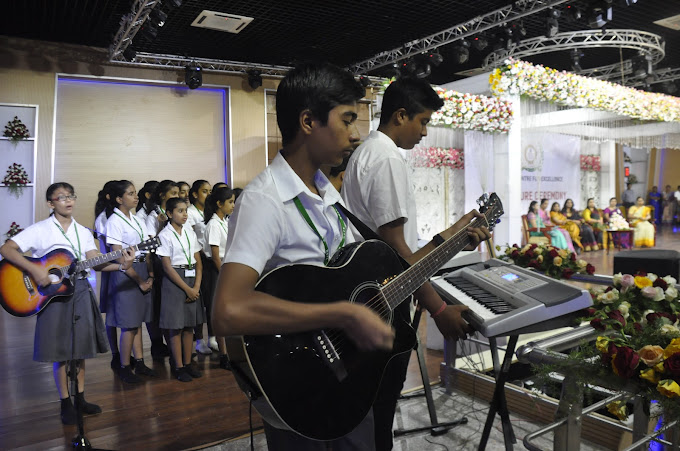
Inclusive education is ultimately a cultural question as much as a structural one. A school with ramps and elevators but a competitive, ranking-obsessed student culture can still be an unwelcoming environment for children who are different. What distinguishes NCFE CV Raman Nagar is the student-led culture that has developed over 20 years — a culture where students run the Blitz Cup Football Tournament, organise the Thinkering Fest, operate the Theater Club and Coding Club, and have introduced a student-initiated Smart Toilet project that reflects an instinct toward community care and problem-solving. This is not a school where a single definition of success dominates student identity. Students who are organisers, creative thinkers, athletes, coders, artists, and community contributors all find visible roles in the school community.
NCFE's own mission framing reinforces this: the school aims to develop active, empathetic, and lifelong learners who contribute to the larger community through a global mindset. Empathy is explicitly named — not as a soft aspiration, but as a core outcome that the school's culture is designed to build. For a child with special educational needs, or for a child whose learning profile is simply different from the majority, empathy in the school community is not a luxury — it is the condition that makes learning possible.

What This Means for Parents Considering NCFE CV Raman Nagar
For parents of children with special educational needs, physical disabilities, or diverse learning profiles who are evaluating schools in the CV Raman Nagar, Indiranagar, Marathahalli, and east Bangalore corridor, NCFE CV Raman Nagar offers a specific and verifiable set of commitments: ramps and elevators across the campus, an explicit inclusive culture, a personalised and multi-modal curriculum, AI-powered learning that adapts to individual pace, a co-scholastic programme that creates multiple pathways to competence, and a twenty-year school community that has developed around values of empathy and belonging.
For parents of children without any identified special needs, these features are also relevant — because an inclusive school is by definition a school that has thought carefully about the full range of human development rather than designing only for the most standard learner. That thought shows up across the curriculum, the campus, and the culture. Parents interested in visiting the campus to see this in person can connect through NCFE's official website or visit directly at 154/1, Vijay Kiran Knowledge Park, 5th Main, Malleshpalya, Bengaluru 560075.
Note: Blogs by Yellow Slate are written based on information, knowledge and perspective of the writer. While every caution has been taken to provide readers with accurate information, please use your discretion before taking any decisions based on the information in this blog. In case you find any information that is factually wrong or something that could be made better, please write to us at contact@yellowslate.com.
Curious about how we arrived at this list? We believe parents deserve full transparency on how schools are evaluated and selected. to understand our school selection methodology.


