Neural Education, Stem Education, and Why Vishwa Vidyapeeth Takshashila Actually Teaches Differently
Here's something that happens in almost every school-search conversation in Yelahanka, Vidyaranyapura, and Sahakar Nagar. Parents spend weeks combing through fee PDFs, transport routes, and school ranking lists — and then, usually over chai somewhere, one of them asks the question that actually matters: "Does this school actually know how to teach?"
Not "does it have air-conditioned classrooms" or "what's the rank list for Grade 10." The real question. The one about whether a child will walk out of there genuinely knowing something, or just trained to pass.
It's a harder question to answer than it looks. Most schools — across board affiliations, fee brackets, the works — run on essentially the same model: teacher explains, student copies, exam tests recall. It's been the standard format for generations. And generations of students have graduated from it not entirely sure what they actually learned.
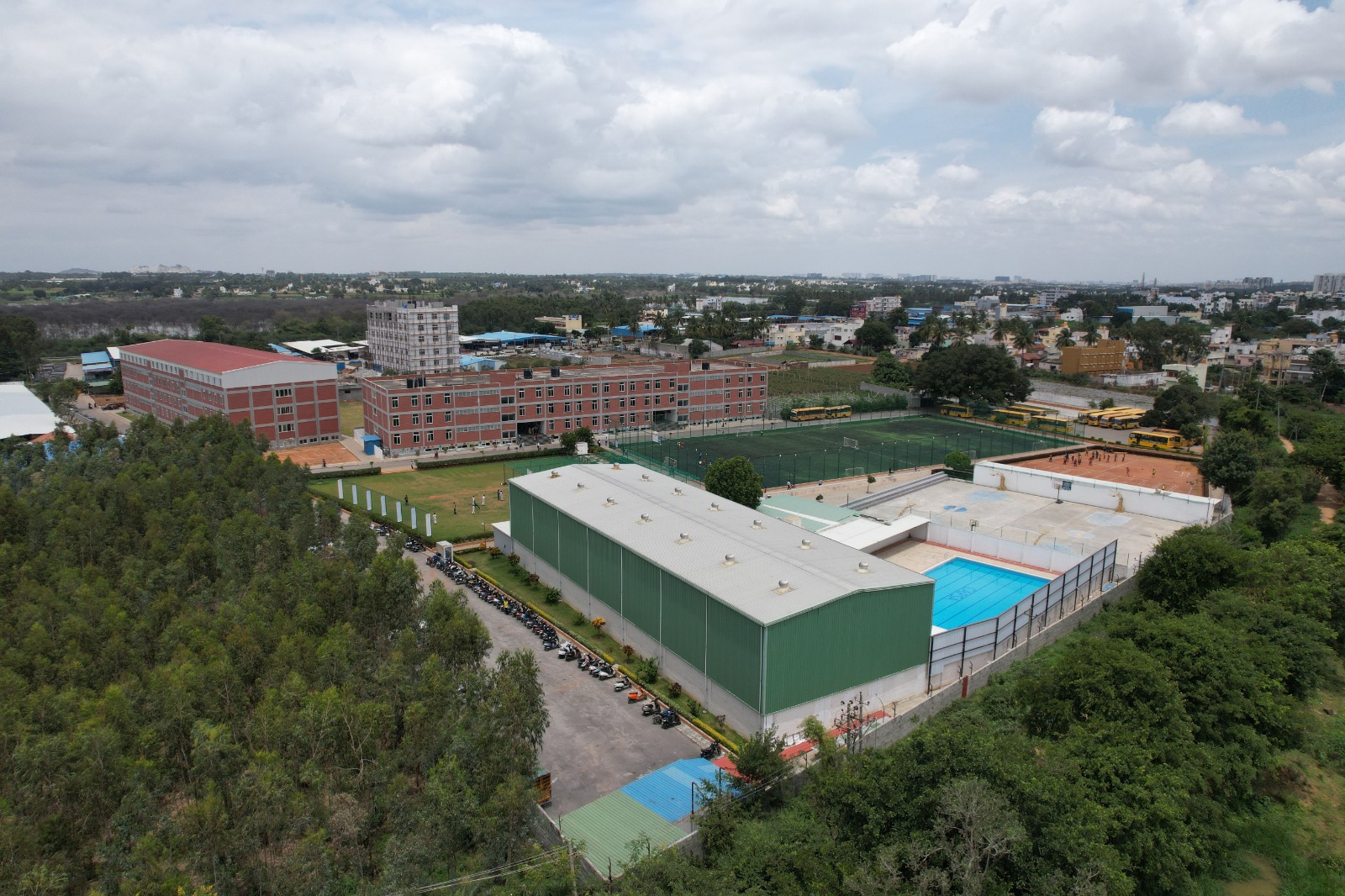
Vishwa Vidyapeeth Takshashila, sitting on 8 acres off Doddaballapura Road in Honnenahalli, Rajanukunte, has a different answer to that question. The school's ICSE campus opened in 2012; the CBSE campus came in 2018. In both cases, the design principle is the same: build classrooms around how children's brains actually work, not around how adults find it convenient to teach.
That's not a marketing line. It's a structural commitment — the kind with specific names, specific methods, and a specific institutional philosophy behind it. This post walks through what it actually means.
Let's Start With the Problem
Think about the last time you tried to recall something you "learned" in school. Something that was explained to you in a lecture, copied into a notebook, and tested on an exam. How much of it is actually there?
For most people, the answer is: not much. And that's not a memory problem. It's a teaching problem.
Neuroscientists have a term for the kind of learning that actually sticks — Long Term Potentiation. Building it requires active engagement, emotional connection, varied repetition, and practical application. A child who grows something in a garden, builds it in a carpentry lab, performs it on stage, or explains it to a classmate isn't just more engaged. They're encoding knowledge in a fundamentally different way. The retention is deeper. The application is more flexible.
The teaching philosophy at Vishwa Vidyapeeth Takshashila is built entirely around this. Not as an experiment. Not as a pilot. As the default, school-wide way of doing things.
Neural Education With CMM: The Part That Makes VVP Takshashila Genuinely Unusual
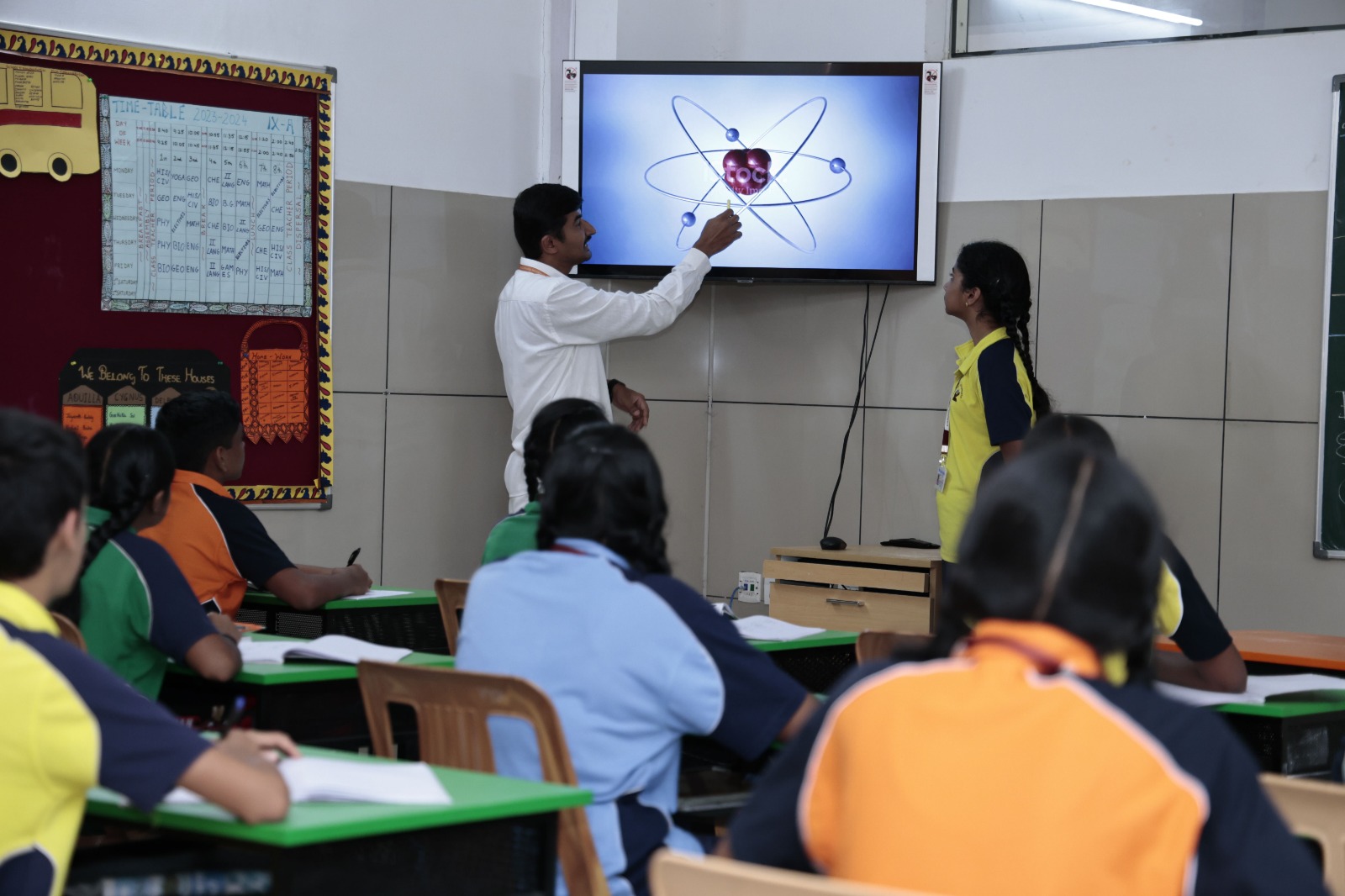
VVP Takshashila is, by its own account, among the first schools in India to formally incorporate neural science into its teaching-learning process. That claim deserves unpacking, because it's easy to slap the word "neuro" onto a school brochure and carry on as before.
At VVP Takshashila, Neural Methodology — CMM — isn't a subject on the timetable. It's the design framework for how every lesson is built: how teachers speak to students, how the classroom environment is constructed, how knowledge gets introduced, revisited, and applied. The architecture underneath everything.
In practical terms, it looks like this:
- Safe environment before content: Pressure and anxiety literally block the brain's ability to form new memories. So classrooms are designed to feel safe first — not soft, just not threatening.
- Long Term Potentiation over rote: Lessons engineer "aha" moments — connections between new material and what a child already knows — because that's the mechanism for durable memory, not repetition.
- Discovery over delivery: Trial and error is the point, not a failure state. Children who arrive at answers themselves are using their brains in a categorically different way than children who are told answers.
- Finding the strengths that grades don't find: Standard testing misses artistic intelligence, spatial reasoning, and kinaesthetic ability. Neural Education actively hunts for these and builds on them.
- Life-readiness as the actual target: The stated goal isn't exam performance. It's a cognitive capacity for adult life.
Neuroscience isn't a buzzword at VVP Takshashila. It's the reason a child comes home from school excited about what happened that day — rather than blank about it.
Six Ways VVP Takshashila Actually Delivers This
Neural Education is philosophy. The curriculum pedagogy at Vishwa Vidyapeeth Takshashila CBSE runs it through six interlocking teaching methods. They're worth understanding individually, because each one does something the others don't.
1. Experiential Learning
The principle is simple: a concept explained to a child is temporary. A concept lived by a child is not. Experiential Learning at VVP Takshashila means project work, field trips, lab experiments, community service, and internships for older students — not occasionally, but structurally.
Parents who visit the campus consistently remark on the activity in the classrooms: students building, testing, arguing, presenting. It looks different because it is different. What parents have said about this, in their own words, is worth reading before you visit.
2. Flipped Learning
In a conventional school: new content gets taught in class, practiced at home. VVP Takshashila inverts this. Students encounter new material before class — reading, watching, preparing. Class time becomes the space for higher-order work: analysis, debate, problem-solving, creative application.
What this builds, over time, is something that can't be manufactured: the habit of independent inquiry. A child who arrives at class having already wrestled with the material is a fundamentally different participant than one arriving cold.
3. Discovery Based Learning
Under the Discovery Based Learning model, teachers stop being the primary source of knowledge. They ask open questions, provide materials and provocations, and get out of the way. Students arrive at answers themselves.
This isn't just pedagogically sound — it's cognitively transformative. Knowledge you discover yourself is encoded more deeply than knowledge handed to you. And children who learn this way develop intellectual confidence: they trust their own thinking, rather than waiting for an adult to validate it.
4. Peer Learning
Students at Vishwa Vidyapeeth Takshashila regularly teach each other — not informally, but structurally. Explaining a concept, coaching a classmate, running a peer review. The school has tracked real, measurable improvement in student performance through this approach.
There's a reason it works. To clearly explain something, you first have to properly understand it yourself. The 'teaching' student deepens their mastery. The 'learning' student gets an explanation in their own language — frequently more accessible than an adult's framing. Both develop communication, leadership, and collaboration fluency.
5. Project Based Learning
Project Based Learning at VVP Takshashila isn't make-work. Students tackle genuine, complex challenges — research, analysis, decision-making, collaboration across roles, and a tangible output that matters beyond the classroom: a radio programme the whole school listens to, a proposal to a community stakeholder, a presentation with an actual audience.
The skills this develops — initiative, resilience, the ability to see something through from brief to delivery — are precisely the ones that exam prep doesn't reach.
6. Student-Led PTMs
At Vishwa Vidyapeeth Takshashila, Parent-Teacher Meetings are student-led. The child presents their own academic progress, names their own strengths and gaps, sets their own goals — with parents and teachers as the audience, not the narrators.
Think about what that requires: self-awareness, honesty, and the ability to articulate your own learning to adults who are invested in it. These are not skills you acquire by copying notes and sitting exams. They're skills you build by being repeatedly placed in situations that require them.
7. Arts Integration
Arts integration at VVP Takshashila is a formal pedagogical method — not an afternoon activity. Music, dance, drama, and visual arts are used as explicit tools to teach complex academic concepts across the curriculum. In practice, this extends through the school's co-scholastic programme:
- Theatre in Education — self-expression, empathy, confidence
- Music — brain development, literacy, mathematical thinking
- Dance — cognitive development, physical health, making learning genuinely fun
- Visual Arts — focus, discipline, creative and critical thinking
None of these are peripheral to the academic programme. They're woven through it. A week-long experiential tour to Leh and Ladakh for Grade 8 students brought this to life in a striking way — encountering Thangka paintings, ritual iconography, and monastic ceremony at Thiksey Monastery, then seeing what education looks like when it draws directly from the music, craft, and stories of the world around it at Ranchio School and SECMOL School. Students returned with a felt understanding of why art belongs at the centre of learning, not at its edges.
The S2S Partnership: H-Cube Learning in the STEM Classroom
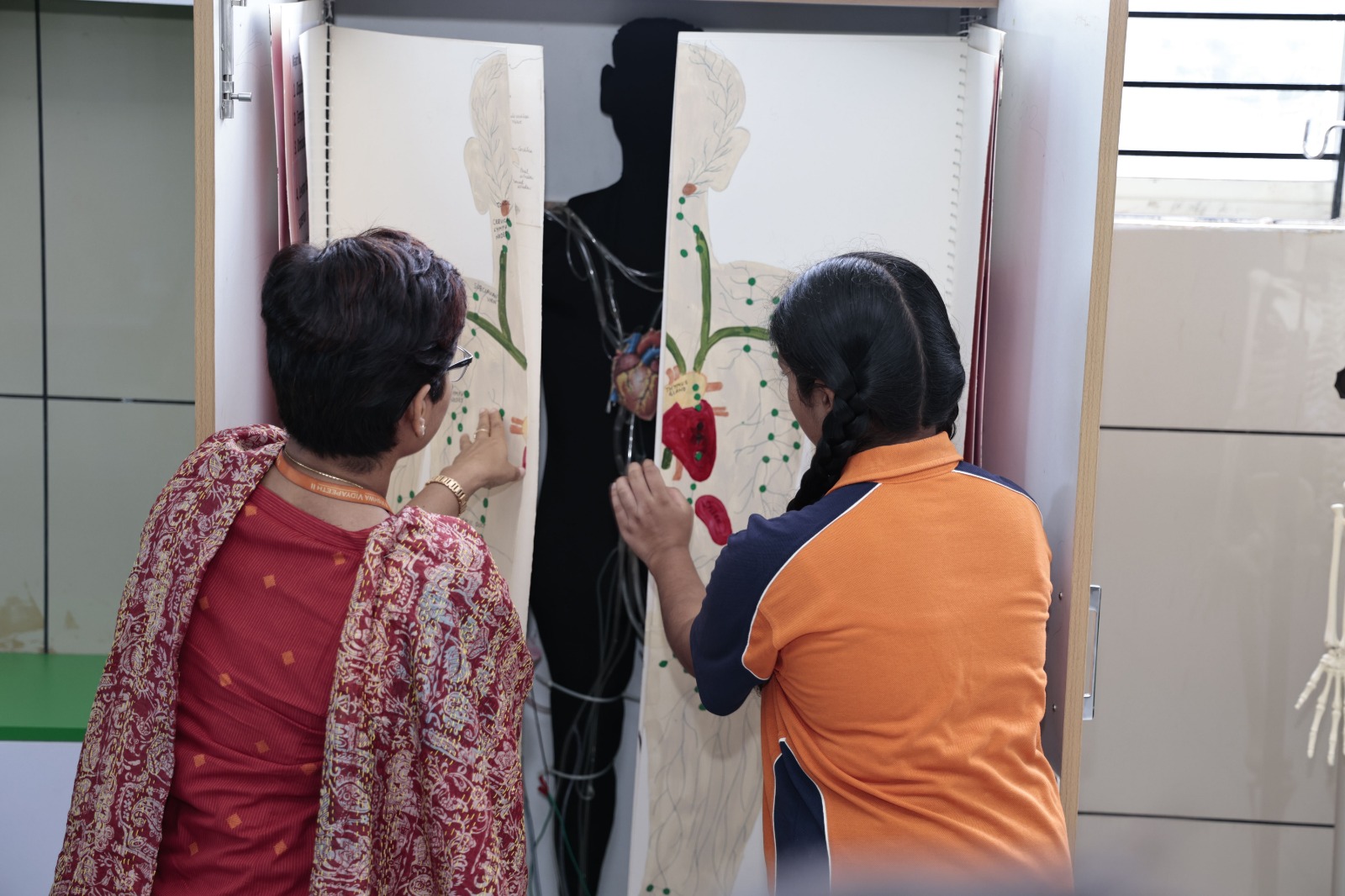
Alongside its own pedagogical framework, Vishwa Vidyapeeth Takshashila runs CBSE STEM education in collaboration with the Seed to Sapling (S2S) team. The methodology S2S brings is called H-Cube Learning, and it maps well onto the neural science principles the school already operates on.
Every S2S lesson moves through three phases:
| Phase | What Happens | Why It Works |
| Hearts-ON | Students are hooked with a real-world problem or observation from their own daily life — something they've seen, experienced, or wondered about. | Emotional engagement comes first. Curiosity is activated before content is introduced. The brain is primed and receptive. |
| Heads-ON | Open-ended questions encourage students to hypothesise and reason toward the concept themselves, with minimal teacher input. | Constructing knowledge actively — rather than receiving it — produces deeper, more durable retention. |
| Hands-ON | Students conduct exploratory activities, individually or in groups, that physically lead them to the solution. | Practical application cements understanding. Abstract ideas become tangible. The 'why' of a concept becomes obvious rather than theoretical. |
"Our objective is to create an enriched, joyful and experiential learning environment where a child enjoys and actively participates to become knowledge generator and not merely being knowledge consumer." — S2S Framework, as implemented at VVP Takshashila
Dasha Prabodha: Ten Skills. Before Age Ten. Every Child.
This is where Vishwa Vidyapeeth Takshashila moves past pedagogy into something more ambitious. Dasha Prabodha — 'dasha' meaning ten, 'prabodha' from Sanskrit meaning awakening — is a structured programme to develop ten specific life competencies in every student before the age of ten. Embedded into the regular curriculum, not bolted on as extras.
- Bhagavad Gita, Vedas and Upanishads — India's oldest philosophical traditions, taught as practical frameworks for a meaningful life, not as religious instruction.
- Organic Farming — hands-on food production that teaches biology, ecology, and a genuine respect for the people who grow what we eat.
- Clay Modelling — motor skills, planning, problem-solving, and plain old fun, through tactile work with clay.
- Woodwork — carpentry that develops hand-eye coordination, responsibility, and the satisfaction of making something real.
- Taekwondo — self-defence, yes, but also dedication, perseverance, and the discipline of a structured practice.
- Public Speaking — persuasion, confidence, and the ability to stand in front of people and say something worth hearing.
- Art Education — Indian art forms including Warli and Madhubani, building creativity and cultural literacy simultaneously.
- Music — mind-body coordination, emotional intelligence, literacy support, and the sheer joy of making sound.
- Cooking — self-dependence, mathematical thinking (measuring, timing, ratios), and social skills, in the school's kitchen lab.
- Theatre — self-esteem, emotional expression, and academic engagement, all through the discipline of performance.
A ten-year-old who can grow food, shape wood, cook a meal, argue a case, perform on stage, and recite the Gita is not the same person as a ten-year-old who has only practised exam technique. The difference will be visible for decades.
The Afternoons Matter Too: Co-Scholastic Life at VVP Takshashila
Roughly one-third to one-half of the day is deliberately given over to creative, physical, and experiential activity — and the school's position is that this isn't a break from learning. It is learning, in a different register. The infrastructure that supports all of this — the labs, the courts, the arts spaces — is worth seeing for yourself.
- Yoga — for every grade, as a tool for physical, mental, emotional, and spiritual balance.
- Music with Furtados School of Music — a professionally structured, internationally benchmarked curriculum: Keyboard for Grades 1–4, Keyboard or Guitar from Grade 5 to 8.
- Dance — classical, folk, and contemporary, including Dandiya, Yakshagana, Punjabi folk forms, and Kol-Attam.
- Pottery and Art — a dedicated Art Lab, properly equipped and used regularly.
- Carpentry and Skating — hands and bodies, not just minds.
- Quality Circle Time (QCT) — for primary years, structured sessions that build listening, communication, and community.
- Bhagavad Gita — recited and discussed at every grade level, as a foundation for ethical reasoning and inner strength.
The Advisory Board Is Not Decorative
One more thing worth knowing about Vishwa Vidyapeeth Takshashila, which most CBSE schools in Bangalore cannot say: its advisory board includes some of India's most genuinely distinguished figures in science and mathematics.
- Padma Bhushan Dr. Nambi Narayanan — the ISRO scientist whose story most of the country now knows.
- Padma Shri Prof. Sujatha Ramdorai — one of India's foremost mathematicians.
- Dr. Nithin Nagaraj — whose research spans nonlinear dynamics and information theory.
- Dr. Raghavendra Rao and Dr. D P Anantha — completing a board that has no vanity in it whatsoever.
More to the point: these aren't names on a letterhead. Students at VVP Takshashila have had on-campus interactions with Dr. Nambi Narayanan, space mission director Sri Subbiah Arunan, and others. Director Ms. Suseela Santhosh has been explicit about this — real exposure to extraordinary people is part of how the school shapes what children believe is possible for themselves.
The Philosophy Underneath Everything
All of this — Neural Education, S2S, Dasha Prabodha, student-led PTMs, the advisory board — flows from a specific institutional philosophy that Vishwa Vidyapeeth Takshashila holds across both its CBSE and ICSE programmes.
"Education is the manifestation of perfection already in man." — Swami Vivekananda
It's the school's vision statement, and it's not wallpaper. It means something specific: every child who walks through the gate already has everything they need. The school's job is not to fill them up with content. It's to draw out and develop what is already there.
The school runs on a 1:10 teacher-to-student ratio across a 2,500-student, 8-acre campus. That ratio isn't a sales figure — it's what makes the teaching methods work. Neural Education and Discovery Based Learning cannot function in rows of forty. The infrastructure and the pedagogy are designed around each other.
One word as the school's motto: Discipline. Not compliance. The Sanskrit sense — sustained, deliberate practice as the only real path to mastery. Which, when you think about it, is exactly what neuroscience says too.
Worth Visiting, If You're Looking
If you're a parent in Yelahanka New Town, Yelahanka Old Town, Vidyaranyapura, Sahakar Nagar, Malleshwaram, RT Nagar, or anywhere in the surrounding belt — and the question that's been nagging at you isn't "which school has the best rank list" but "which school actually knows how to teach" — then Vishwa Vidyapeeth Takshashila is worth putting on your shortlist.
CBSE and ICSE streams, Pre-Primary through Grade 12, on 8 acres at Honnenahalli, Rajanukunte. For more on the curriculum, facilities, and the admissions process, the Vishwa Vidyapeeth Takshashila CBSE website is the right place to start.
Note: Blogs by Yellow Slate are written based on information, knowledge and perspective of the writer. While every caution has been taken to provide readers with accurate information, please use your discretion before taking any decisions based on the information in this blog. In case you find any information that is factually wrong or something that could be made better, please write to us at contact@yellowslate.com.
Curious about how we arrived at this list? We believe parents deserve full transparency on how schools are evaluated and selected. to understand our school selection methodology.


