Teaching Methodologies at The Shri Ram Universal School Bangalore: Where Tradition Meets Innovation
When parents in North Bangalore search for schools that transcend conventional teaching approaches, The Shri Ram Universal School Bangalore stands out as a compelling choice. Located in the peaceful neighborhood of Chokkanahalli, this institution has redefined modern education by seamlessly blending time-tested pedagogical wisdom with innovative teaching methodologies. For families seeking the best CBSE schools in Bangalore that prioritize how children learn rather than just what they learn, understanding TSUS Bangalore's distinctive approach becomes essential.
Established in 2024 through a collaboration between Shri Educare Limited and Samagra Shikshana Samithi Trust, The Shri Ram Universal School Bangalore carries forward the prestigious legacy of The Shri Ram Schools that have consistently ranked among India's top educational institutions since 2008. Spread across 4.5 acres beside a tranquil lake, the campus embodies the school's educational philosophy—learning happens everywhere, not just within four walls. Moreover, with an annual fee structure ranging from ₹1,60,000 to ₹1,80,000 for grades Nursery through 8th, the institution positions itself as offering premium pedagogy at accessible prices.
The teaching methodologies at TSUS Bangalore represent a lived, breathing educational ecosystem where every classroom interaction, activity, and assessment is thoughtfully designed around one central belief: every child is inherently unique, possessing distinct abilities that deserve recognition and nurturing. Consequently, this comprehensive exploration delves into the specific teaching approaches that distinguish The Shri Ram Universal School Bangalore in the competitive educational landscape of Chokkanahalli and North Bangalore.
About The Shri Ram Universal School Bangalore: A Foundation Built on Excellence
The Shri Ram Universal School Bangalore embodies more than just another educational institution in the city's growing school landscape. It represents the continuation of a distinguished legacy that began with Sir Shri Ram, founder of prestigious institutions like Shri Ram College of Commerce and Lady Shri Ram College for Women. The school's establishment in 2024 brought the renowned pedagogical philosophy of The Shri Ram Schools from Delhi and Gurgaon to Karnataka, specifically tailored for North Bangalore families.
Operating under the management of Samagra Shikshana Samithi Trust—a foundation with strong credentials in Bangalore's higher education sector since 1997—TSUS Bangalore benefits from decades of educational expertise. The partnership with Shri Educare Limited ensures adherence to best teaching practices, methodologies, and value systems that have made The Shri Ram Schools consistently feature among India's premier institutions. Furthermore, this collaborative approach brings both legacy and innovation to Bangalore's educational ecosystem.
The school currently serves students from Nursery through Grade 8, with planned expansion aligned with student progression. The 4.5-acre campus in Chokkanahalli, situated near Thanisandra Main Road and approximately one kilometer from Bhartiya City, provides a peaceful lakeside setting away from urban chaos. This strategic location reinforces the institution's commitment to creating an environment where learning feels natural, unhurried, and connected to nature.
Central to TSUS Bangalore's identity is its commitment to what the institution calls a "value-driven approach in a global setting." The school views academic achievement and character development as interconnected dimensions of education rather than separate pursuits. Therefore, the teaching methodologies consistently integrate values, ethics, and cultural awareness alongside intellectual development. The institution proudly embraces its role in "nurturing and stabilizing the 'Happiness Quotient' in every child," positioning itself as a "Happy School" where joy and learning coexist harmoniously.
The school's architectural design follows the BALA (Building as a Learning Aid) principle, meaning every physical aspect—from classroom layouts to open spaces—serves educational purposes. This thoughtful approach extends to maintaining optimal student-teacher ratios that enable personalized attention, ensuring innovative teaching methodologies can be implemented effectively with each individual learner. Ultimately, TSUS Bangalore aims to prepare children not just for examinations but for "the world of today as well as that of tomorrow."
Child-Centric Philosophy: The Foundation of All Teaching
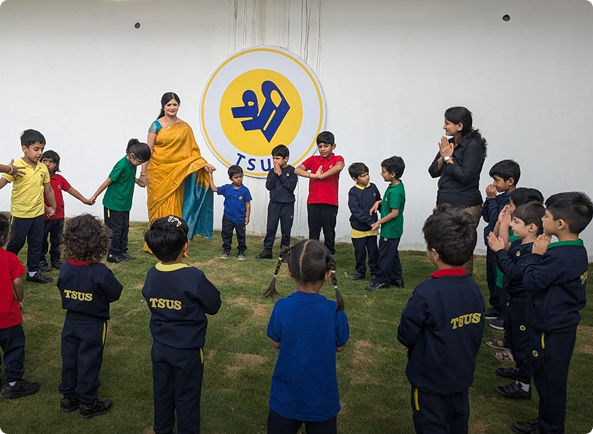
Understanding the teaching methodologies at The Shri Ram Universal School Bangalore requires first grasping the philosophical framework underpinning every pedagogical decision. The institution operates on a fundamental premise: recognizing the individuality and uniqueness of each child. This isn't merely a tagline but a principle actively shaping classroom dynamics, curriculum design, assessment methods, and teacher training.
The child-centric approach at TSUS Bangalore acknowledges that children possess different learning styles, paces, and strengths. Consequently, teachers are trained to recognize and accommodate visual, auditory, kinesthetic, and tactile learners within the same classroom environment. Rather than forcing all students through a single instructional method, educators adapt teaching to meet diverse needs. For instance, a mathematics concept might be introduced through visual diagrams for some students, physical manipulatives for kinesthetic learners, and rhythmic patterns for auditory learners—all within the same lesson.
Moreover, this philosophy extends beyond academic instruction to encompass emotional, physical, social, and intellectual well-being. The school recognizes that a child struggling emotionally cannot fully engage academically, and a child lacking physical activity cannot sustain mental focus. Therefore, the teaching methodologies deliberately integrate socio-emotional skills, physical development, and intellectual growth rather than treating them as separate domains. This holistic integration ensures students develop as complete individuals rather than merely as repositories of information.
Experiential Learning: Education Through Direct Experience
Perhaps the most distinctive teaching methodology at The Shri Ram Universal School Bangalore is its unwavering commitment to experiential learning. The institution fundamentally rejects textbook-driven, passive learning models where students merely listen, memorize, and reproduce information. Instead, the entire campus functions as an immersive learning laboratory where concepts come alive through direct experience, exploration, and discovery.
Experiential learning at TSUS Bangalore means students actively engage with content through hands-on activities, real-world applications, and multisensory experiences. For example, rather than simply reading about photosynthesis in a textbook, students plant seeds, observe growth patterns over weeks, measure variables, document changes, and draw conclusions from their observations. This direct engagement transforms abstract concepts into concrete understanding that students retain far longer than memorized facts.
The school's 4.5-acre campus provides abundant spaces for experiential learning. Outdoor areas aren't merely playgrounds but extension classrooms where geography comes alive through nature walks, mathematics manifests in measuring distances and calculating areas, and environmental science emerges through observing ecosystems. Additionally, the lakeside location offers unique opportunities for studying aquatic life, understanding water cycles, and exploring biodiversity—all through direct observation rather than secondhand descriptions.
Indoor experiential learning happens through specialized spaces called "Think Labs" and "Wonder Time" sessions. These dedicated periods allow students to explore topics that intrigue them, conduct experiments, build projects, and collaborate on creative solutions. Teachers act as facilitators rather than lecturers during these sessions, guiding inquiry without dictating outcomes. Consequently, students develop critical thinking skills, learn to ask meaningful questions, and discover that knowledge creation is an active process they can participate in.
For Pre-Primary students (Nursery through UKG), experiential learning manifests through play-based activities. Children engage in dramatic play, sensorial learning activities, art exploration, and discovery hours that build foundational skills while honoring their natural inclination toward play. Free play—both structured and unstructured, indoor and outdoor—forms a substantial portion of the early years curriculum, recognizing that play is children's primary mode of learning.
For Primary students (Grades I through V), experiential learning becomes more structured while remaining hands-on. Drama and storytelling bring literature alive, making characters and narratives memorable. Music integration helps students understand patterns, sequences, and cultural expressions. Wide-ranging artistic and hands-on activities ensure every subject connects to tangible experiences rather than remaining theoretical.
Activity-Based and Inquiry-Based Learning: Engagement Through Action and Questions
Closely related to experiential learning, activity-based learning represents another cornerstone methodology at TSUS Bangalore. Classroom time is rarely dominated by teacher lectures. Instead, students spend substantial portions of lessons working individually, in pairs, or in small groups on tasks requiring application of concepts rather than passive reception of information. For instance, a mathematics lesson on fractions might involve physically dividing objects, creating visual representations, solving real-world problems, and playing games that reinforce fractional thinking.
The institution's teaching methodology deliberately incorporates multiple activity types to maintain engagement and accommodate different learning preferences. These include role plays where students embody concepts or historical figures, projects allowing extended exploration of topics, presentations providing opportunities to articulate understanding, and collaborative activities teaching teamwork alongside academic content.
Furthermore, TSUS Bangalore places significant emphasis on inquiry-based learning, particularly as students progress through primary and into middle school years. This methodology transforms students from passive recipients of knowledge into active investigators who formulate questions, seek answers, evaluate information, and construct understanding through guided exploration.
Inquiry-based learning begins with helping students develop questioning skills. Teachers model how to ask meaningful, open-ended questions that lead to investigation rather than simple factual recall. Classroom discussions often begin not with teacher presentations but with student wonderings about topics, which then shape the direction of learning. Students might investigate why certain materials float while others sink, examine primary source documents about historical events, or explore patterns in number sequences—always formulating hypotheses, testing theories, and drawing evidence-based conclusions.
Collaborative Learning and Differentiated Instruction: Meeting Individual and Social Needs
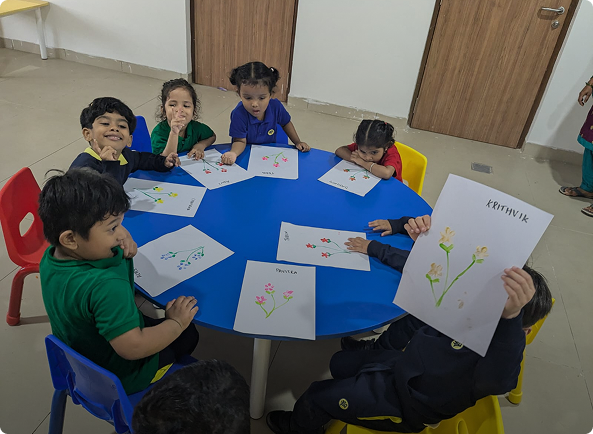
Recognizing that learning is fundamentally a social process, The Shri Ram Universal School Bangalore incorporates collaborative and peer learning extensively. Rather than viewing education as an individual pursuit where students compete, the school fosters a collaborative culture where students learn from and with each other, developing both academic and social competencies simultaneously.
Collaborative learning structures classroom activities around group work where students with diverse abilities, perspectives, and strengths work together toward common goals. Teachers assign roles, rotate responsibilities, and assess both group products and individual contributions, ensuring collaboration benefits everyone involved. Students develop communication skills, empathy, leadership abilities, and conflict resolution capabilities through these structured collaborative experiences.
Additionally, the teaching methodology embraces differentiated instruction—tailoring content, process, and products to individual student needs. Rather than delivering identical instruction to all students and expecting uniform outcomes, teachers at TSUS Bangalore modify approaches based on students' readiness levels, interests, and learning profiles. Those who grasp concepts quickly receive enrichment activities that deepen understanding, while students needing additional time receive targeted instruction with modified explanations and scaffolded practice.
The school's favorable student-teacher ratio supports differentiated instruction by making individualized attention feasible. With manageable class sizes, teachers can monitor individual progress, provide targeted feedback, adjust instruction responsively, and build relationships with each student. This personal connection enables teachers to understand students as individuals rather than generic learners, making differentiation more effective.
Technology Integration: Digital Tools Enhancing Learning
The Shri Ram Universal School Bangalore recognizes that technology plays an imperative role in modern education and has thoughtfully integrated digital tools into its teaching methodology. However, the integration is purposeful rather than using technology for its own sake. Digital tools supplement and complement conceptual understanding, ensuring technology enhances learning rather than distracts from it.
Technology integration begins with infrastructure that makes digital learning accessible. Google Enabled Classrooms throughout the campus provide students and teachers with access to digital resources, collaborative tools, and interactive content. These smart classrooms feature modern educational technology that makes learning more engaging and interactive. Air-conditioned classrooms with technological tools create comfortable environments where students can focus.
The teaching methodology uses technology to reach every learner, recognizing that digital tools can accommodate diverse learning needs effectively. Visual learners benefit from videos and animations, auditory learners access recordings and audio explanations, and kinesthetic learners engage with simulations where they manipulate variables and observe results. Technology enables differentiation at a scale impossible with traditional methods alone.
However, TSUS Bangalore maintains balance in technology use, recognizing that fundamental skills like handwriting, mental mathematics, and face-to-face communication remain important. The teaching methodology integrates technology strategically—using it when it offers clear advantages while maintaining hands-on experiences and human interactions equally crucial for development.
Assessment for Learning and Teacher Development: Supporting Growth
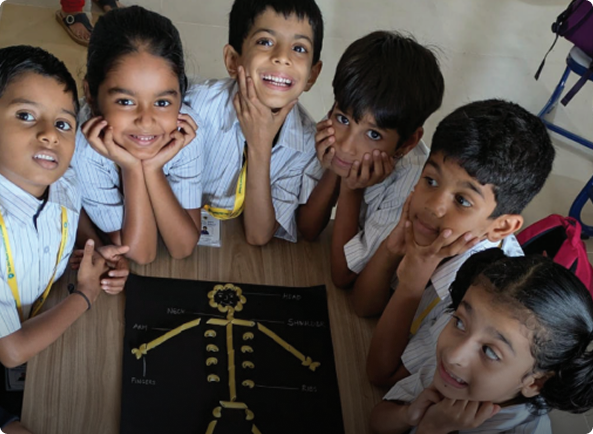
The teaching methodology at TSUS Bangalore recognizes that assessment serves learning rather than merely measuring it. The institution follows a school-based Continuous and Comprehensive Evaluation (CCE) system aligned with CBSE requirements but implemented in ways that prioritize student growth, provide actionable feedback, and reduce examination stress.
Continuous assessment means evaluation happens regularly throughout learning rather than only at term conclusions. Teachers gather evidence of understanding daily through observations, discussions, work quality, and problem-solving approaches. Comprehensive assessment evaluates multiple dimensions—intellectual, physical, social, and emotional development—recognizing education encompasses far more than test scores.
Feedback at the school is timely, specific, and actionable rather than simply summative grades. Teachers provide descriptive comments explaining strengths, improvement areas, and specific strategies for growth. This specificity guides improvement rather than merely praising or criticizing.
Supporting these sophisticated methodologies, TSUS Bangalore invests substantially in teacher professional development through comprehensive Teacher Enrichment Programs, Faculty Development Programs, and regular seminars. These initiatives ensure faculty stay current with evolving educational research, refine pedagogical skills, and continually improve practice. Teachers participate in subject-specific training and general pedagogical seminars addressing teaching strategies, classroom management, assessment practices, and child development.
Conclusion: A Holistic, Child-Centered Approach to Education
The teaching methodologies at The Shri Ram Universal School Bangalore represent a comprehensive, thoughtfully designed approach that places children at the center of all educational decisions. Through experiential learning that engages students directly with concepts, activity-based and inquiry-based approaches that make learning active rather than passive, collaborative structures that develop social alongside academic competencies, differentiated instruction that honors individual differences, and purposeful technology integration that enhances rather than replaces fundamental teaching, TSUS Bangalore has created an educational ecosystem aligned with how children naturally learn.
These methodologies aren't merely theoretical constructs mentioned in promotional materials but lived practices evident in daily classroom experiences. Furthermore, they're supported by ongoing teacher development, appropriate infrastructure, and an institutional commitment to prioritizing learning quality over examination scores. For parents in Chokkanahalli, North Bangalore, and surrounding areas seeking schools where teaching methodologies reflect current educational research and honor children's uniqueness, The Shri Ram Universal School Bangalore offers a compelling option.
The institution's emphasis on creating a "Happy School" where the "Happiness Quotient" is nurtured alongside academic achievement reflects an understanding that successful education produces not just knowledgeable students but well-rounded, confident, capable individuals prepared for the complexities of modern life. Through its distinctive teaching methodologies, TSUS Bangalore is building a legacy in Bangalore education—one where tradition and innovation, academic rigor and joy, individual growth and community, all coexist harmoniously.
Note: Blogs by Yellow Slate are written based on information, knowledge and perspective of the writer. While every caution has been taken to provide readers with accurate information, please use your discretion before taking any decisions based on the information in this blog. In case you find any information that is factually wrong or something that could be made better, please write to us at contact@yellowslate.com.
Curious about how we arrived at this list? We believe parents deserve full transparency on how schools are evaluated and selected. to understand our school selection methodology.


