The Vision Behind Vishwa Vidyapeeth Takshashila School: 13 Years, Two Boards, and a Mission That Has Not Changed
Most schools have a vision statement. It appears in the prospectus, on the homepage banner, perhaps on a painted wall near the entrance. At most institutions it functions as wallpaper — aspirational language that bears little relationship to what actually happens in classrooms.
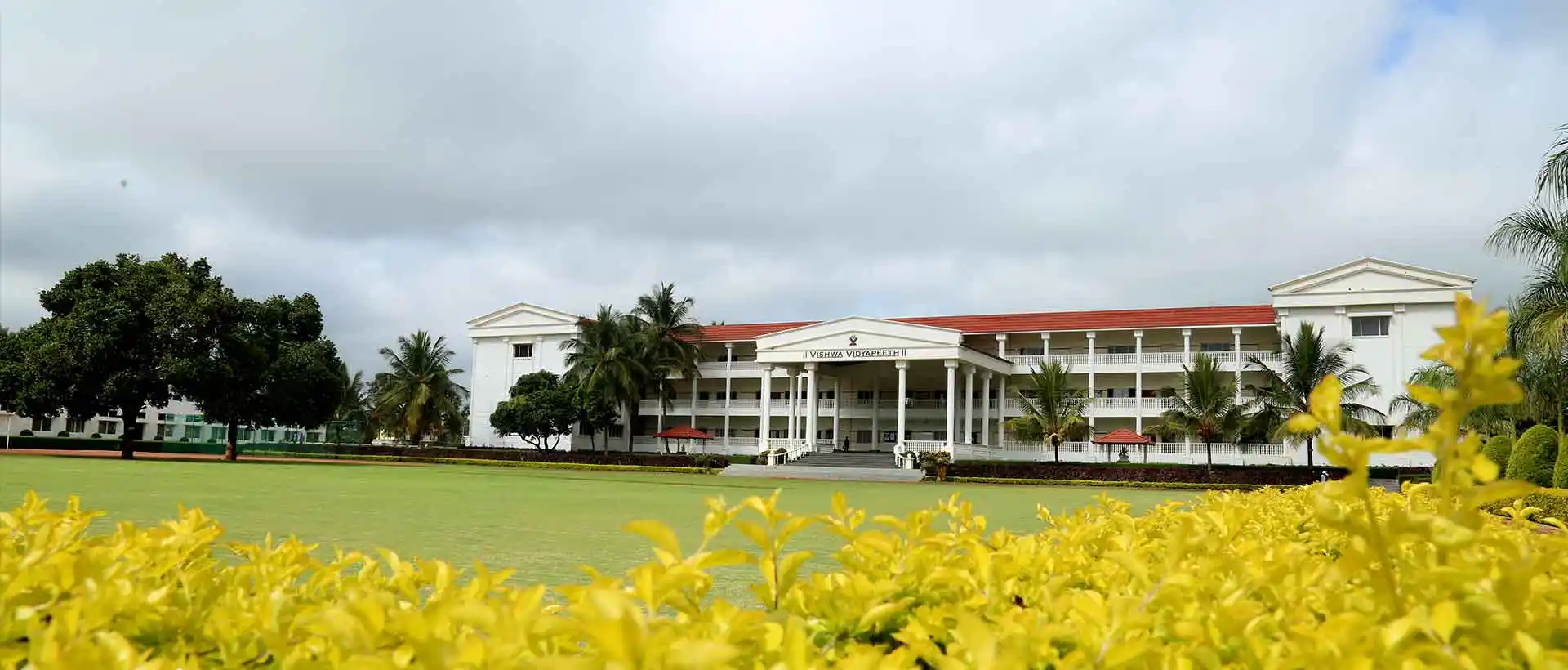
What makes Vishwa Vidyapeeth Takshashila School, Yelahanka worth a closer look is the degree to which its founding philosophy has not just been stated but actively built — year by year, programme by programme, decision by decision — over thirteen years. The school that opened in Yelahanka on 1st June 2012 with a single board and classes from Playgroup to Grade 5 is, in 2025, one of the few campuses in North Bangalore offering both ICSE and CBSE under the same roof, with 2,500 students, 250 teachers, and a catalogue of institutional innovations that reads like a deliberate response to everything conventional schooling gets wrong. And the philosophical thread connecting the first day of school in 2012 to the present is still the same one it started with.
This is the story of where that philosophy came from, who built it, and what it actually means for children studying at Vishwa Vidyapeeth Takshashila School Yelahanka today.
The Name, the Trust, and the Foundation
Before understanding the school, it helps to understand the name. Vishwa means Universe. Vidya means Education. Peeth means sacred place. Together, the name positions itself not as a building or a business but as something more ancient — a revered place of learning in the tradition of India's great centres of knowledge. The colour chosen for the school's identity is terracotta, the colour of Mother Earth, associated with healing, sacrifice, and bravery. The logo's three ascending steps represent the journey toward that sacred place. Even the visual identity was chosen with intention.
Vishwa Vidyapeeth Group of Schools was founded on 29th October 2011 in the fond memory of Late Smt. Chandramma and Late Sri Y. Subba Raju — two people described as noble souls whose memory the institution was created to honour. The vehicle for this founding was C S Education Trust, a not-for-profit charitable trust. The trustees are a dedicated group of professionals from diverse backgrounds, all committed to imparting education of the highest standard while keeping intact Indian values. That combination — the highest academic standards and the deepest cultural roots — is not an accidental pairing. It is the central tension that every decision at Vishwa Vidyapeeth Takshashila School has been made to resolve.
The Trust's guiding philosophy is explicit: to impart education to students from all walks of life, to create a bond between academic and non-academic employees, and to build a close-knit student community oriented toward all-round development and successful citizenship. The school's motto — Discipline — is not a slogan. It was the primary motivation for starting the school at all. In the Trust's own words, they felt the need to start a school not merely to educate children but to inculcate discipline as the core in everyone's life.
Ms. Suseela Santhosh: The Director Who Built It
Any serious understanding of Vishwa Vidyapeeth Takshashila School requires understanding its Director, Ms. Suseela Santhosh, because the school's philosophy and her personal journey are not separable.
Born in 1978, Ms. Suseela Santhosh grew up in a joint family where both parents were teachers. She was, from childhood, immersed in the world of education — sitting with her parents as they graded papers, watching how they prepared their lessons. Resources were limited, but she performed well academically and was an active participant in interschool and intercollegiate dance competitions. She was not someone insulated from difficulty, and this would later shape her conviction that every child, regardless of background, deserves genuine, individualised attention.
The trajectory of her professional life before education is significant and unusual. Ms. Suseela Santhosh trained and worked as a nurse — completing a B.Sc. in Nursing from Oxford College of Nursing and spending eleven years in the health profession. It was in nursing that she developed a worldview that would eventually define the school she built: she realised that this profession looks beyond treating individuals to rehabilitating them — providing the mental and physical support needed to get back into life. The shift from nursing to education in 2010 was not a career change so much as a deepening of the same commitment. She came to believe that for genuine change to happen in a person's life, childhood is the critical intervention point.
She joined hands with C S Education Trust when it was floated in 2011 and was instrumental in conceptualising, articulating, and implementing the Guru-Shishya Parampara as the pedagogical and cultural backbone of the school. She took over as Director in 2014. What followed was a decade of institutional building that earned VVP recognition as the No. 1 ICSE School in India under the parameters of Holistic Education, Individual Attention, and Value for Money — and that eventually attracted an invitation from the Government of China to promote educational and cultural exchange, making VVP one of just four schools in India selected for that collaboration.
Her philosophy, distilled to its simplest form, is this: at the very core of our humanity is our care for one another. This is not abstract sentiment. It is the rationale behind Mother on Duty, behind Home Visits by teachers, behind the decision from day one to run an in-house kitchen providing hot and wholesome vegetarian meals for every student and every staff member — a detail that signals something important about how the school thinks about its responsibilities to the people inside it.
The Vision and Mission: What They Actually Mean at Takshashila
The vision of Vishwa Vidyapeeth Takshashila School, Yelahanka draws directly from Swami Vivekananda: 'Education is the manifestation of perfection already in man.' The school's interpretation of this is precise and non-negotiable. Every child has the potential to reach this perfection — provided they have the right motivation and guidance. The aim is to provide holistic stimulus to each child to develop every aspect of their potential: intellectual, physical, emotional, social, ethical, artistic, and cultural.
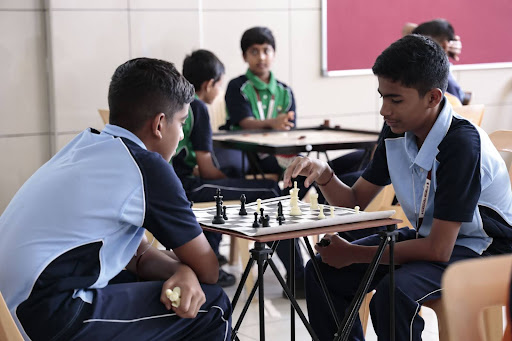
This is not a selective list. The school is specific that all seven dimensions matter, and the school's programme architecture is designed to address each of them concretely. Intellectual development comes through Neural Education and the Seed to Sapling STEM partnership. Physical development comes through 15+ sports with genuinely international-standard facilities. Emotional development is addressed through the Jeevana Kaushalya life skills programme, the Dasha Prabodha ten-skill curriculum, and a classroom culture built on the Guru-Shishya tradition. Social development through community service programmes, VVPMUN, and the Annadata Sukhibhava initiative. Ethical development through Bhagavad Gita classes embedded in the timetable from Pre-Primary to Grade 12. Artistic development through Bharatiya Kala Vaibhava and the dedicated arts programmes in Dasha Prabodha, including specifically Indian art forms like Warli and Madhubani. Cultural development through Sanskrit for all, the Ganitha Mela mathematics festival, and the school's deliberate aspiration to create global citizens with a strong Indian core.
The mission sits alongside the vision and is more operational in character: to provide a well-rounded curriculum, facilities and an environment that empower both the learner and the educator to reach their maximum potential. The inclusion of the educator is deliberate. VVP's belief is that no child should waste a single day of learning due to a lack of enthusiasm from teaching staff — and the school invests in its teachers accordingly, including the distinctive Sanskrit language programme for educators that began in Academic Year 2021-22, running on alternate Fridays and Saturdays to ensure teachers are themselves fluent in the cultural heritage they are conveying to students.
For families from Yelahanka Old Town, Yelahanka New Town, Vidyaranyapura, Sahakar Nagar, Attur Layout, Amruthahalli, Thanisandra, Jalahalli, Malleshwaram, and R T Nagar who are evaluating the best ICSE schools in Yelahanka Bangalore or the best CBSE schools near Doddaballapur Road Bangalore, these are not marketing claims. They are commitments that are tested and renewed with every academic year.
A Thirteen-Year Journey: How the Takshashila Campus Grew
The Takshashila campus has a documented history that is worth tracing, because it shows how the school's philosophy has been expressed in concrete decisions over time — not merely stated and then abandoned when difficult.
The school opened on 1st June 2012 with the ICSE curriculum, classes from Playgroup to Grade 5, and from day one the in-house kitchen and dining facility that would remain a constant across the entire group. In 2013-14, the school fixed a lower cap on class strength to improve quality — choosing to limit scale rather than compromise on individual attention. Yoga, Skating, and Indoor Games were introduced that same year. The first annual day, Vishwa Tarang, was celebrated.
By 2015-16, VVP students were already participating in social service — Swachh Bharat Abhiyan and Street Mime for Traffic Awareness — reflecting the school's belief that civic responsibility is not something learned in a classroom but practised from an early age. In 2016-17, the Mother on Duty programme was launched, along with the first international student tour to NASA and other institutions in the United States.
The launch of the CBSE curriculum in 2018-19, along with Permanent Affiliation for ICSE and ISC through to Grade 12, and the launch of the new campus at Honnenahalli — the Takshashila campus — represented the most significant structural expansion in the school's history. In that same year, VVP was awarded No. 1 ICSE School in India for Individual Attention to Students and Value for Money for the second consecutive year.
The years that followed brought further milestones. The first VVPMUN in 2019-20. The launch of the Eco-Friendly Self-Sustainable Campus in 2020-21, including Organic Farming, Zero Waste Management, Rainwater Management, Grey Water Farming, Dry Leaf Composting, and Mulch Gardening — a cluster of sustainability commitments that predated most schools' awareness of these issues. Dasha Prabodha in 2021-22, and with it the formal Sanskrit programme for teachers. The Annadata Sukhibhava community feeding initiative in 2022-23, in which raw materials collected from students every fortnight are cooked and served to those in need by students, parents, and staff together.
In 2022-23, VVP was awarded Most Innovative School with Academic Excellence in Bangalore by Asia Today, Most Innovative School with Quality Education in Karnataka by Top Notch Foundation, Top Star Rated School of India by CED Foundation, and was ranked No. 2 in India and No. 1 in Karnataka and Bangalore for High Happiness Quotient Schools by the Education World Special Jury panel. This last recognition — for happiness — is perhaps the most telling. A school built to help students enjoy their journey of learning has, over thirteen years, produced evidence that they do.
The Gnanavatika experiential learning programme launched in 2023-24, blending ancient Gurukul values with modern education through structured real-world experiences. Bharatiya Kala Vaibhava brought India's cultural heritage — classical arts, traditional dances, music, regional customs — into a grand campus-wide celebration that same year. The Nambi Antariksha Kalakshetra space lab, inaugurated by Dr. Nambi Narayanan himself, opened at the Magadha campus in 2024-25. And in 2025-26, the NCC 40 KAR Battalion was launched at VVP, adding a formal framework for discipline, patriotism, and national service — and the Anantha Plate Bank, inaugurated in collaboration with Adamya Chetana, became the first initiative of its kind by any school in India.
The Advisory Board: Who Guides the Academic Vision
The intellectual seriousness of Vishwa Vidyapeeth Takshashila School, Yelahanka is reflected in the calibre of its Advisory Board. Padma Bhushan Dr. Nambi Narayanan, the celebrated ISRO space scientist, serves on the board — and his connection to the school is not merely ceremonial. He personally inaugurated the Nambi Antariksha Kalakshetra space lab, and students have had the opportunity to meet him on campus. Padma Shri Prof. Sujatha Ramdorai, one of India's most distinguished mathematicians, is also on the board — a direct connection to the school's investment in mathematics education through the Ganitha Mela and the Madhava Ganitha Kalakshetra Math Lab. The advisory board also includes Dr. D P Anantha, Dr. Nithin Nagaraj, Dr. Raghavendra Rao, and Shri Basavaraj Umarani.
These are people whose presence signals something about the school's ambitions — not for rankings or examination results, but for the kind of curiosity, rigour, and cultural depth that produces the next generation of scientists, scholars, artists, and citizens.
Two Boards, One Philosophy
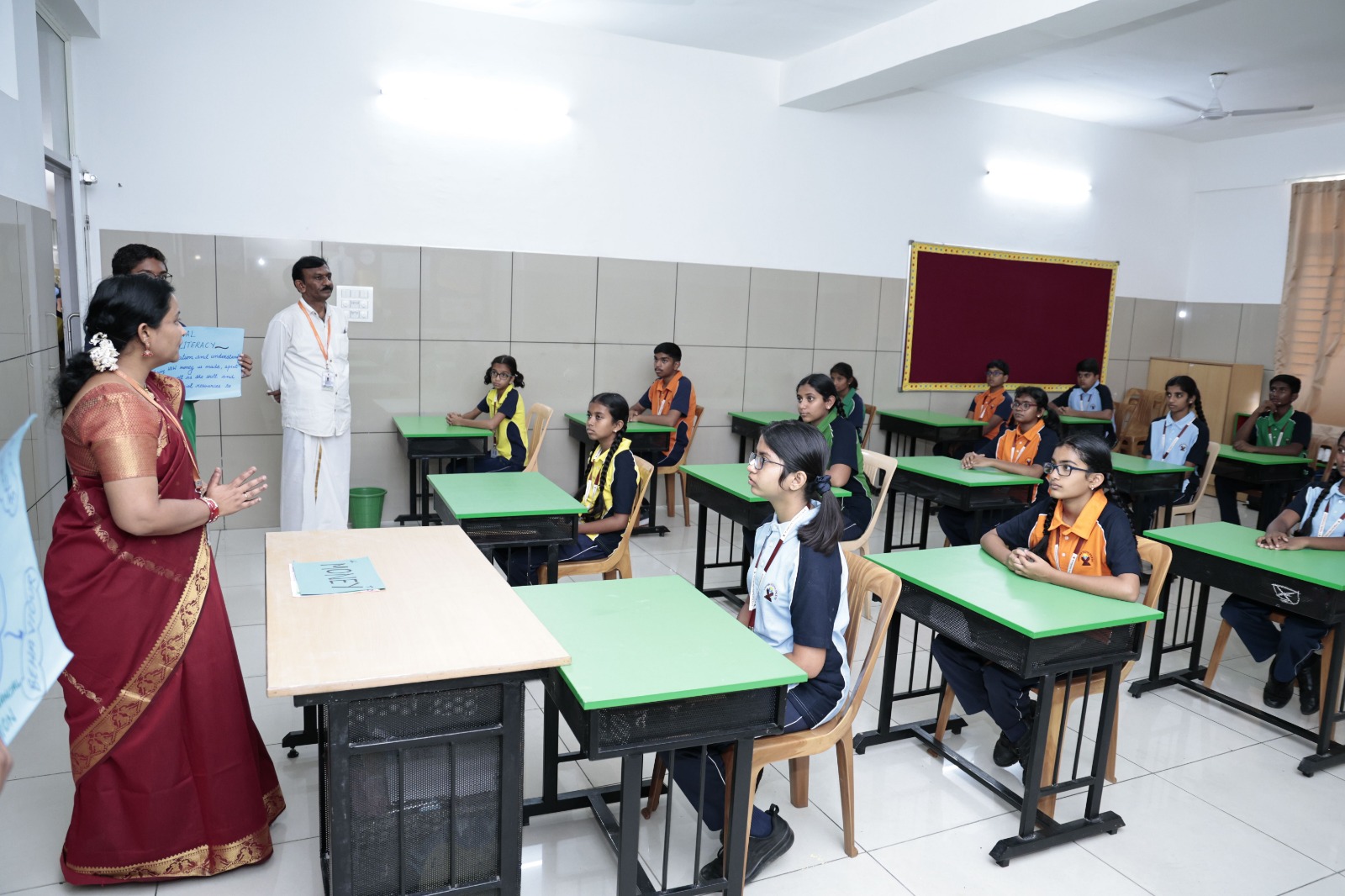
The Takshashila campus at Honnenahalli is one of the few campuses in the best schools near North Bangalore offering both ICSE (Grade 1 to Grade 12, ICSE established 2012) and CBSE (Pre-Primary to Grade 12, CBSE launched 2018) under a single institutional identity. This is meaningful for parents in a way that goes beyond curriculum comparison. It means that the school's investment in Neural Education, Dasha Prabodha, Gnanavatika, Bhagavad Gita, Yoga, Sanskrit, Organic Farming, and all the rest is not dependent on which board a family chooses. Both ICSE and CBSE students at Vishwa Vidyapeeth Takshashila School, Yelahanka are educated within the same philosophical framework and have access to the same campus culture, the same 1:10 student-teacher ratio, and the same commitment to holistic development.
Collaboration with Reva University and Chanakya University further extends this framework beyond the school years — creating pathways for students to continue learning in academic environments that share VVP's commitment to combining intellectual excellence with cultural engagement. The PĀRAMPARE Heritage Club, co-launched with Reva University at the Takshashila campus in February 2023, promotes awareness of Bengaluru's heritage and sustainability — a concrete expression of the school's belief that education should connect students to the world they actually live in.
For parents in Yelahanka, Vidyaranyapura, Sahakar Nagar, and across North Bangalore who are looking for the top CBSE and ICSE schools with Indian values in Bangalore, this breadth of engagement — built steadily over thirteen years without abandoning the founding vision — is what makes the Takshashila campus worth visiting, understanding, and considering seriously.
The name means something. The mission has not changed. And the track record shows that both were meant from the beginning.
Note: Blogs by Yellow Slate are written based on information, knowledge and perspective of the writer. While every caution has been taken to provide readers with accurate information, please use your discretion before taking any decisions based on the information in this blog. In case you find any information that is factually wrong or something that could be made better, please write to us at contact@yellowslate.com.
Curious about how we arrived at this list? We believe parents deserve full transparency on how schools are evaluated and selected. to understand our school selection methodology.


