CAS at Johnson Grammar School IBDP: How Creativity, Activity and Service Shape Grade 11 and 12 Students
Ask any IBDP student what surprised them most about the programme and the answer is rarely a subject. It's CAS — Creativity, Activity and Service. While the six subjects and the extended essay get most of the attention during the admissions process, CAS is the component of the IB Diploma that most profoundly shapes who a student becomes during those two years. At Johnson Grammar School IBDP, Mallapur, CAS is taken seriously as a core part of the school's educational commitment — not a checkbox, but a sustained programme of real-world engagement that runs across the full two years of Grade 11 and Grade 12. This blog explains what CAS is, why it matters, and what it actually looks like in practice at Johnson IBDP.
What CAS Is and Why the IB Requires It
The IB Diploma Programme requires students to complete six subjects, an Extended Essay, Theory of Knowledge, and CAS. Of these, CAS is the one that cannot be crammed, outsourced, or prepared for the night before a deadline. It must be lived. CAS stands for Creativity, Activity and Service — three distinct strands that together require students to engage meaningfully with the world outside the classroom across their two years of study.
Creativity covers artistic and creative thinking, including participation in arts, crafts, performance, and design. Activity covers physical exertion — sport, fitness, dance, or any physical challenge. Service covers engagement with the community in ways that make a genuine difference — teaching, volunteering, fundraising, environmental work. The IB's purpose in requiring CAS alongside rigorous academic subjects is clear: to produce graduates who are not only intellectually prepared but ethically grounded, physically active, and socially engaged. At Johnson Grammar School IBDP, which has been an authorized IBDP institution since 2008 and has sent over 300 students through the programme across 17 batches, CAS is a well-established part of the school's rhythm — not a new experiment.
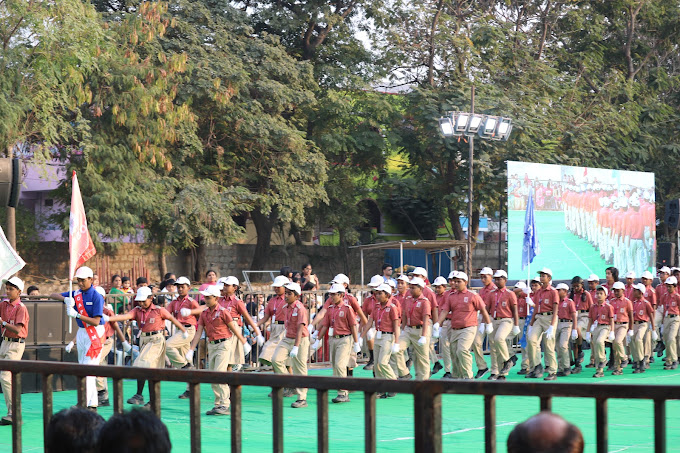
CAS in Action: What Johnson IBDP Students Actually Do
The most useful way to understand CAS at Johnson Grammar School IBDP is through specific examples from the school's documented activities — because the range and depth of what students have undertaken is the clearest signal of how seriously the programme is run.
Health Awareness Walk — Community Service and Creativity: The school's Social Awareness Club led a campaign to discourage junk food consumption and promote healthy eating habits. Every Wednesday was observed as a no-junk-food day on campus. The campaign was then extended into the surrounding residential community through an awareness walk — students going door to door and street to street to educate people about healthy food habits. This is CAS at its most direct: a student-initiated, community-facing activity that required planning, communication, and physical engagement simultaneously.
Jaipur Educational Trip — Creativity and Activity: Students travelled to Jaipur for a CAS trip with a packed educational itinerary. They visited Haathi Gaon, the elephant village near Amber Fort, where they encountered the value of empathy as a practical life skill. They visited the blue pottery industry and participated in hands-on learning — discovering every step of the ceramics process. They also learned block printing and colour mixing from craftsmen in a participatory workshop format. The combination of cultural exposure, practical craft learning, and direct engagement with artisans outside Hyderabad gave students a CAS experience that no classroom can replicate.
Service at Shri Mudiraj Memorial School: Johnson IBDP students volunteered at Mudiraaj Memorial School, assisting teachers by teaching students from Grade 1 to Grade 5. The school notes that students came away with a significantly deeper appreciation for their own teachers — observing first-hand how much patience teaching actually requires, and how visibly children respond to the presence of engaged helpers. This activity captures what service in the IB context is designed to produce: not just hours logged, but genuine perspective shift.
Service at Sadhana — Institute for the Intellectually Challenged: Students from Johnson IBDP's Cultural Club chose to celebrate Diwali by spending time with children at Sadhana, an institute for the intellectually challenged. They performed a skit based on scenes from the Ramayana, engaged children in art and painting, whitewashed walls, and planted saplings on the grounds. This was a carefully planned, multi-dimensional service activity that combined cultural expression with physical labour and emotional engagement with children who have special needs.
Trip to Mathepally Village: Students conducted educational activities for Zila Parishad school students at Mathepally village. A distinctive challenge arose: the local students did not speak English, and the school had only recently transitioned from Telugu to English instruction. Johnson IBDP students were asked to teach in Telugu — a stretch for many of them, but one the school describes as a challenge they met well. This activity built adaptability, cross-cultural communication, and genuine humility in a way that no urban classroom experience could.
Candle Making and Eco-Friendly Ganesha Workshop: For Deepawali, students participated in a workshop on making fancy candles — bubble candles, wax candles, and brightly coloured varieties — which were later sold as a fundraiser. Separately, an eco-friendly Ganesha-making session using clay was organised, with each student required to make five idols. The fundraised proceeds from both activities went to Sadhana, connecting the creativity strand directly back to the service strand and creating a complete loop of student-led social impact.
Halloween Cultural Event: Students organised and participated in a Halloween celebration to foster global awareness of international traditions. Folk tales about Halloween from multiple countries were shared, students arrived in costume, and a ramp walk was conducted to music. The event was entirely student-organised, requiring creative planning, logistics, and cultural research — a CAS activity that celebrated global mindedness while developing organisational skills.
What CAS Develops That Subjects Cannot
The activities described above have something in common beyond their variety: they required students to operate in contexts where they were not experts, where the outcome was uncertain, and where their effort directly affected other people. This is precisely what CAS is designed to create. A student who has taught primary school children in a village, volunteered at an institution for children with special needs, and led a community health awareness walk has developed a kind of practical empathy and social confidence that no examination can assess or award.
For parents considering Johnson Grammar School IBDP for their child's Grade 11 and Grade 12 years, CAS is worth understanding not just as a requirement but as an opportunity. The 100% university admission rate that the school maintains across 17 batches is built on students who present not only strong academic scores but complete IBDP profiles — including a well-documented CAS portfolio that demonstrates character, initiative, and real-world engagement. Universities, particularly international ones (which account for 36% of Johnson IBDP's placements), look specifically at CAS records as evidence of the qualities that academic transcripts cannot capture.

CAS as Part of the Johnson IBDP Experience
At Johnson Grammar School IBDP, CAS sits alongside the school's broader understanding of what Grade 11 and Grade 12 should produce in a student. The school describes its IBDP as an enriching and transformative experience — and the word "transformative" is earned most clearly through CAS, where students step outside their academic comfort zones, take responsibility for their own projects, and discover capabilities they didn't know they had.
The ManageBac platform used by the school for academic planning and tracking also supports CAS documentation — giving students a structured system for recording their activities, reflections, and learning outcomes in a format that forms part of their official IBDP submission. For families in Hyderabad considering the best IBDP schools in the city — Mallapur, Nacharam, Uppal, Habsiguda, Tellapur, and the wider east Hyderabad corridor — CAS quality is one of the dimensions that separates schools that offer IBDP from schools that truly deliver it. Johnson Grammar School's documented CAS programme, built across 17 batches since 2008, is evidence of the latter. Parents who want to understand more about the programme are welcome to explore the school's offerings at Johnson Grammar School IBDP's official website.
Note: Blogs by Yellow Slate are written based on information, knowledge and perspective of the writer. While every caution has been taken to provide readers with accurate information, please use your discretion before taking any decisions based on the information in this blog. In case you find any information that is factually wrong or something that could be made better, please write to us at contact@yellowslate.com.
Curious about how we arrived at this list? We believe parents deserve full transparency on how schools are evaluated and selected. to understand our school selection methodology.


