Robotics, Vedic Mathematics, MUN and More: The Specialised Programmes at MIT VGS Loni Kalbhor
Most CBSE schools in the Pune–Solapur corridor offer a standard programme: academics, some sports, perhaps a cultural event or two. MIT Vishwashanti Gurukul School, Loni Kalbhor goes considerably further — with a set of specialised programmes that sit above and beyond the regular curriculum, designed to build skills that board examinations don't test but the real world does. This blog covers the programmes that distinguish MIT VGS Loni Kalbhor from a standard CBSE school: Robotics and STEM, Vedic Mathematics, Model United Nations, financial literacy, entrepreneurship, digital literacy and coding, and the school's community service and environmental initiatives.
Robotics, STEM and Junior Robocon
MIT Vishwashanti Gurukul School runs Robotics and STEM programmes as a core part of its specialised offering — not as an optional club for the technically inclined, but as part of the school's stated commitment to technology-driven, innovation-oriented learning. The school's own innovation labs and technology-enabled infrastructure support this directly.
One of the school's flagship events is Junior Robocon — an in-house robotics competition where students design, build, and programme robots to complete defined challenges. Robocon, in its international avatar, is one of Asia's most prestigious robotics competitions for engineering students. MIT VGS brings this culture of competitive robotics into the school years, exposing students to engineering thinking, iterative problem-solving, and the discipline of taking a design from concept to working prototype under time pressure. For students in Loni Kalbhor and the broader Pune East corridor considering the best CBSE schools in Pune, the presence of a dedicated robotics programme backed by actual competition experience is a meaningful differentiator.
Vedic Mathematics and Indian Knowledge Systems
MIT Vishwashanti Gurukul School explicitly integrates Indian Knowledge Systems (IKS) into its curriculum — and Vedic Mathematics is one of the most practically impactful expressions of this. Vedic Mathematics is a system of mental calculation techniques derived from ancient Indian mathematics, based on sixteen sutras that allow students to perform complex arithmetic operations — multiplication, division, squares, cubes — with speed and accuracy that conventional methods cannot match.
For students preparing for competitive examinations where mental calculation speed matters — NTSE, Olympiads, JEE — Vedic Mathematics is not a heritage exercise. It is a genuine cognitive and competitive tool. MIT VGS's integration of IKS alongside its CBSE curriculum means students receive both the national examination framework and an intellectual heritage that enriches how they think about numbers, patterns, and structure. This combination of modern CBSE rigour with the depth of India's classical mathematical tradition is one of the school's distinctive positions among the best CBSE schools in Loni Kalbhor and Pune.
Model United Nations (MUN)
Model United Nations is a simulation of the United Nations system where students represent countries, debate global issues, draft resolutions, and build consensus under parliamentary procedure. MIT VGS offers MUN as part of its skill development and beyond-academics portfolio — a programme that develops research, public speaking, diplomacy, persuasive writing, and the ability to argue positions under pressure.
These are skills that rarely appear in a standard CBSE classroom but matter enormously in higher education and professional settings. A student who has participated in MUN has practiced reading complex policy documents, synthesising a country's geopolitical position, articulating it in formal debate, and negotiating with peers from different "nations" toward a shared resolution. For parents evaluating the best schools near Hadapsar and Loni Kalbhor for their children's holistic development, MUN at MIT VGS provides an internationally relevant skill-building experience within a school that is otherwise firmly rooted in CBSE and Indian values.
Digital Literacy, Coding and Entrepreneurship
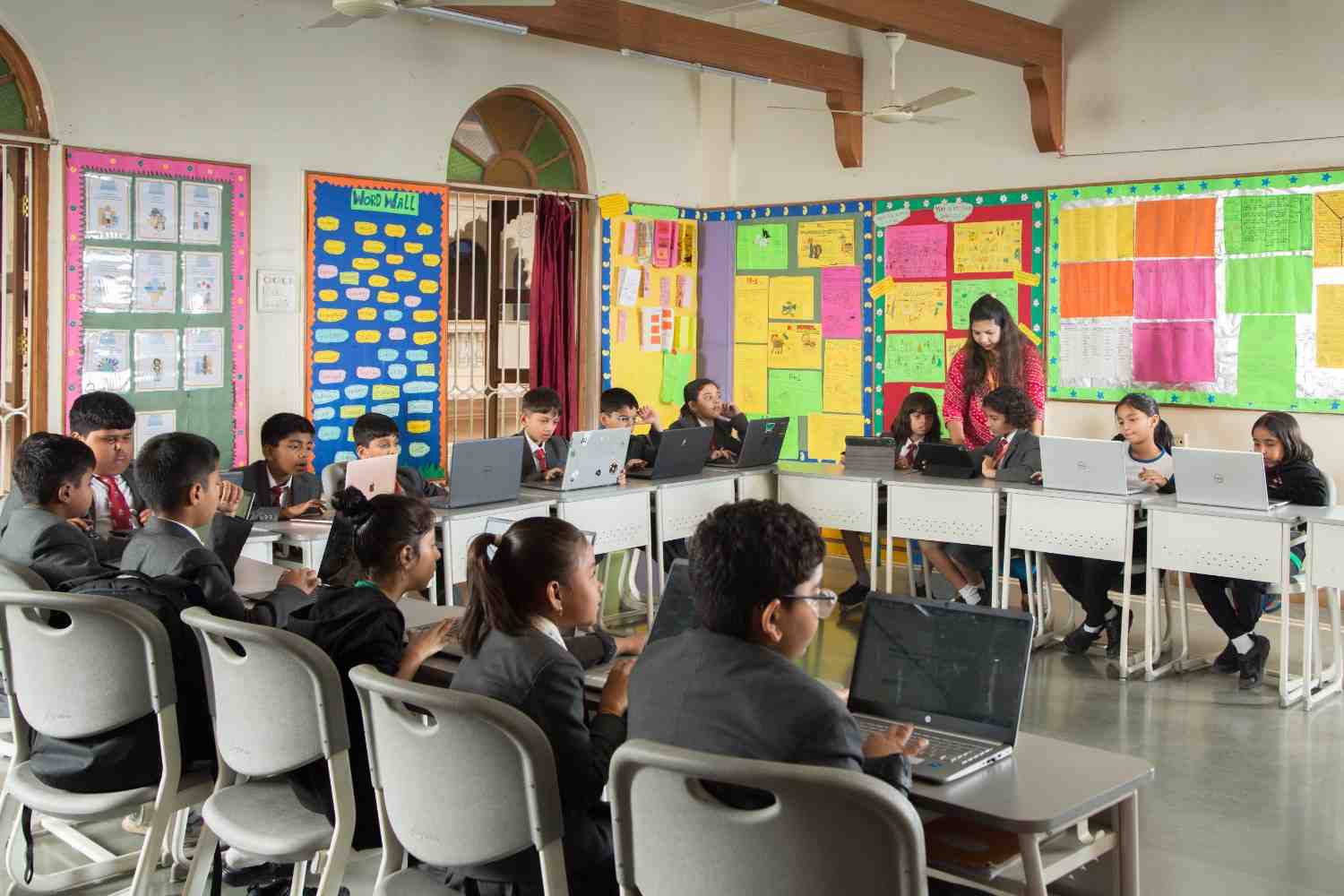
MIT VGS runs dedicated coding clubs and digital literacy workshops that teach programming languages, game design, and web development — with a philosophy that students should be creators of technology, not merely consumers of it. The school's curriculum includes basic computer skills, digital citizenship, and coding programmes that are tailored by age group and build progressively across school years.
The entrepreneurship programme takes this further — students learn about business planning, marketing, budgeting, and the process of developing a product or service from idea to execution. Hands-on activities like school marketplaces and idea pitching sessions give students a real-world experience of what it means to build something, find customers, and account for costs. Financial literacy is woven into the same strand — students learn budgeting, saving, and investing through simulation games and role-play activities, building the money management instincts that are genuinely absent from most school curricula. Together, these three programmes — digital literacy, coding, and entrepreneurship — form a coherent future-skills stack that prepares students for an economy where technology and self-driven initiative matter as much as academic qualification.
Communication, Debate and Public Speaking
The school's skill development programme treats communication as a distinct, teachable competency rather than a byproduct of English classes. Debates, elocution contests, extempore speaking events, and essay writing competitions are regularly organised — not as once-a-year events but as recurring activities built into the school calendar. The Language Extravaganza is a flagship annual event specifically dedicated to celebrating linguistic diversity and building language skills across the student body.
The school also runs career talks with industry experts and resume-building workshops for older students — creating a direct bridge between school-level communication development and the professional skills that universities and employers actually evaluate. For students in the Pune East area who aspire to be articulate, confident, and quick-thinking adults, the structured communication programme at MIT VGS is one of the more substantive offerings among CBSE schools in the Loni Kalbhor corridor.
Community Service, Sustainability and Environmental Initiatives
Community service is listed as a core component of the MIT VGS curriculum rather than an optional add-on. The school's initiatives include environmental conservation activities — rainwater harvesting education, tree plantation drives, recycling projects, and gardening — as well as volunteering at orphanages and homes for the physically challenged. Students don't just learn about social responsibility in classrooms; they enact it through structured community engagement that is built into the school year.
The environmental and sustainability strand of the programme teaches students about water conservation, eco-friendly practices, and environmental advocacy in ways that are practical and hands-on rather than purely theoretical. For parents who want their children to develop a sense of civic engagement and environmental stewardship alongside academic competence, this community service structure at MIT Vishwashanti Gurukul School represents a meaningful institutional commitment — the kind that shapes character rather than just filling a school brochure.
What These Programmes Mean for Your Child's Education
The combination of Robotics and Junior Robocon, Vedic Mathematics and IKS integration, Model United Nations, digital literacy and coding, entrepreneurship, financial literacy, structured debate and communication, and community service creates a programme ecosystem that goes well beyond what most CBSE schools in Pune offer as standard. At MIT Vishwashanti Gurukul School, Loni Kalbhor, these programmes are not decorative — they are structured, progressive, and tied to the school's founding philosophy of quality education rooted in Indian values and holistic development. Families in Loni Kalbhor, Hadapsar, Wagholi, and the Pune East corridor who want to understand how these programmes work in practice and what a school day actually looks like at MIT VGS are encouraged to visit the campus on the Pune-Solapur Highway, near MIT Staff Quarters, Loni Kalbhor, Maharashtra 412201.
Note: Blogs by Yellow Slate are written based on information, knowledge and perspective of the writer. While every caution has been taken to provide readers with accurate information, please use your discretion before taking any decisions based on the information in this blog. In case you find any information that is factually wrong or something that could be made better, please write to us at contact@yellowslate.com.
Curious about how we arrived at this list? We believe parents deserve full transparency on how schools are evaluated and selected. to understand our school selection methodology.


