Space Lab, Neural Science, and 10 Unique Ways Vishwa Vidyapeeth Magadha School Teaches Differently
There's a school sitting quietly on 7 acres in Nekkundi Dommasandra, Varthur, that a surprising number of parents in Whitefield and Marathahalli haven't properly had a conversation about yet. It opened in 2020. It has 250 students. And it does things in the classroom — and beyond the classroom — that put most CBSE schools in this corridor to considerable shame.
That school is Vishwa Vidyapeeth Magadha School. And before we get into the list format the title promises, it's worth pausing on why any of this actually matters.
Every school in Bengaluru — in Kadugodi, KR Puram, Kundanahalli, Budigere Cross, wherever — will tell you it's 'holistic.' That word has been used so many times it's essentially stopped meaning anything. What's rarer, and considerably harder to fake, is a school that has built specific, named, verifiable systems around a teaching philosophy — and then committed to them structurally, not just rhetorically. Vishwa Vidyapeeth Magadha has done that. This blog walks through what those systems actually are, one by one, with nothing invented.
The Foundation: Neural Education and the Challenge Mosaic Model
Before any list, there's one thing to understand: everything at VVP Magadha sits on a neuroscience-informed teaching philosophy. The school calls it Neural Education, delivered through the Challenge Mosaic Model — CMM.
This is more specific than most schools' vague nods to 'brain-based learning.' VVP Magadha's approach explicitly references the roles of distinct brain structures in how children actually learn: the amygdala — which governs emotional regulation and, when triggered by stress or fear, actively shuts down memory formation — Broca's area, which handles language production, and Wernicke's area, which manages comprehension. The design implication is direct: a classroom that feels threatening or high-pressure is one where the amygdala is running the show, and real learning is being suppressed. So the first job of every lesson is to make the environment feel safe.
From that foundation, the CMM works toward what the school calls UBD — Understanding Big Ideas. Not recall of isolated facts. Not exam technique. Genuine conceptual understanding, supported through improved retention, sustained engagement, and confident self-expression. The methodology draws on experiential learning, reflective activities, creative assignments, and co-learning structures. It's not one method — it's the architecture that holds everything else together.
Vishwa Vidyapeeth Magadha School is among the first schools in India to formally incorporate neural science into its teaching-learning process. In the Whitefield–Varthur corridor, nothing else quite like it exists. If you want to understand how this philosophy is mapped onto the actual CBSE curriculum your child will be studying, this complete curriculum guide for parents is the right place to start.
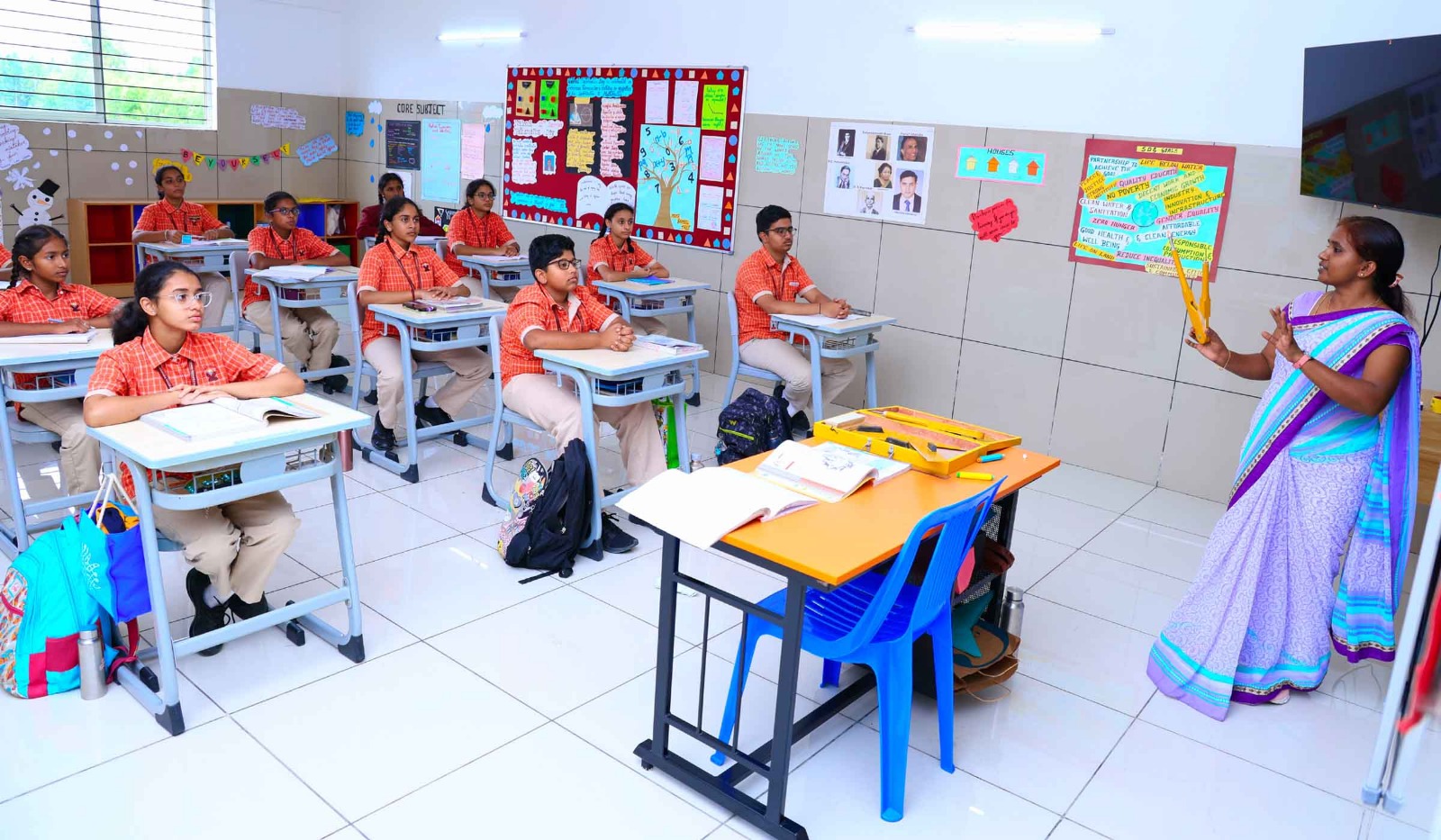
10 Ways Vishwa Vidyapeeth Magadha School Teaches Differently
1. Experiential Learning — Because a Concept Lived Is Never Forgotten
The experiential learning programme runs on a simple conviction: students retain what they actively do, not what they passively receive. So classroom projects tackle real-world problems. Lab work means actual experiments, not demonstrations. Field trips are curriculum-linked — not just recreational days out — and community service is built into the structure, not bolted on as an afterthought.
Children building, testing, failing, trying again, and quietly figuring things out. That's what a substantive school day actually looks like.
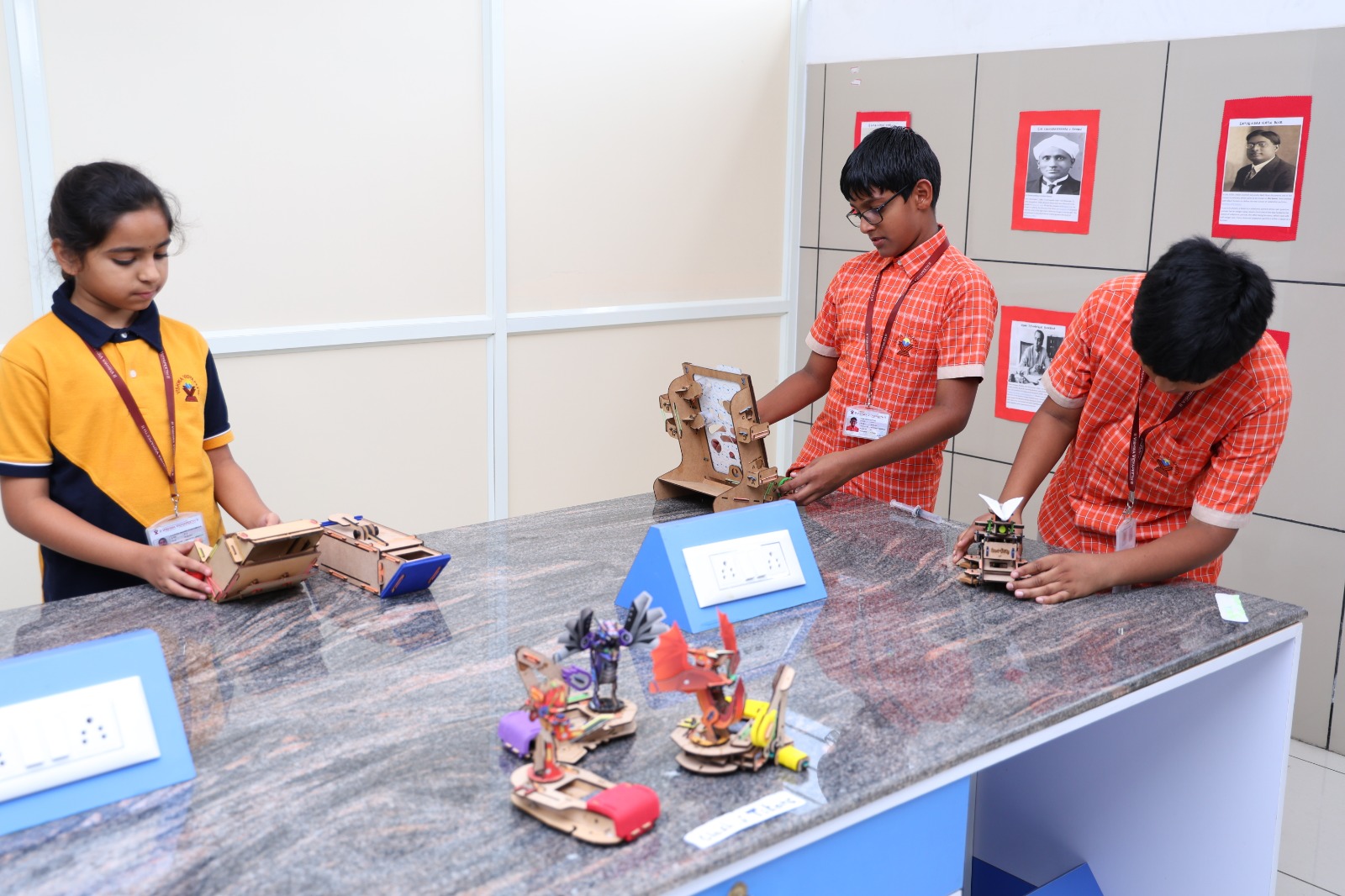
2. The Space Lab with Genex Space — Something No Other School in Varthur Has
VVP Magadha has built a dedicated Space Lab on campus, developed in partnership with Genex Space. Students explore the solar system, study astronauts and the International Space Station, learn about rocket components, and investigate space farming — all in a purpose-built learning environment, right there on the Varthur campus.
Beyond the lab, students have participated in stargazing and solar observation sessions using actual high-quality telescopes. Real telescopes. Real night sky. The kind of experience that quietly shifts what a child thinks is possible for themselves.
Across the Whitefield–Marathahalli corridor — with its dozens of competing CBSE schools — no other school has a functioning, curriculum-linked Space Lab. That's not a cosmetic differentiator. It represents a serious investment in sparking scientific curiosity that no amount of textbook coverage can replicate. For a full picture of the campus infrastructure that makes programmes like this possible, see this comprehensive guide to VVP Magadha's infrastructure and facilities.
3. Flipped Learning — Class Time for Thinking, Not Just Listening
At most schools, the format is familiar: content is delivered in class, and students practise it at home. VVP Magadha inverts this deliberately. Students encounter new material before they come in — reading, watching, preparing — so that when they arrive, the lesson can go deeper immediately, without burning time on basic content delivery.
Class time, freed from that basic function, becomes space for interactive discussion, problem-solving, debates, role-plays, quizzes, and group presentations. As a by-product — not an add-on — students build real confidence, communication skills, and the ability to stand up and speak in front of a room.
4. Discovery Based Learning — Where the Teacher Becomes the Least Dominant Voice
Under VVP Magadha's Discovery Based Learning model, students are given open questions, materials, and challenges — and then expected to find answers themselves. Teachers act as facilitators and guides, not the primary source of knowledge in the room.
What this builds over time is intellectual confidence — the specific kind that comes from having repeatedly discovered things through your own reasoning rather than always waiting for an adult to supply the right answer. A child who trusts their own thinking is a fundamentally different learner from one who doesn't.
5. Peer Learning — Teaching Your Classmates to Understand It Yourself
Peer learning at Vishwa Vidyapeeth Magadha is structured and assessed — not informal, not occasional. Students are trained as peer teachers, placed in teaching roles across subjects including Mathematics, Science, Languages, and Social Studies, with feedback collected continuously to improve the process.
The school has tracked measurable improvements in academic performance through this model. The mechanism isn't mysterious: you genuinely cannot clearly explain something you haven't properly understood. And a peer's explanation — in their own language, pitched at their own level — is often more accessible than a formal teacher's delivery.
6. Project Based Learning — Real Stakes, Real Outputs
Project Based Learning at VVP Magadha is not make-work. Students tackle substantive real-world challenges that require genuine research, critical analysis, decision-making, cross-role collaboration, and a tangible, publicly-presented output. These projects connect classroom subjects with actual problems in the world outside.
The skills this builds — initiative, persistence, managing ambiguity, seeing something through from brief to delivery — are precisely the ones that exam preparation never reaches, and precisely the ones every professional environment will immediately recognise and value.
7. Activities Based Learning (ABL) — Doing as the Deepest Form of Understanding
Activities Based Learning at VVP Magadha is a formal pedagogical approach embedded within the CBSE curriculum — not a break from serious study. ABL recognises that children learn most effectively when they are active participants: constructing, experimenting, problem-solving, and discovering concepts through structured hands-on experiences rather than passive reception of information.
In practice, this means students engage with academic content through purposefully designed activities that make abstract ideas concrete and visible — building models to understand geometry, conducting experiments to grasp scientific principles, using manipulatives to internalise mathematical operations. The activity is the lesson, not an illustration of it. As a core component of the CBSE framework alongside Project Based Learning, ABL is woven into the daily academic programme across subjects and grade levels.
8. Sports Integration — Physics Lessons on the Football Ground
Sports integration at Vishwa Vidyapeeth Magadha uses physical activities to illuminate academic concepts directly. Physics becomes viscerally clear on a football pitch or basketball court. Mathematics shows up in trajectories, angles, and scores. The body learns what the mind has only processed abstractly — and that physical understanding sticks.
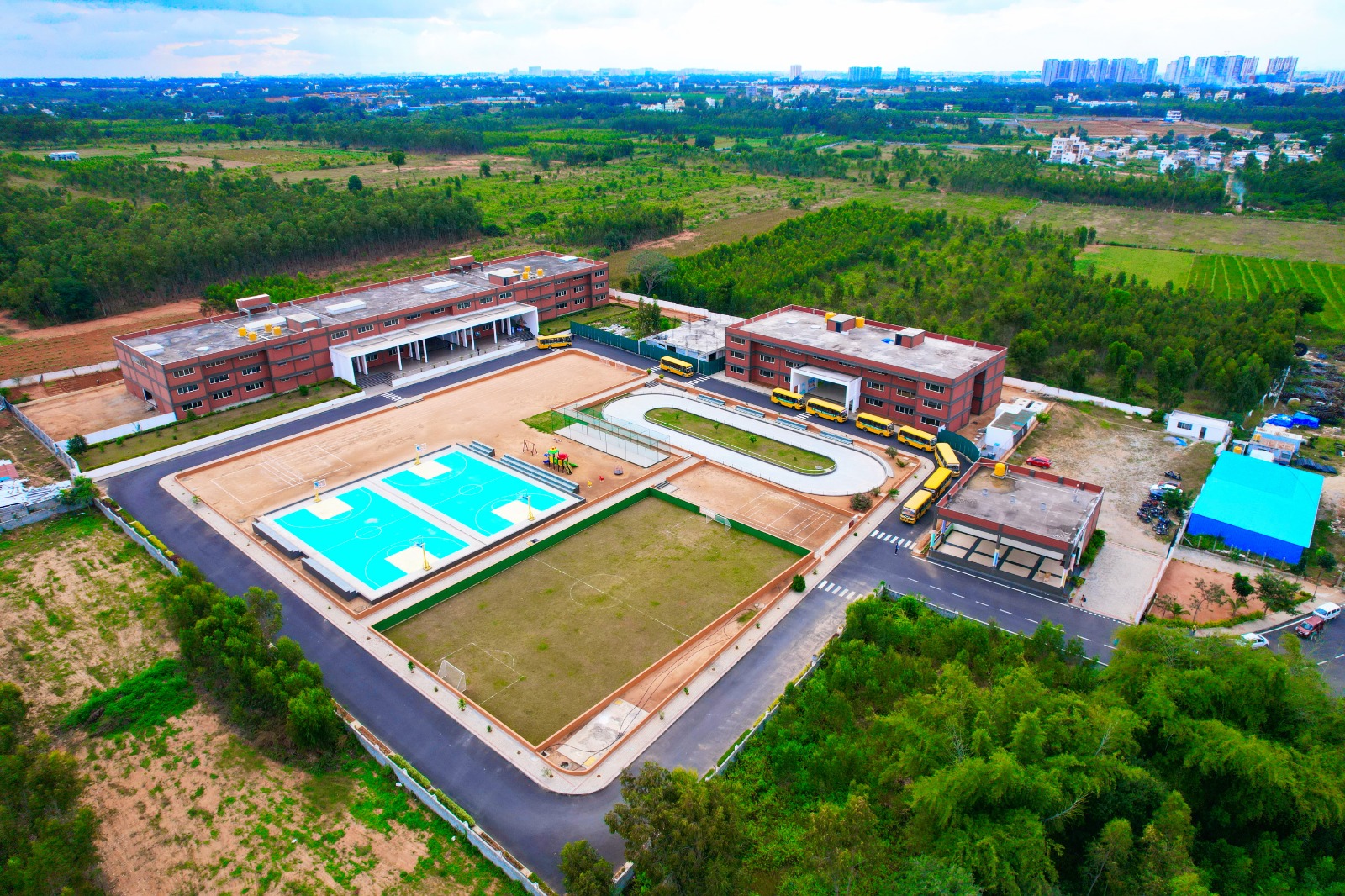
This makes the school's sports facilities something more than fitness amenities. The skating rink, cricket nets, football ground, basketball and volleyball courts, Taekwondo indoor room, and yoga room are curriculum tools as much as they are recreational spaces. For parents who want a closer look at the full range of activities these facilities support, this detailed overview of extracurricular activities at VVP Magadha covers exactly that.
9. Storytelling as Pedagogy — The Oldest Teaching Method, Brought Back on Purpose
VVP Magadha formally recognises storytelling as pedagogy — not as a warm-up or a reward for finishing early, but as a primary teaching tool built explicitly into its framework.
The logic is unassailable: stories capture and hold attention more effectively than almost any other format. Abstract concepts become relatable narratives. Information tied to a story — to emotion, imagery, and sequence — is retained far longer than information delivered as isolated facts. A lesson structured as a story is a lesson the child will still be able to reconstruct months later.
10. The Trans-disciplinary Approach — Where Subject Walls Come Down
The trans-disciplinary approach at VVP Magadha means subjects are taught in integration around central themes or real-world problems — not in isolation. A unit on water conservation draws from Geography, Science, Mathematics, and Social Studies simultaneously. A project on local history involves Language, Art, and Social Science together.
Children who learn this way develop a working understanding that the world doesn't divide itself into subjects — because it doesn't. They carry knowledge across domains fluidly, ask better questions, and approach problems with more resourcefulness than students trained in rigidly siloed disciplines.
Seed to Sapling: The STEM Math Lab That Runs Alongside All of This
Alongside its own pedagogical framework, Vishwa Vidyapeeth Magadha runs its STEM mathematics education through a formal partnership with the Seed to Sapling (S2S) team. The S2S method is called H-Cube Learning — three distinct phases that every lesson moves through:
| Phase | What Happens in the Classroom | Why It Works |
| Hearts-ON | Students are hooked by a real-world problem, observation, or phenomenon from daily life — something they've seen, felt, or wondered about. Curiosity is activated before any content is introduced. | The brain is primed and genuinely receptive rather than passively waiting. The lesson begins with a question the student already cares about. |
| Heads-ON | Open-ended questions push students to hypothesise and reason toward the concept themselves, with minimal teacher input. The idea is constructed, not handed over. | Actively building knowledge produces deeper and more durable retention than receiving it ready-made. Understanding arrives as discovery, not instruction. |
| Hands-ON | Students conduct exploratory activities — individually or in groups — that bring them physically to the solution. Abstract ideas become tangible. | Practical application cements understanding. The 'why' becomes obvious through experience rather than theory. What the hand does, the brain remembers. |
The S2S philosophy also insists on emotional stability and a strong moral foundation alongside intellectual growth — which maps directly onto VVP Magadha's own conviction that education is not, and should never be, purely about cognitive outcomes.
Gnanavatika — Back to Gurukula: The Programme That Exists Nowhere Else in Varthur
There's a six-year immersive programme at Vishwa Vidyapeeth Magadha called Gnanavatika — Back to Gurukula. Designed for students in Grades 7 to 12, it's unlike anything offered by any competitor school in Whitefield, Varthur, or Marathahalli.
The premise is straightforward: India's ancient Gurukula tradition asked students to step out of comfort zones, engage directly with the real world, develop practical life skills, and build character through experience rather than instruction. VVP Magadha has revived this — not as a vague philosophical nod, but as a structured, supervised, assessed programme with clear learning objectives and verifiable outcomes.
In practice, it means Experiential Yatras — immersive learning journeys across nine states of India: Andhra Pradesh, Himachal Pradesh, Karnataka, Leh and Ladakh, Madhya Pradesh, Punjab, Rajasthan, Tamil Nadu, and Uttarakhand. Students have visited the Infantry School, the Officers Training Academy in Chennai, Wagah Border, INS Kadamba in Karwar, the Tropic of Cancer marker in Madhya Pradesh, Bhimbetka rock shelters, and a Mutt in Haridwar. These are experiences most adults have never had.
The programme's learning objectives are specific:
- Adaptability and Life Skills — resilience, communication, financial and organisational skills.
- Value-Based Living — hands-on practice in gardening, pottery, bamboo weaving, and cooking.
- Patriotism and Service — direct engagement with the country's culture and communities.
- Mind and Body Wellness — through physical activity, yoga, and meditation.
- Disciplined Living — aligned with Gurukula principles of non-violence, truth, and sustainability.
- Community Engagement — real-world service and collaboration beyond the campus.
- Integrated Joyful Learning — across biodiversity, ecology, water conservation, medicinal plants, and forest art.
Parent testimonials from families whose children have gone through Gnanavatika are telling. One described a notable shift in their daughter's leadership abilities and problem-solving confidence. Another wrote that the Bhopal visit — which included time at the Infantry School and dinner with officers — was something their family would never have organised on their own. A third described the programme as helping their child "discover themselves, be confident and make their lives worthy" — a particular resonance in a world where children are increasingly prone to anxiety when they encounter failure. For a full collection of what parents across programmes are saying, this comprehensive parent review guide for VVP Magadha Varthur is worth reading in full.
A child who goes through Gnanavatika from Grade 7 to Grade 12 will have learned to adapt in unfamiliar places, served communities, built things with their hands, and stood at Wagah Border understanding exactly what they were standing for.
Dasha Prabodha: 10 Life Skills Woven Into the Regular Curriculum
Running in parallel with all of the above is Dasha Prabodha — VVP Magadha's programme to build ten specific life skills in every student, integrated into the regular curriculum rather than offered as optional extras. 'Dasha' means ten. 'Prabodha' means awakening.
- Bhagavad Gita, Vedas and Upanishads — practical frameworks for a peaceful and meaningful life, taught through real-world examples rather than ritual recitation.
- Organic Farming — hands-on biology, ecology, and nutrition, alongside a genuine respect for farmers and for food itself.
- Clay Modelling — fine motor development, planning, problem-solving, and the simple satisfaction of making something from nothing.
- Woodwork — hand-eye coordination, physical and emotional development, responsibility, and the ability to build something real and lasting.
- Taekwondo — self-defence, but more importantly: discipline, perseverance, body awareness, and mutual respect.
- Public Speaking — persuasion, confidence, the ability to hold a room, and early development of genuine communication ability.
- Cooking — self-dependence, mathematical thinking (measuring, timing, weighing), and social skills through the school's kitchen lab; students explore six tastes — sweet, sour, chilli, salt, bitter, and ghee.
- Art Education — Indian art forms including Warli and Madhubani, building both creativity and cultural literacy in the same stroke.
- Music — brain development, literacy, mathematical thinking, and emotional coordination, in a context that feels joyful rather than academic.
- Theatre — creativity, emotional intelligence, confidence, and the willingness to be fully present and expressive in front of others.
One More Thing Worth Saying: Small Is the Point
Everything described above works better at small scale. Neural Education, Peer Learning, trans-disciplinary projects, the Space Lab, Gnanavatika Yatras — none of these function meaningfully in anonymous, overcrowded classrooms where a teacher is managing forty children and cannot possibly know how each one is actually thinking.
VVP Magadha has 250 students. A 1:10 teacher-to-student ratio. It was established in 2020 — built with intentional design from the ground up, not accumulated over decades of institutional inertia. Director Ms. Suseela Santhosh leads a Group of Schools whose advisory board includes:
- Padma Bhushan Dr. Nambi Narayanan — ISRO scientist
- Padma Shri Prof. Sujatha Ramdorai — one of India's foremost mathematicians
- Dr. Nithin Nagaraj — researcher in nonlinear dynamics and information theory
- Dr. Raghavendra Rao
- Dr. D P Anantha
- Shri Basavaraj Umarani
That calibre of advisory backing is visible in the seriousness of the programmes on the Varthur campus. For parents in Kannamangala, Mugalur, Whitefield, and Budigere Cross comparing VVP Magadha against much larger, more established schools nearby — larger isn't better when what you actually want is for your child to be seen as an individual, taught with intention, and known by name by every teacher in the building.
If You're Looking for Something Different in Varthur — It's Here
If the standard school formula — large class, textbook delivery, exam focus — feels like it's missing something important, Vishwa Vidyapeeth Magadha School in Varthur is worth a proper campus visit. For a complete picture covering fees, admissions process, facilities, and what other parents have said, this detailed overview of VVP Magadha School has everything you need before you make an enquiry.
Pre-Primary (Nursery, LKG, UKG) and CBSE Grades 1 to 10. Seven acres. Nekkundi Dommasandra.
Transport routes cover Whitefield, Marathahalli, Kadugodi, KR Puram, Kundanahalli, Hoskote Road, Chikkathirupathi Road, Borewell Road, Hoodi Main Road, Immadihalli Road, Doddanekkundi Main Road, Belthur Main Road, and Budigere Cross.
Note: Blogs by Yellow Slate are written based on information, knowledge and perspective of the writer. While every caution has been taken to provide readers with accurate information, please use your discretion before taking any decisions based on the information in this blog. In case you find any information that is factually wrong or something that could be made better, please write to us at contact@yellowslate.com.
Curious about how we arrived at this list? We believe parents deserve full transparency on how schools are evaluated and selected. to understand our school selection methodology.


