Is Vishwa Vidyapeeth Magadha School Varthur the Right School for Your Child?
Choosing a school is one of the most consequential decisions a parent makes — and if you're in the Varthur–Whitefield corridor of Bangalore, you've almost certainly come across Vishwa Vidyapeeth Magadha School Varthur at some point in your research. A CBSE school spread across an 18-acre campus in Nekkundi Dommasandra, it's grown from a single campus into part of a four-campus group serving over 3,500 students. But "well-known" doesn't automatically mean "right fit." This blog takes a practical, parent-first look at what Vishwa Vidyapeeth Magadha School Varthur actually offers — and which kinds of families are most likely to thrive here.
The school runs from Nursery to Class 10, following the CBSE curriculum under Affiliation No. 831350. Its location in Varthur makes it one of the more accessible options for families in Sarjapur Road, Whitefield, and the Gunjur area. Among the best CBSE schools in Varthur, Vishwa Vidyapeeth Magadha School stands out for a combination of reasons that go well beyond syllabus and exam prep — though it handles those dimensions seriously too. Here's what you need to know.
A School Built Around Six Core Pillars — and What That Actually Means
Most schools list values. Vishwa Vidyapeeth Magadha School Varthur builds its entire educational philosophy around six specific pillars: Discipline, Indian Culture, Indian Values, Patriotism, Focus on Sanskrit, and Yoga. These aren't just decorative on the website — they show up in the daily schedule, in subject offerings, and in the school's signature programmes.
The philosophy draws from the concept of Dharma — a way of life centred on balance and alignment with one's deeper truth. The school traces this to the ancient Guru-Shishya Parampara, bringing a sense of continuity with India's educational heritage while delivering a fully modern CBSE curriculum. Students attend Bhagavad Gita classes, participate in yoga sessions, and engage with Sanskrit — not as optional enrichment, but as embedded parts of school life.
For parents who want their child to develop a strong cultural identity alongside academic ability, this framework makes Vishwa Vidyapeeth Magadha School Varthur a genuinely distinctive option among the best schools in Bangalore. For families prioritising a purely secular or Western-influenced environment, it's worth visiting the campus first to understand how these elements are woven into the school day.
The Neural Science Advantage: How Teaching Actually Happens Here
How Vishwa Vidyapeeth Magadha School Varthur Approaches Learning
One of the most specific and verifiable claims the school makes is that it is among the first schools in India to integrate neuroscience into its teaching-learning process. This isn't a marketing tagline — it's built into the pedagogical framework through what the school calls the Challenge Mosaic Model (CMM).
The CMM draws on neurological insights — including how the amygdala manages emotional regulation and how Broca's and Wernicke's areas support language — to shape how teachers present content and how students process it. The goal, as the school describes it, is UBD (Understanding Big Ideas): moving students from surface memorisation toward deeper comprehension and personal growth.
In practical classroom terms, this translates into several distinct methods running concurrently. Flipped learning means students acquire foundational knowledge before class, freeing classroom time for higher-order discussions and problem-solving. Peer learning puts students in teaching roles, which deepens their own understanding while building communication and leadership skills. Discovery-based learning encourages students to draw on intuition, imagination, and prior experience rather than passively absorbing information. And through a trans-disciplinary approach, subjects aren't taught in silos — a physics concept might be explored through a sports activity, or a mathematical idea through music.
What Vishwa Vidyapeeth Magadha School's Pedagogy Looks Like Beyond the Classroom
The Space Lab, created in partnership with Genex Space, is perhaps the most vivid example of experiential learning on campus. Students explore topics ranging from the solar system and astronaut life to space farming and rocket components — including hands-on stargazing and solar observation with telescopes. The STEP and LEARN room takes a similar approach to kinaesthetic learning, while the Math Lab makes abstract numerical concepts tangible. For parents evaluating the best CBSE schools in Bangalore's Whitefield area, this density of specialised learning spaces is worth noting.
Project-based learning rounds out the classroom experience — students work in teams on real-world challenges, with field trips and outdoor education adding context that textbooks alone can't provide.
Campus, Facilities, and Daily Life
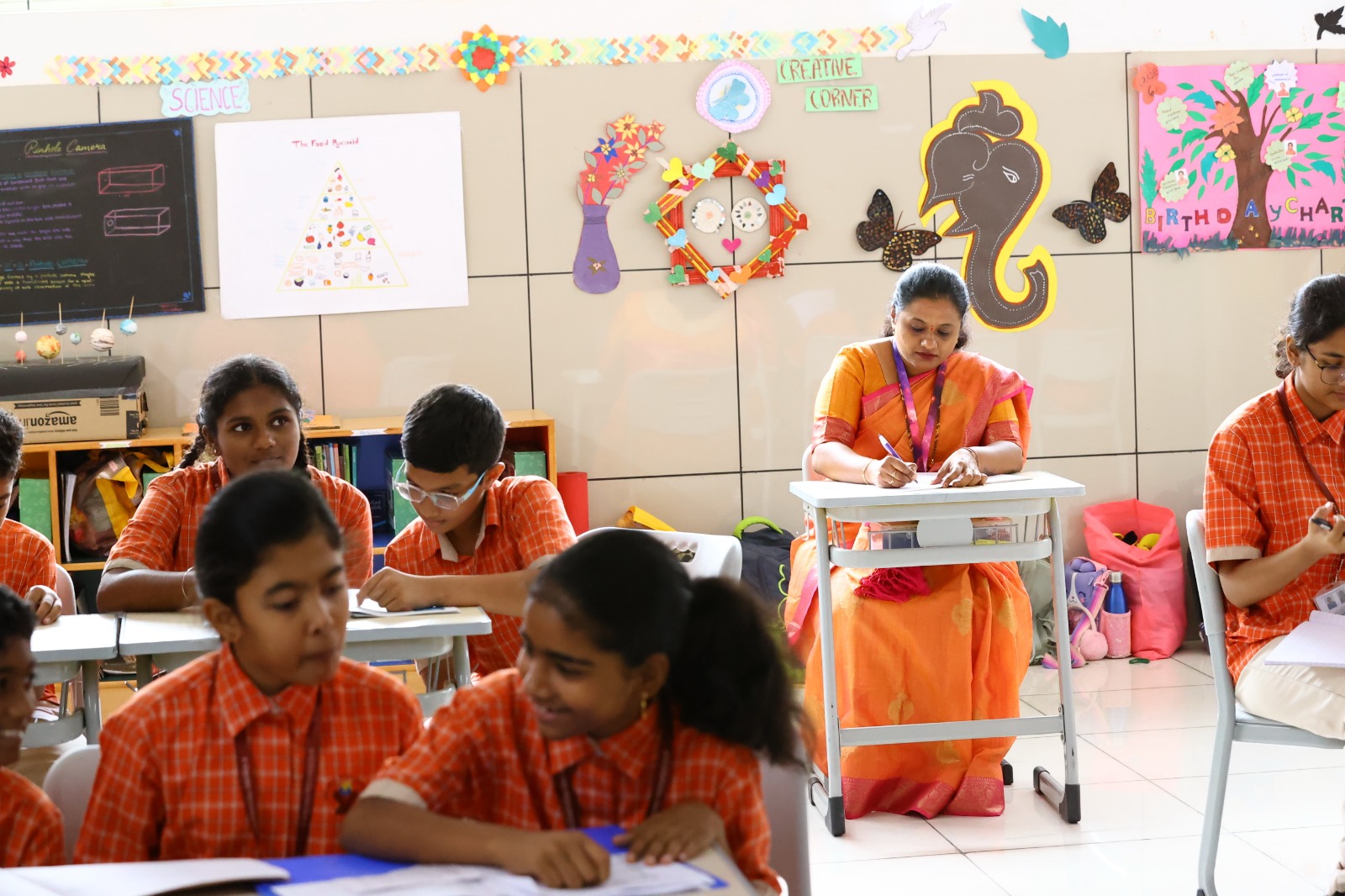
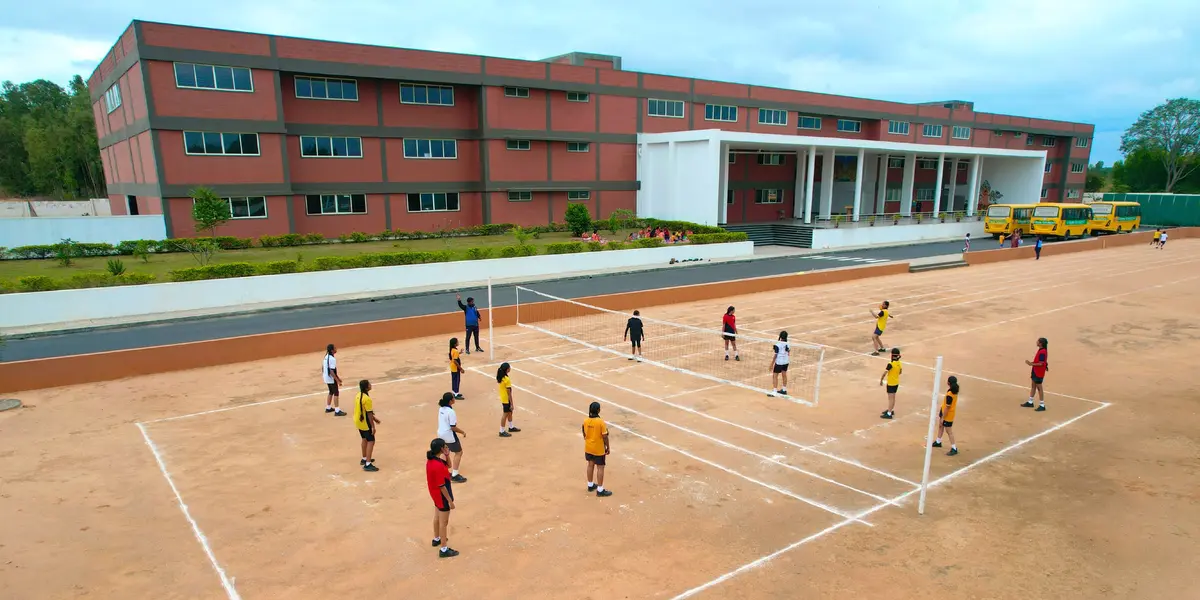
The 18-acre Varthur campus is organised into separate blocks for Pre-Primary, Primary, and Secondary sections, each designed to be age-appropriate. Smart classrooms with digital learning technology are standard across grades. The school's lab infrastructure includes Physics, Chemistry, Biology, and Computer labs, alongside the specialised Space Lab and Math Lab mentioned above. An audiovisual room, library, art room, and indoor games room add to the range of learning environments available.
An in-house kitchen and dedicated dining hall is one facility parents consistently highlight in reviews. The school prepares and serves balanced meals on campus, removing the lunchbox decision from parents' daily routines while also — as the school explicitly notes — educating students about food habits and reducing food wastage. This is a genuine differentiator from many schools in the area.
Round-the-clock CCTV surveillance and a dedicated infirmary room address safety and health concerns. For daily commute, the school operates a fleet of 75 GPS-enabled buses, each equipped with speed governors, CCTV cameras, seat belts, and a lady attendant. School timings run from 7:55 am to 2:45 pm for Primary, Middle, and Secondary students (Monday to Friday), with Saturday attendance on the first two Saturdays of the month.
Languages offered include English (medium of instruction), Kannada, Hindi, and Sanskrit.
Beyond Academics: Sports, Culture, and Parent Involvement
Vishwa Vidyapeeth Magadha School Varthur's Co-Curricular Depth
The school offers over 14 sports disciplines, which is a meaningful number for a CBSE school in Varthur. The list includes cricket, football, basketball, throwball, athletics, taekwondo, skating, gymnastics, table tennis, chess, carrom, yoga, and jump rope — a spread that covers team sports, individual disciplines, and mind games. Sports integration is also used pedagogically: connecting subjects like Physics and Mathematics to physical activity in ways that make complex concepts easier to understand.
Cultural programming runs through three flagship annual events. Bharatiya Kala Vaibhava celebrates India's classical arts and cultural heritage. Ganitha Mela is an annual mathematics festival with interactive workshops and competitions. Jai Jawan Jai Kisan honours soldiers and farmers — a distinctly values-driven event that connects students to the social fabric around them. These aren't one-off assemblies; they're described as carefully curated learning experiences in their own right.
The Dasha Prabodha programme and co-scholastic activities add further depth, ensuring students engage with areas like music, dance, drama, and visual arts throughout the school year.
Parent Engagement at Vishwa Vidyapeeth Magadha School, Varthur
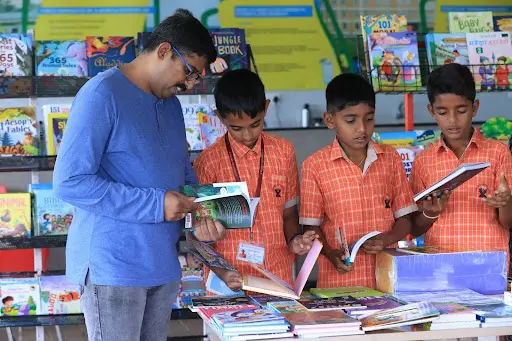
Parent involvement is actively structured into the school experience in ways that go beyond the usual parent-teacher meetings. The Mother on Duty programme invites mothers to spend a day on campus, observing the school environment and seeing first-hand how their child learns and interacts. The Parent Engagement Programme conducts regular workshops covering effective parenting techniques, communication strategies, and how to support a child's growth without pressure.
Home Visits — where teachers visit students' homes — are another initiative, giving educators insight into each child's home environment and enabling more personalised instruction. Parent testimonials on the school website reflect a consistent appreciation for responsive communication through both a school app and WhatsApp, GPS-enabled bus tracking, and the general accessibility of teachers and administrative staff.
For families who want to be genuinely involved in their child's school life rather than simply briefed on report cards, this degree of structured parental engagement is a real draw.
Who Is This School Actually For?
After looking at the full picture, a few parent profiles emerge as strong fits for Vishwa Vidyapeeth Magadha School Varthur.
Families with a strong connection to Indian culture and traditions will find an environment that actively reinforces those values rather than treating them as add-ons. The Sanskrit focus, Bhagavad Gita classes, yoga, and cultural events are a natural fit for parents who want their child's education to be rooted in Indian identity.
Parents who prioritise teaching quality and pedagogical innovation — not just infrastructure — will find the neural science-based, multi-method approach genuinely interesting. The combination of flipped learning, peer learning, discovery-based learning, and space education gives the school intellectual substance that goes beyond syllabus coverage.
Families looking for the best schools in Varthur or the best CBSE schools in Whitefield Bangalore that also offer meaningful sports and co-curricular options alongside academics will find the 14+ sports disciplines and rich cultural programming provide balance without compromising on academic rigour.
Parents who value structured involvement in their child's school experience — through programmes like Mother on Duty, home visits, and regular workshops — will find more opportunity here than at a school that treats parent engagement as an afterthought.
It's equally worth being clear about what this school isn't: it doesn't offer the IB or IGCSE curricula at this campus (those are available at other VVP campuses in Yelahanka), it runs only to Class 10 at Varthur, and its strong Indian-values ethos is a defining characteristic rather than a background detail.
The Verdict
Vishwa Vidyapeeth Magadha School Varthur earns its reputation as one of the more thoughtfully built CBSE schools in Varthur, Bangalore. The 18-acre campus, 1:10 student-teacher ratio, neuroscience-integrated pedagogy, 14+ sports, in-house kitchen, and structured parent involvement programmes give it a distinctive profile. The school's commitment to Indian culture and values runs through everything — from daily yoga and Sanskrit to flagship cultural events — making it particularly well-suited for families who want that dimension to be central, not peripheral.
Note: Blogs by Yellow Slate are written based on information, knowledge and perspective of the writer. While every caution has been taken to provide readers with accurate information, please use your discretion before taking any decisions based on the information in this blog. In case you find any information that is factually wrong or something that could be made better, please write to us at contact@yellowslate.com.
Curious about how we arrived at this list? We believe parents deserve full transparency on how schools are evaluated and selected. to understand our school selection methodology.


