The Philosophy Behind the Teaching at The Peepal Grove School
Most parents looking at boarding schools for their children are asking a version of the same question: will this school actually teach my child to think, or will it just teach them to pass exams? It's a fair question — and for most institutions, the honest answer lands somewhere uncomfortable. At The Peepal Grove School, nestled in a valley in Chittoor, Andhra Pradesh, the answer is unequivocally the former. This co-educational ICSE boarding school, founded in 2006 and affiliated to the CISCE Board, has built its entire identity around a teaching philosophy that looks, feels, and functions very differently from what most Indian parents grew up with — or what they encounter at conventional schools today. Understanding that philosophy is essential before deciding whether this school is the right fit for a child.
What "Teaching" Actually Means at The Peepal Grove School
Walk into a classroom at The Peepal Grove School, and the first thing you notice is the ratio. With one teacher for every five students, a class here looks nothing like the forty-strong rows most of us picture when we think of school. But the ratio is only the beginning — it's the philosophy behind that ratio that matters.
The school's founder, Sri M, articulated the core vision from the outset: teachers here play the role of "friendly guides who inspire students through dialogue and discussion, instead of spoon-feeding them." That's not a marketing line — it's a structural principle. The school operates on the belief that genuine learning happens when a student is encouraged to question, explore, and discover rather than simply absorb and reproduce. This process-oriented approach means the journey of understanding matters as much as the destination of a correct answer.

How the Peepal Grove School Teaching Methodology Begins in the Early Grades
For students in Grades 4 to 8, The Peepal Grove School teaching methodology concentrates on building six foundational skills: Explanation, Interpretation, Application, Perspective, Empathy, and Self-Knowledge. These aren't soft abstractions — they're the intellectual building blocks the school believes underpin all meaningful learning. A child who can interpret a text, apply a concept to a new situation, and examine a question from multiple perspectives is, in the school's view, far better prepared for both academic rigour and real life than one who has simply memorised the right answers.
The emphasis in these years is on collaborative learning over direct instruction. Teachers don't stand at the front and deliver content; they facilitate conversations, pose questions, and create situations where students arrive at understanding through their own inquiry. In every area, the school stresses critical thinking and what it describes as an open approach to explore diverse dimensions. The result is students who become comfortable sitting with uncertainty — who don't panic when there isn't an obvious answer, because they've been trained to trust the process of working things out.
Notably, spoken Sanskrit is taught to all students in these grades, not as a dead language exercise but as a living connection to the cultural roots of Indian thought. It's a deliberate choice that reflects the school's broader commitment to grounding students in their heritage while simultaneously equipping them with global perspectives.
The Teacher-Student Relationship as a Learning Instrument
Among the best residential schools in South India, very few treat the teacher-student relationship itself as a pedagogical tool. At The Peepal Grove School, it absolutely is. The school's about page describes "a close teacher-student relationship" as "the bedrock of a healthy learning environment." This isn't simply about being warm and approachable, though the atmosphere certainly is both. It's about building enough trust that a student feels genuinely safe asking questions, admitting confusion, or challenging a premise.
Principal Viraj Naidoo, who joined The Satsang Foundation in 2002 and has been at the school since its inception, articulates this clearly: "The key role of teachers is to be enablers and not enforcers." He goes further, describing what he sees as the three fundamental needs that a school must meet — the need for autonomy, relatedness, and competence. These aren't buzzwords; they're the operating framework for every teacher-student interaction on campus.
The Peepal Grove School Teaching Methodology and the Role of Assessment
Assessment at The Peepal Grove School is deliberately varied. The school uses formative, diagnostic, summative, evaluative, and informative tools — resisting the reduction of a child's progress to a single number or ranking. When a concept is taught, the objectives are clearly specified and then assessed using national and international benchmarks. At the end of each term, parents receive a comprehensive progress report over email. Beyond that, each parent meets every subject teacher once per term for diagnostic and formative feedback that is, as the school puts it, non-judgmental in nature.
The "no comparison between students" approach is foundational here. Among the best ICSE schools in Andhra Pradesh, this commitment to removing competitive ranking from the learning environment is rare and deliberate. The school believes that comparisons undermine the very curiosity and openness they are trying to cultivate — that a child worried about where they rank relative to their classmates cannot be fully present in the act of discovering something new.
Learning Beyond the Classroom
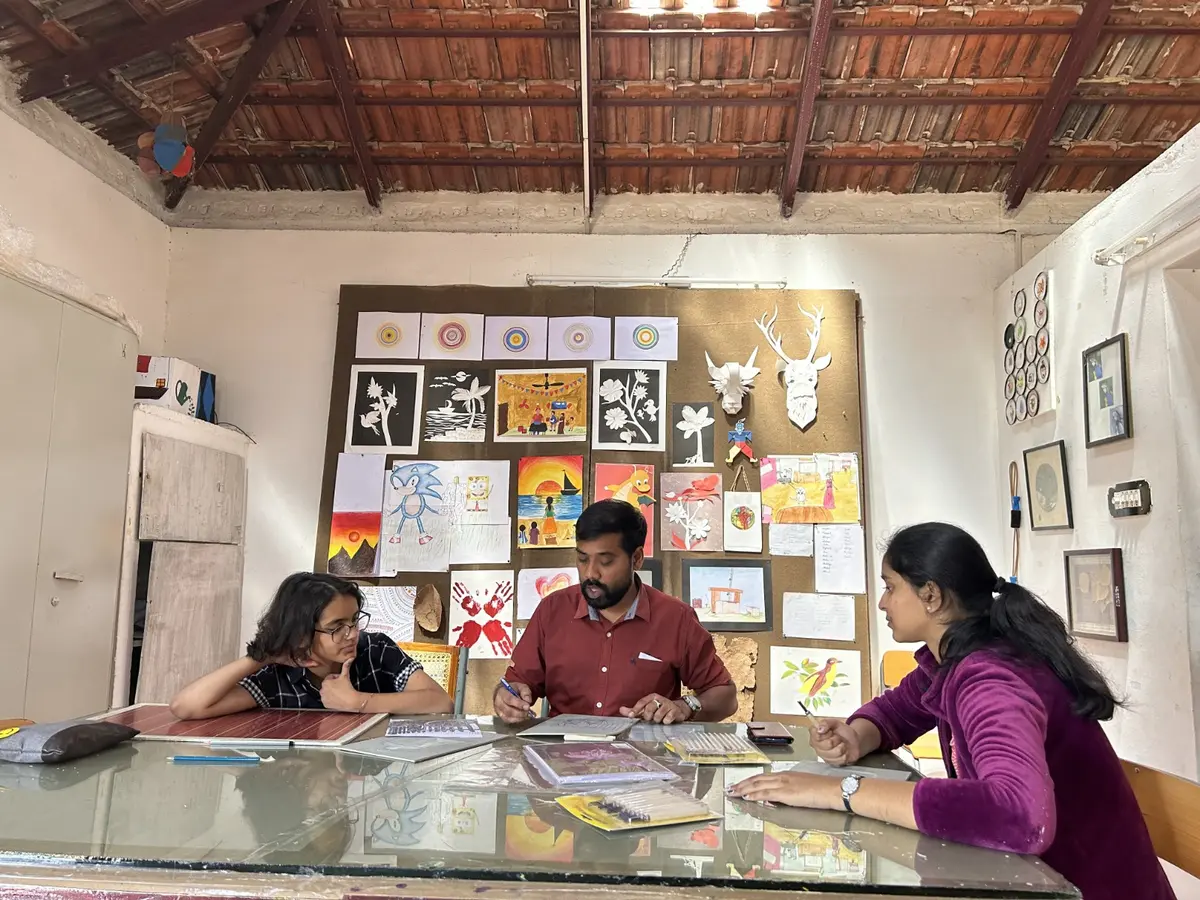
The Peepal Grove School teaching philosophy extends well beyond lessons and textbooks, into every corner of the campus and the daily schedule. The school's Learning page describes hands-on activities as "an integral part of our academic programme" — not an optional supplement, not a reward for completing work, but woven into the fabric of what learning means here.
This conviction shows up in concrete, meaningful ways. Once a term, all grades go for a half-day trek. Grade 11 and 12 students are taken to a neighbouring hillock for an overnight camp where they set up tents, build a fire, and cook a basic meal in the outdoors. The school runs a rural outreach programme that includes bird watching, biodiversity studies, rainwater harvesting awareness, tree planting, and rural education — and students participate actively rather than observe passively.
The Peepal Grove School Teaching Methodology in Practice: Workshops and Professionals
Alongside the regular faculty — all of whom hold B.Ed degrees and graduate or postgraduate qualifications — The Peepal Grove School regularly invites professionals from varied domains to conduct workshops and share their expertise. Scientists, athletes, musicians, dramatists, and IT experts have all run short courses for students. The school carefully verifies speakers' credentials and ensures their approach aligns with student interests and learning goals. This practice, relatively uncommon among best boarding schools in Andhra Pradesh, gives students first-hand exposure to what expertise looks like across different fields — and the breadth of career possibilities available to curious, capable people.
The school also runs a programme called Experiential Learning, where once a week all students engage in an activity or club of their choice for 1.5 hours, with activities rotating monthly. This structured space for self-chosen exploration is itself a pedagogical statement: that students who have agency over their learning become more engaged, more self-directed learners overall.
De-conditioning as a Core Educational Value
Perhaps the most distinctive aspect of the teaching philosophy at The Peepal Grove School is its emphasis on what it calls "de-conditioning." Sri M writes about this directly: de-learning, or de-conditioning, is part of what teachers themselves undergo, allowing them to stay genuinely open to new ideas. The expectation is that educators model the intellectual humility and openness they are asking of students. A teacher who has examined and questioned their own assumptions is far better placed to guide a student through the same process.
Executive Director Sunanda Ali, who has spent over fifteen years at the school following more than four decades in education, captures what this looks like at the student level: "Education should open out the world for the child, encourage her to think on her own and discover things for herself. This will inculcate a love of learning which should last her throughout her life. Through the educational process, a student should learn 'how to learn', what she is good at and what is deeply important to her."
That phrase — "how to learn" — is really the goal of the teaching methodology here. Not a fixed body of knowledge, but a set of habits, capacities, and orientations that a student carries forward into every challenge they'll face after leaving the valley in Chittoor. Among the best alternative boarding schools in India, few have articulated this goal so clearly or built a structure so genuinely aimed at achieving it.

What This Means for Parents Considering the School
For families exploring the best ICSE boarding schools in South India, or specifically looking at residential schools near Bangalore or Hyderabad, The Peepal Grove School will appeal most to parents who want their child to graduate as an independent thinker rather than a proficient test-taker. The school accepts students from Grade 4 to Grade 9 and Grade 11, drawing from across India and abroad — currently students from over 20 states and countries study here together, with a maximum of 25 students per grade.
Parent testimonials consistently describe transformation: children who arrived quiet and withdrawn leaving with confidence, perspective, and a genuine appetite for learning. That outcome isn't accidental. It's the natural product of a teaching philosophy that has been designed, refined, and lived — not just written in a mission statement — for nearly two decades.
If you'd like to explore what a day in this learning environment looks like for your child, visit the school's official website to learn more and begin the admissions process for the 2026-27 academic year, currently open for Grades IV to IX and Grade XI.
Note: Blogs by Yellow Slate are written based on information, knowledge and perspective of the writer. While every caution has been taken to provide readers with accurate information, please use your discretion before taking any decisions based on the information in this blog. In case you find any information that is factually wrong or something that could be made better, please write to us at contact@yellowslate.com.
Curious about how we arrived at this list? We believe parents deserve full transparency on how schools are evaluated and selected. to understand our school selection methodology.


