VISAT: Vishwa Vidyapeeth's Future Readiness Framework
Most parents ask some version of the same question when comparing schools: will this place prepare my child only for the next exam, or for the life that comes after it? It's a fair question. At Vishwa Vidyapeeth Bengaluru, that broader approach to education is brought together through VISAT, the Vishwa Vidyapeeth Future Readiness Framework.
Emerging over 15 years of Vishwa Vidyapeeth's educational journey, VISAT brings together five interconnected competencies that the institution believes are important for preparing young people for an evolving world: Visionary Thinking, Innovation & Creativity, Social Intelligence & Collaboration, Analytical Thinking & Problem Solving, and Technological Literacy & Adaptability.
VISAT forms a common educational approach across Vishwa Vidyapeeth's three campuses. In this article, we explore the framework with a closer look at Vishwa Vidyapeeth North Bengaluru School.
What makes VISAT worth a closer look is that it isn't a new programme added to the timetable. Instead, it brings together the different learning experiences across Vishwa Vidyapeeth (academics, activities, sports, arts, technology, leadership and experiential learning) under a common framework. For families researching the best schools in Yelahanka, this guide explains what VISAT includes and how its five competencies connect with the learning experiences students encounter.
Understanding VISAT: Vishwa Vidyapeeth's Future Readiness Framework
VISAT brings together five interconnected competencies within Vishwa Vidyapeeth's Future Readiness Framework:
- V – Visionary Thinking
- I – Innovation & Creativity
- S – Social Intelligence & Collaboration
- A – Analytical Thinking & Problem Solving
- T – Technological Literacy & Adaptability
The framework does not replace existing programmes. Instead, it connects different learning experiences into one coherent journey towards future readiness.
For Vishwa Vidyapeeth School, this provides a broader context for understanding how academics and experiences beyond the classroom can contribute to students' development. Rather than viewing activities such as sports, arts, technology, leadership or experiential learning as separate initiatives, VISAT brings them together around broader competencies such as creativity, collaboration, problem-solving and adaptability.
This makes the framework useful for parents exploring the school. Instead of simply looking at a list of activities, they can consider what skills and capabilities those experiences are designed to develop.
What Future Readiness Means at Vishwa Vidyapeeth, Yelahanka
It's easy to assume "future-ready" means knowing how to use the latest technology. However, Vishwa Vidyapeeth defines it more broadly. For the institution, future readiness means being able to imagine possibilities, create solutions, work with others, think critically, adapt to change and use technology responsibly. These capabilities are developed through academics, experiential learning, co-scholastic activities, leadership, sports, arts, service, innovation, technology and global exposure.
That's why VISAT brings together five areas of development:
- Imagine and lead
- Create and innovate
- Collaborate and serve
- Analyse and solve
- Adapt and use technology responsibly
For families exploring Vishwa Vidyapeeth Yelahanka School, these competencies provide a broader way to understand the learning experiences that sit alongside academics.
The Five Competencies That Shape VISAT
VISAT brings five interconnected competencies together under Vishwa Vidyapeeth's Future Readiness Framework. While the framework extends across Vishwa Vidyapeeth's institutions, Yelahanka School provides the context for understanding how this broader educational approach can relate to school life.
V — Visionary Thinking: Developing a Broader Perspective
Visionary Thinking is about helping students look beyond what exists today, understand possibilities and develop the confidence to shape tomorrow. Within the VISAT framework, this competency is connected with experiences such as Gnanavatika – Back to Gurukula, space education, sustainability and SDG initiatives, student leadership, career guidance, NCC and global learning. VVPMUN is also part of the experiences associated with this pillar.
Together, these experiences encourage students to think with foresight, understand their place in a wider world and take greater ownership of their future.
I — Innovation & Creativity: Turning Ideas Into Possibilities
Innovation begins with curiosity. Within VISAT, students are encouraged to question, imagine, experiment and turn ideas into meaningful outcomes. The competency extends beyond technology to include entrepreneurship, design thinking, arts, writing, theatre, music, dance and hands-on learning.
Experiences associated with this pillar include Navonmesh – Innovation & Entrepreneurship, Krishi Vatika, the School Innovation Council, Budding Authors, Visual Arts & Craft, Theatre, Music & Dance, Art-Integrated Learning and the Expression Series. For a closer look at learning beyond academics at Vishwa Vidyapeeth School, you can also explore our guide to co-curricular life at Vishwa Vidyapeeth Yelahanka School.
S — Social Intelligence & Collaboration: Building the Ability to Work With Others
Social Intelligence & Collaboration focuses on communication, teamwork, responsibility and service. The VISAT framework connects these skills with experiences such as Dasha Prabodha, Jeevana Kaushalya, the Student Council, sports and the House system, literary enrichment, community service and SEWA, cultural programmes and VVPMUN.
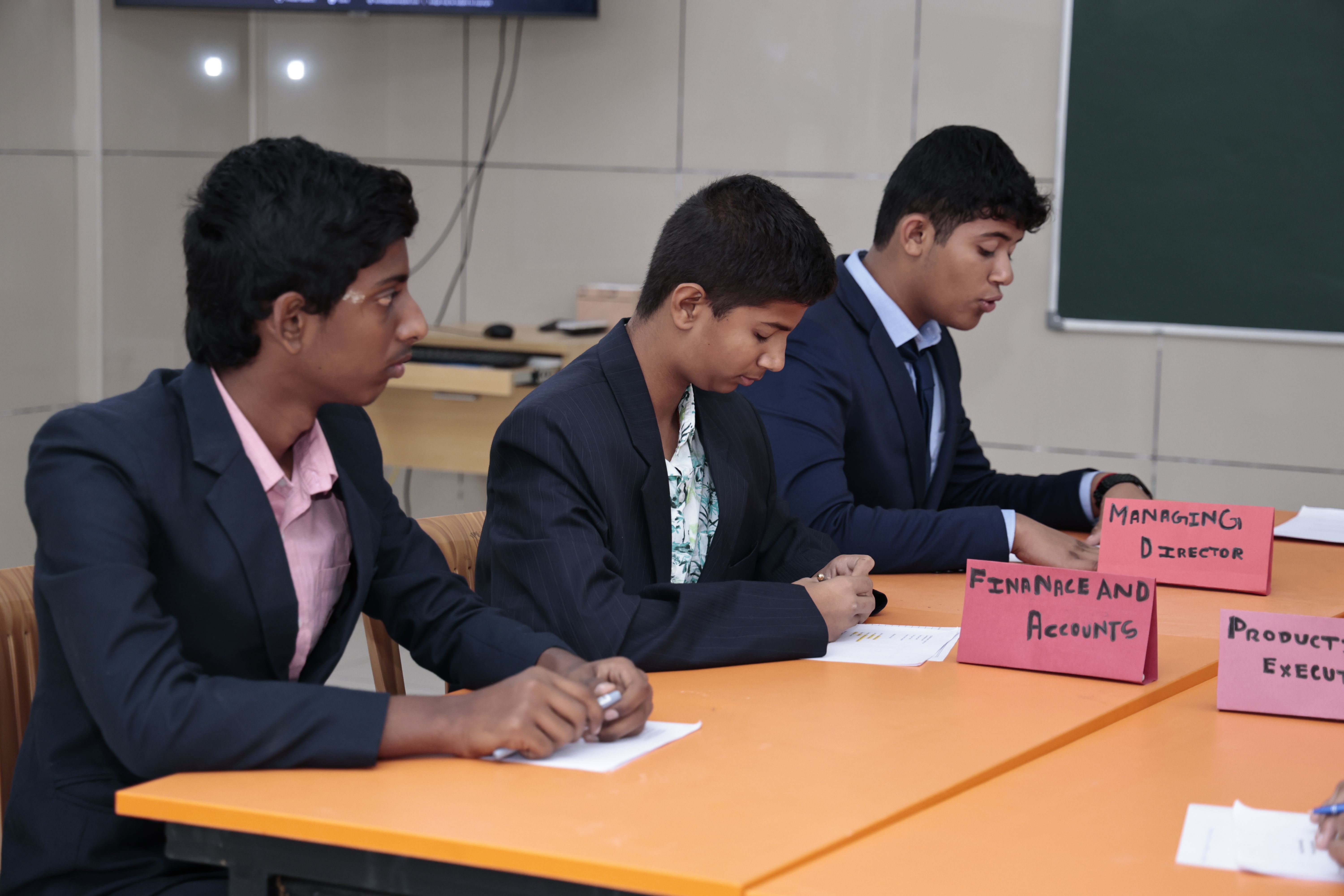
The underlying idea is that leadership involves more than leading others. Students also need to listen, cooperate, communicate effectively and take responsibility for their actions and communities.
A — Analytical Thinking & Problem Solving: From Questions to Solutions
Analytical Thinking & Problem Solving focuses on helping students make sense of information, ask meaningful questions and approach unfamiliar problems with confidence. VISAT connects this competency with mathematics, inquiry, research, financial literacy, Olympiads, project-based learning and real-world problem solving.
The experiences associated with this pillar include mathematics programmes, Ganitha Mela, Math Carpentry, financial literacy, academic Olympiads, inquiry-based learning, research-based learning, problem-based learning, and data literacy and interpretation. The emphasis is on moving beyond simply remembering answers towards understanding how to investigate a question, analyse information and work towards a solution.
T — Technological Literacy & Adaptability: Preparing for a Changing Technological World
The final pillar recognises how quickly technology is changing the world. Within VISAT, technological literacy goes beyond simply knowing how to use digital tools. It focuses on helping students understand technology, adapt to change and use it thoughtfully.
The framework brings together experiences such as robotics, STEAM education, coding, computational thinking, digital literacy and AI readiness, alongside cyber safety and awareness and digital citizenship. The broader aim is to help students become confident problem-solvers and responsible creators who can adapt as technology continues to evolve.
How VISAT Comes Together in Practice
VISAT becomes easier to understand when the competencies are viewed through the experiences students encounter. A student might explore sustainability through growing food, build and programme a robot, participate in a Model United Nations, work through a mathematical challenge, take on a leadership responsibility, contribute to community service, explore space or develop an entrepreneurial idea.
These experiences do not necessarily develop just one competency. A single activity can involve creativity, problem-solving, collaboration and technological understanding at the same time. VVPMUN, for example, connects with both Visionary Thinking and Social Intelligence & Collaboration.
This interconnected approach is central to VISAT. Rather than treating skills such as creativity, collaboration, analytical thinking and adaptability as separate outcomes, the framework brings them together across different areas of learning.
15 Years of Learning, Brought Together Through VISAT
VISAT represents the culmination of Vishwa Vidyapeeth's 15-year journey in education. The framework brings together an educational ecosystem that has evolved through experiential and Gurukula-inspired learning, innovation, sustainability, leadership, sports, arts, global exposure, robotics, AI and community engagement.
Rather than presenting these as disconnected initiatives, VISAT gives them a common framework through five future-readiness competencies. For parents, this provides a way to understand how different parts of the learning experience connect with one another.
To explore more about the vision and leadership behind Vishwa Vidyapeeth, you can also read the story behind the school's educational journey.
What VISAT Means for Parents Considering Vishwa Vidyapeeth at Yelahanka
For parents considering Vishwa Vidyapeeth School, VISAT offers another lens through which to understand the school's broader educational environment. The framework connects areas that parents may otherwise view separately: academic learning, experiential activities, creativity, sports, arts, leadership, technology and community engagement.
Rather than looking only at the number of activities a school offers, parents can use the five competencies to ask more specific questions:
- What do students learn through these experiences?
- How do they connect with classroom learning?
- Where do students get opportunities to create, collaborate, investigate and take responsibility?
Parents can also explore the school's campus facilities and parent reviews for a broader understanding of Vishwa Vidyapeeth School at Yelahanka.
Understanding the Broader Approach Behind VISAT
VISAT brings together five areas that Vishwa Vidyapeeth considers important to future-ready education: Visionary Thinking, Innovation & Creativity, Social Intelligence & Collaboration, Analytical Thinking & Problem Solving, and Technological Literacy & Adaptability.
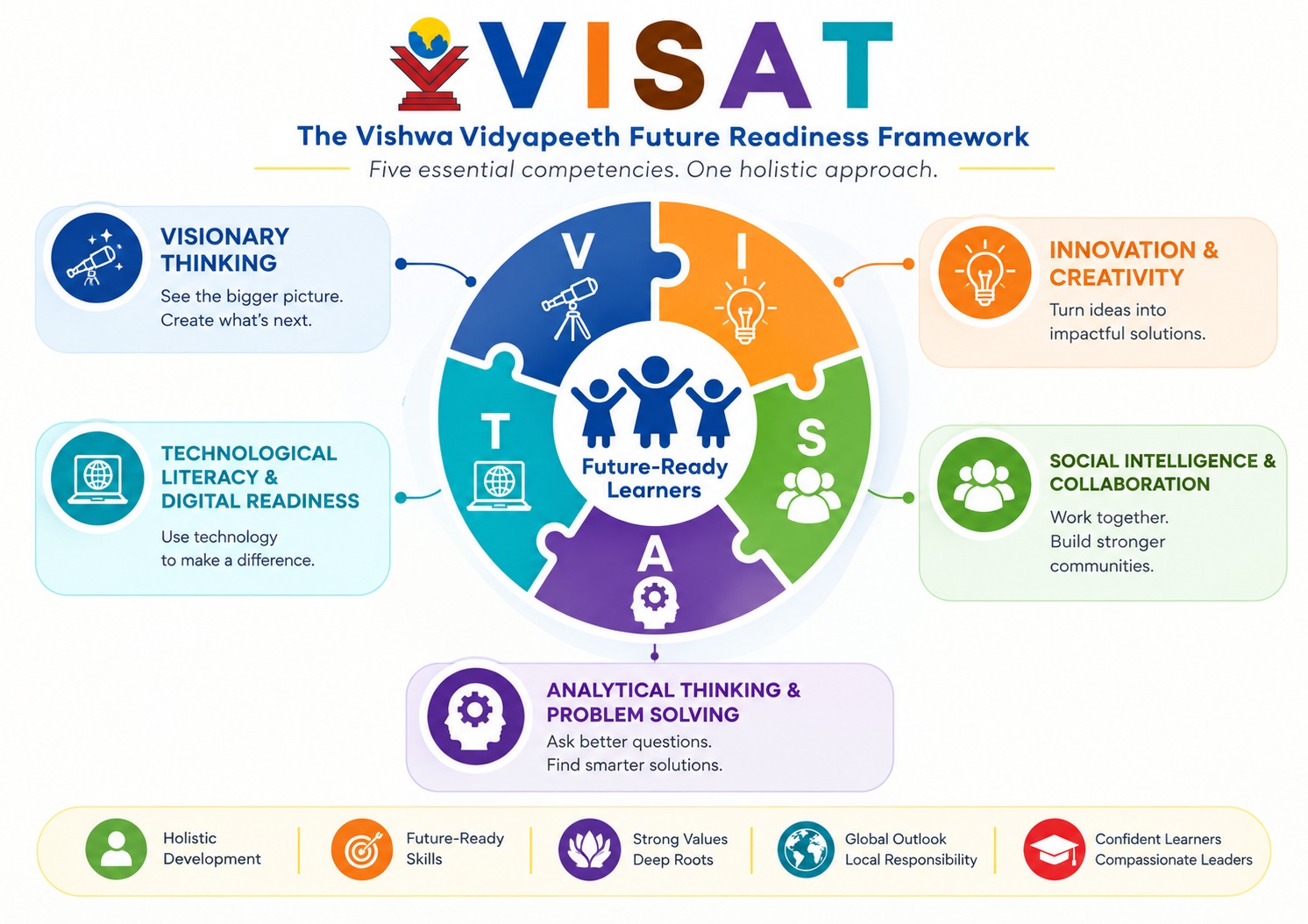
The framework is not presented as a replacement for academic learning. Instead, it brings academics, experiential learning, creativity, collaboration, problem-solving, technology and other areas of student development into a common direction.
For families exploring Vishwa Vidyapeeth Yelahanka School, VISAT therefore offers a useful lens for understanding how Vishwa Vidyapeeth connects academic learning with the wider development of students, helping them build the ability to think, create, collaborate, solve problems and adapt as they progress through school.
Note: Blogs by Yellow Slate are written based on information, knowledge and perspective of the writer. While every caution has been taken to provide readers with accurate information, please use your discretion before taking any decisions based on the information in this blog. In case you find any information that is factually wrong or something that could be made better, please write to us at contact@yellowslate.com.
Curious about how we arrived at this list? We believe parents deserve full transparency on how schools are evaluated and selected. to understand our school selection methodology.


