FAQs About The Peepal Grove School — Parents' Most Common Questions Answered
Choosing a residential school for your child is one of the most significant decisions you'll make as a parent — and naturally, the questions pile up fast. How does life work in a boarding school? What's the teaching philosophy? What do fees actually cover? And is this school the right fit for a child who's been in a regular day school all along? If The Peepal Grove School has caught your attention, you've probably found yourself searching for answers to exactly these questions.
Tucked away in the Chittoor district of Andhra Pradesh, The Peepal Grove School — or TPGS, as most parents and alumni call it — is unlike most schools you'll come across. It's co-educational, fully residential, affiliated to the CISCE board, and rooted in a philosophy that takes education far beyond textbooks and mark sheets. Founded in 2006 by Sri M and inaugurated by former President Dr A.P.J. Abdul Kalam, the school has spent nearly two decades carving out a distinct identity among the best residential schools in India.
This post answers the most common questions parents ask about The Peepal Grove School — everything from admission timelines and fee structure to daily life on campus, teaching methodology, and what happens after Grade 12. Whether you're just beginning your research or finalising a decision, consider this your go-to reference.
Frequently Asked Questions About The Peepal Grove School
About the School and Its Philosophy
Q1. What kind of school is The Peepal Grove School, and what makes it different?
The Peepal Grove School is a co-educational, fully residential school affiliated to the CISCE board, offering the ICSE curriculum for Grades 4 to 10 and the ISC curriculum for Grades 11 and 12. It is located in Gongivaripalli, Chittoor district, Andhra Pradesh — 180 km from Bengaluru and 75 km from Tirupati.
What sets it apart is its foundational philosophy: that education should make children self-reliant, curious, and capable of thinking for themselves. The school was founded by Sri M — an educationist, social reformer, and spiritual guide — whose objective was to move learning away from rote memorisation and unhealthy competition toward curiosity, creativity, and critical thinking. Teachers at TPGS are described as "friendly guides who inspire through dialogue and discussion, instead of spoon-feeding." That philosophy isn't just written on a wall — it shapes how every class is run, how assessments are designed, and how the school day unfolds.
The campus itself — a 30-acre valley surrounded by forested hills, dotted with ponds and home to over 90 species of birds — is considered part of the infrastructure. Outdoor learning, trekking, bird watching, and biodiversity studies aren't electives here; they're built into the programme.
Q2. Who founded The Peepal Grove School, and when was it established?
The Peepal Grove School was founded in 2006 by Sri M (also known as Mumtaz Ali), a social activist, educationist, author, and spiritual leader. Sri M has been associated with the Ramakrishna Mission and served as a trustee of the Krishnamurti Foundation. He is also known for spearheading the Walk of Hope — a Padayatra from Kanyakumari to Kashmir in 2015–16.
The school was inaugurated by the then President of India, Dr A.P.J. Abdul Kalam, in December 2006. It operates as a project of The Satsang Foundation. Importantly, the school has no branches or franchisees — there is only one Peepal Grove School, located at Gongivaripalli, Chittoor.
The current Principal is Viraj Naidoo, who joined The Satsang Foundation in 2002 after completing his Masters from the Tata Institute of Social Sciences, Mumbai. He served as Academic Coordinator from the school's inception and was invited to take on the role of Principal in 2021.
Q3. How big is the school, and how many students does it have?
The campus spans 30 acres, nestled in a valley surrounded by hills. The school has a maximum capacity for 180 students across all grades, with a maximum of 25 students admitted per grade — and only one section per grade. This deliberately small size is central to everything the school does.
The teacher-student ratio is 1:5, one of the lowest in the country. Students come from across India — representing more than 20 states and countries — creating a genuinely multicultural residential community. The school currently has a composition of approximately 40% girls and 60% boys.
Academics and Curriculum
Q4. What board and curriculum does The Peepal Grove School follow?
The Peepal Grove School is affiliated to the CISCE Board (Council for the Indian School Certificate Examinations). It follows the ICSE curriculum from Grades 4 to 10, and the ISC (Indian School Certificate) curriculum for Grades 11 and 12. Among the best ICSE boarding schools in South India, TPGS stands out for how it integrates the curriculum with experiential and nature-based learning.
The school takes a two-phase academic approach:
- Grades 4–8: The focus is on developing fundamental skills — Explanation, Interpretation, Application, Perspective, Empathy, and Self-Knowledge. Collaborative learning is prioritised over direct instruction. Students are also taught spoken Sanskrit as a foundational element of Indian cultural knowledge.
- Grades 9–12: The curriculum becomes more rigorous, with greater emphasis on board examinations. Students use multimedia facilities, a comprehensive library, and well-equipped laboratories.
Assessment at TPGS is multi-dimensional — formative, diagnostic, summative, evaluative, and informative — with objectives assessed against national and international benchmarks. Parents receive detailed progress reports at the end of each term, including individual feedback from every subject teacher.

Q5. How does The Peepal Grove School approach teaching? Is it very different from a regular school?
Yes — quite different, and deliberately so. The teaching philosophy at The Peepal Grove School is rooted in the belief that students learn best when they are given the space to question, discover, and engage with ideas — not when information is simply delivered to them.
Teachers are trained to use a variety of methodologies catering to different learning styles. All faculty hold a B.Ed degree along with a graduate or postgraduate qualification. Beyond regular faculty, professionals from varied domains are invited to conduct workshops and share their expertise with students.
In the lower grades, the emphasis is on collaborative rather than teacher-directed learning. In the senior years, academic rigour and board preparation become more central, while the investigative spirit is maintained. Students in Grades 11 and 12, for instance, are taken on night camps to a neighbouring hillock where they set up tents, cook a basic meal, and live frugally outdoors — an experience that no textbook can replicate. Among the best residential schools in Andhra Pradesh, this integration of outdoor experience with academic learning is one of TPGS's most distinctive characteristics.
Admissions
Q6. Which grades does The Peepal Grove School admit students into, and what is the age requirement?
The Peepal Grove School currently admits students into Grades IV to IX and Grade XI. The school does not accept students in Grades 10 or 12. The minimum eligible age for admission to Grade 4 is 8.5 years.
Q7. What is the admission process and timeline?
The Online Application Form opens every September. Admissions for the following academic year (which begins in June) are open from December to March. If seats for a particular grade are filled before March, applications for that grade close earlier.
The selection process varies by grade:
- Grades 4–7: Parent and student interviews
- Grades 8–9: Written tests in Mathematics and English, followed by parent and student interviews
- Grade 11: Written tests in the chosen subjects, followed by parent and student interviews
A Registration Fee of ₹6,000 is payable when submitting the online application form. Candidates from unrecognised schools or under private study must provide an Aadhaar card (Indian nationals) or passport (foreign nationals), along with a Certificate of Study. Successful applicants are informed by email and must bring required documents on the joining date, along with the original Transfer Certificate.
Q8. What are the fees at The Peepal Grove School?
Here is the fee structure as available:
Fee Component | Amount |
|---|---|
| Registration Fee | ₹6,000 (paid with application) |
| Admission Fee (one-time) | ₹45,000 |
| Tuition & Boarding Fee — Grades IV to X | ₹6,10,000 per year |
| Tuition & Boarding Fee — Grades XI to XII | ₹7,10,000 per year |
| Refundable Caution Deposit — Grades IV to X | ₹4,88,000 |
| Refundable Caution Deposit — Grades XI to XII | ₹5,68,000 |
The annual Tuition and Boarding Fee is payable in two equal instalments — the first by March 15 and the second by September 15. The fee covers food, lodging, library, labs, games, and cultural activities. Additional expenses (books, excursions, medical, public examination fees, annual magazine, stationery, and miscellaneous items) are payable separately.
The school accepts payments via bank deposit, wire/online transfer, demand draft, or UPI/QR code. The fee structure is revised every September for the following academic year — always check the school's official website for the most current figures.
Campus Life and Boarding
Q9. What does a typical day look like for students at The Peepal Grove School?
Life at The Peepal Grove School is structured but not rigid. The day begins at 6:30 am with Yoga, Music, or Fitness activities, followed by breakfast, assembly, and classes. Classes are held in 45–90 minute sessions, which allows for deeper engagement with each subject rather than rushed transitions.
Post lunch, students have approximately two hours of quiet time in the dormitories — for reading, rest, and reflection. Sports hour begins at 4:00 pm for junior students and 5:00 pm for seniors, followed by snacks, showers, and dinner. The evening winds down with a one-hour prep session, after which students have leisure or self-study time before retiring for the night.
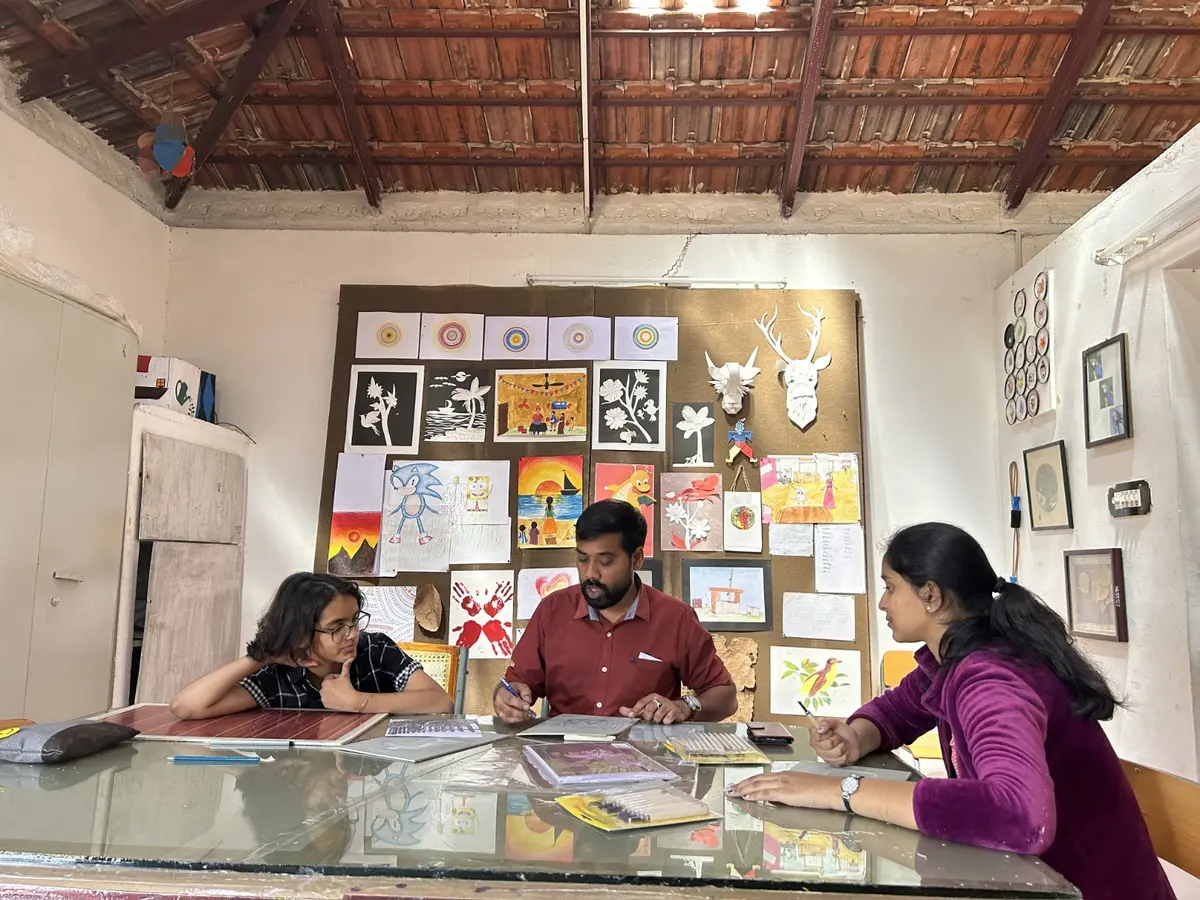
Weekends have their own rhythm — sports matches, cycling around campus, treks, and free time in the Art Block, Music Room, or Kalaripayattu pit. Teachers remain available over weekends for students who need academic help.
Q10. How are dormitories structured, and are students supervised?
Dormitory occupancy is capped at 8 students per room. Teachers and house parents live on campus alongside students, creating a genuine residential community rather than a supervised institution. House parents are described as being more like older friends than authority figures, with senior students often taking on informal mentoring roles.
Students are not permitted to keep money on hand. If a student needs to purchase anything during the term, the school procures it on their behalf — these expenses are tracked and shared with parents at the end of the term. A tuck shop on campus provides utility items on a credit facility that parents repay at term-end.
Q11. Are digital devices allowed? What about internet access?
The school takes a deliberate, balanced approach to technology. Senior students are permitted to use personal digital entertainment devices — such as portable MP3 players — for restricted durations over weekends. These are handed over to house parents at other times. Students have access to the internet in the computer lab, with restricted access.
The philosophy behind this is straightforward: in the absence of constant digital stimulation, children gain time. They pursue hobbies, develop skills, and engage with their surroundings and peers in ways that screen-heavy environments rarely allow.
Q12. What extracurricular activities and sports does the school offer?
The Peepal Grove School treats extracurricular activities as an integral part — not an add-on — of its academic programme. Yoga, Kalaripayattu, Music, Dance, and Art are built directly into the school timetable.
Sports facilities include a cricket ground, football field, tennis courts, basketball court, and indoor badminton courts. Notably, TPGS is widely recognised as the only residential school in India with a dedicated Kalari pit for the practice of Kalaripayattu, the ancient martial art indigenous to South India.
Beyond sports, students participate in camps and treks (including night camps for Grades 11–12), community service through a rural outreach programme, biodiversity studies, and grade-wise excursions around the country. The school also runs an active connection with The Satsang Vidyalaya — a rural school for children of low-income communities in Madanapalle — through teacher training, coaching, events, and ongoing interactions.

Career Guidance and Life After TPGS
Q13. Does the school provide career guidance? How does it help students choose their future path?
Yes. The Peepal Grove School offers a structured career guidance programme for students from Grades 9 to 12. The school collaborates with a carefully assessed career counselling organisation that helps students identify their areas of interest, aptitude, and suitable career paths based on comprehensive assessments.
Additionally, regular Alumni Sessions are held — online and in person — where current students can interact with alumni who serve as mentors. These sessions offer practical guidance on university applications, course selection, and career decisions drawn from real-world experience. The school makes it clear that it does not solicit admissions for any specific university; instead, university announcements are shared with parents to help them evaluate options independently.
Parent Sentiments
Parents who have chosen The Peepal Grove School for their children consistently highlight the transformation they observe in their children — in character, confidence, and outlook — as the defining outcome of the school. The family-like atmosphere, the quality of teacher-student relationships, the nature environment, and the balance between academic rigour and holistic development receive strong and repeated mention.
Here is a summary of parent sentiment across key parameters:
- Teaching Quality: ~92% positive — parents frequently cite dedicated, engaged faculty and the low teacher-student ratio as standout strengths
- Campus & Environment: ~95% positive — the 30-acre natural setting is viewed as a genuine asset, not just a backdrop
- Overall Satisfaction: ~88% positive — the transformation in children's values, confidence, and independent thinking is most commonly cited
- Extracurricular Activities: ~90% positive — Kalaripayattu, music, art, and the outdoors programme receive strong appreciation
- Residential Life: ~85% positive — the boarding experience, community, and independence-building are highly valued, though the initial separation is noted as an adjustment
- Value for Fees: ~78% positive — parents acknowledge it is a significant investment but consider it well-justified given what the school delivers
Still Have Questions?
The best way to get answers that go beyond any FAQ page is to visit the campus in person. The Peepal Grove School is a school that genuinely rewards a visit — the campus, the students, the teachers, and the atmosphere speak for themselves in ways no blog can fully convey. Parents considering admission are encouraged to reach out through the school's official website to arrange a visit and speak directly with the team.
If you're at the early stages of evaluating residential schools in South India, also explore the detailed Yellow Slate guides on The Peepal Grove School's infrastructure, its ICSE curriculum approach, and its extracurricular programme — each addresses a different dimension of what makes this school stand out among the best boarding schools in Andhra Pradesh.
Note: Blogs by Yellow Slate are written based on information, knowledge and perspective of the writer. While every caution has been taken to provide readers with accurate information, please use your discretion before taking any decisions based on the information in this blog. In case you find any information that is factually wrong or something that could be made better, please write to us at contact@yellowslate.com.
Curious about how we arrived at this list? We believe parents deserve full transparency on how schools are evaluated and selected. to understand our school selection methodology.


